
How to Plan Career Growth with Identity-Based Strategies
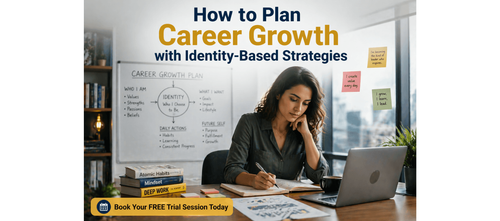

How to Create a Personal Identity Experiment Plan for Career Growth—Without Leaving Your Job
Most professionals don’t struggle because they lack skills. They struggle because they lack clarity.
You may have built a solid career, gained experience, and developed valuable capabilities. Yet, when it comes to making your next move, the path feels uncertain. You overthink, second-guess, and delay decisions—hoping clarity will come with more reflection.
But clarity rarely comes from thinking alone. It comes from action.
That’s where the guidebook “Designing a Personal Identity Experimentation Plan for Career Growth” becomes powerful. Instead of forcing you to make high-stakes decisions based on assumptions, it gives you a structured system to test different career identities in the real world—safely, practically, and without leaving your current role.
Download these resources and apply them alongside your daily work for improved clarity, productivity, and professional growth. You can also book a free trial to gain expert guidance and enhance your communication, problem-solving, and decision-making skills. The materials are designed in a clear, structured format to help professionals learn efficiently and implement insights with confidence.
Who Is This Blog For?
- Working professionals with 0–15 years of experience seeking career clarity
- Individuals considering a career transition but unsure where to begin
- Professionals stuck between multiple career paths or interests
- Mid-career professionals looking for more meaningful or aligned work
- Individuals who overthink career decisions instead of taking action
- Professionals who want to build a strong and authentic career identity
Why This Topic Matters Today?
In today’s fast-evolving job market, traditional career paths are becoming less predictable. Professionals are no longer confined to linear growth within a single role or industry. Instead, they are expected to adapt, evolve, and reposition themselves continuously.
Despite this shift, most people still approach career decisions through excessive planning and introspection. This often leads to:
- Analysis paralysis and delayed decisions
- Career moves based on assumptions rather than evidence
- Persistent dissatisfaction despite outward success
- Lack of a clear and compelling professional narrative
The guidebook highlights a critical insight: the problem is not a lack of options—it is a lack of structured experimentation. Without testing potential paths in real-world scenarios, professionals remain stuck in uncertainty.
Core Concept
At the heart of this guidebook is the PIE Model, a structured framework designed to help professionals experiment with and refine their career identity over time.
The PIE Model consists of three interconnected phases:
Probe
This phase focuses on understanding your current professional identity. It involves mapping your roles, strengths, values, and narrative. The goal is not deep introspection but structured data collection about where you stand today.
Iterate
This is where real progress happens. Instead of relying on assumptions, you design and run small, low-risk experiments. These experiments help you test different career identities in real-world conditions and generate meaningful feedback.
Embed
In this phase, you convert insights into action. Based on the results of your experiments, you decide whether to continue, adjust, or abandon a direction. This is where your career identity begins to take shape through evidence-backed decisions.
The key principle underlying this model is simple but powerful: action precedes clarity. You do not think your way into the right career—you experiment your way into it.
How This Blog and Guidebook Help You?
This blog and the guidebook together help you move from uncertainty to clarity by giving you a structured approach to career exploration.
You will be able to:
- Replace overthinking with action-oriented experimentation
- Test multiple career paths without high risk
- Build confidence through real-world validation
- Develop a clearer and more compelling professional narrative
- Make career decisions based on evidence rather than assumptions
Instead of waiting for the “perfect plan,” you start building clarity step by step through structured action.
Step-by-Step Breakdown
Step 1: Map Your Current Identity Landscape
The first step is to understand where you currently stand. This involves completing an identity audit across four key areas:
- Roles: The formal and informal roles you currently play
- Strengths: The work you excel at and enjoy doing
- Values: What you refuse to compromise on in your work
- Narrative: How you currently describe your career story
This step is not about perfection. It is about capturing raw, honest insights that will serve as the foundation for your experiments.
Step 2: Identify Your Identity Hypotheses
An identity hypothesis is a testable belief about who you could become professionally.
For example, instead of saying “I want to move into a new field,” you define a specific hypothesis such as:
“I believe I would thrive in a role that involves structured problem-solving and direct user impact.”
You then:
- Write 2–3 identity hypotheses
- Rate your confidence in each one
- Identify gaps in evidence that need to be tested
This step transforms vague curiosity into structured exploration.
Step 3: Design Your Identity Experiments
This is the most critical step in the process. Instead of making major career changes immediately, you design small, low-risk experiments.
Each experiment includes:
- A clear objective linked to a hypothesis
- A specific action to be taken
- A defined time window
- Success and failure signals
Examples of experiments include:
- Publishing content in a new domain
- Engaging with professionals in a target industry
- Taking on short-term projects or freelance work
- Testing a new communication or leadership style
These experiments generate real-world feedback without putting your current role at risk.
Step 4: Run, Read, and Reflect
Running experiments is only half the process. The real value comes from how you interpret the results.
The guidebook introduces a Weekly Signal Log to track three key indicators:
- Energy signal: Did the work energise or drain you?
- Response signal: How did others react to your efforts?
- Narrative signal: How naturally could you talk about the work?
You also reflect using structured questions such as:
- What surprised you during the experiment?
- When did you feel most aligned with the work?
- What feedback did you receive?
This ensures that your decisions are based on consistent patterns, not isolated experiences.
Step 5: Pivot or Persist Decision Framework
After completing an experiment cycle, you make one of three decisions:
- Persist: Continue exploring the same direction
- Pivot: Modify the hypothesis and test a new variation
- Park: Set the direction aside for now
This decision is based on evidence collected during the experiment, not emotional reactions or external pressure.
The goal is to make deliberate, informed choices about your career direction.
Common Mistakes
The guidebook highlights several common mistakes that limit career growth:
Treating research as experimentation
Reading about a field is not the same as engaging with it. Real growth comes from action.
Running too many experiments at once
This reduces focus and weakens the quality of insights. Limiting active experiments improves clarity.
Skipping reflection
Without structured reflection, valuable insights are lost. Consistent review is essential.
Quitting too early
Initial discomfort is normal. Decisions should be based on sustained patterns, not early resistance.
Working in isolation
Involving peers or mentors helps uncover blind spots and accelerates learning.
Avoiding these mistakes ensures that your experimentation process remains effective and insightful.
How Should You Use This Guidebook Effectively?
To maximise the value of this guidebook, follow a structured approach:
- Allocate 2–3 focused hours to complete the initial identity audit and hypothesis creation
- Design your first experiment within a defined time frame of up to 6 weeks
- Schedule a weekly 10-minute review session to track signals and reflect
- Limit yourself to one or two experiments at a time for better focus
- Revisit and refine your hypotheses based on real-world feedback
The guidebook is not meant to be read once and forgotten. It is a working tool that you revisit and apply continuously as your career evolves.
Key Takeaways
- Career clarity comes from action, not overthinking
- Your professional identity is not fixed—it evolves through experimentation
- Small, low-risk experiments provide powerful career insights
- Energy, feedback, and narrative clarity are key signals to track
- Structured reflection is essential for making informed decisions
- Pivoting is not failure—it is a step toward better alignment
- Consistent experimentation leads to stronger, more confident career choices
Your Next Step: Accelerate Your Career with PlanetSpark
Creating an impact-driven resume is not just about landing your next job—it’s about owning your professional story and presenting it with clarity, confidence, and credibility. When your resume clearly communicates value, results, and impact, opportunities follow naturally.
At PlanetSpark, we are committed to empowering working professionals with practical, outcome-focused resources that drive real career growth. From resume building and workplace communication to leadership presence and professional writing, our programs are designed to help you succeed in today’s fast-evolving job market.
Visit https://www.planetspark.in/resources to explore:
- Career and resume-building guides
- Workplace communication and professional writing resources
- Skill-development tools curated for working professionals
Want a deeper, hands-on experience?
You can also book a free trial session to learn more about PlanetSpark’s Working Professional Courses, designed to accelerate your career through personalised coaching, real-world practice, and expert guidance.
Your career deserves more than generic advice.
It deserves clarity, confidence, and measurable impact.
Personalized Communication Roadmaps
Record a video to get a AI generated personalized communication reports