
How to Read Interview Signals
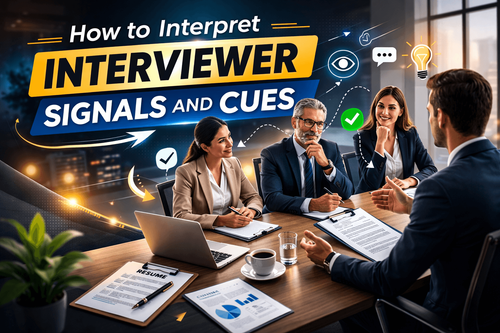

How to Read Interviewer Signals and Decode What They Really Mean About Your Candidacy
You walk out of an interview
replaying every moment in your head. They smiled. They nodded. They asked about your notice period. They mentioned the next round. But then they said, “We’ll get back to you.”
For most working professionals, interviews feel ambiguous and emotionally draining—not because they lack preparation, but because they don’t know how to interpret what actually happened in the room.
Interviews are not just about answering questions. They are dynamic conversations filled with verbal and non-verbal signals that reveal how you are being evaluated. When you understand how to read interviewer cues correctly, you stop guessing and start responding strategically in real time.
This guide breaks down how to interpret interviewer signals before, during, and after the conversation—so you can adapt intelligently, manage expectations, and increase your chances of success.
Who Is This Blog For?
This blog and the accompanying guidebook are designed for:
- Working professionals preparing for job switches or internal promotions
- Candidates attending multiple interview rounds and seeking clarity on outcomes
- Mid-career professionals aiming for leadership or managerial roles
- Job seekers who struggle with post-interview anxiety and overthinking
- Professionals who want to improve interview awareness and confidence
Why This Topic Matters Today?
Hiring decisions today are faster, more structured, and more competitive than ever. Recruiters and hiring managers often interview multiple candidates in a short span of time. They rarely give direct feedback during the conversation.
Instead, they communicate through signals—tone shifts, body language, follow-up depth, and future-oriented language. Misinterpreting these cues can lead to:
- Unnecessary self-doubt
- False confidence
- Missed opportunities to clarify weak answers
- Poor follow-up communication
Understanding interviewer signals allows you to:
- Adjust your responses mid-conversation
- Reinforce strong impressions
- Clarify doubts before they become rejection reasons
- Leave interviews with better clarity and composure
In a competitive job market, awareness becomes a strategic advantage.
Core Concept or Framework Explained
The foundation of interpreting interviewer signals lies in observing patterns rather than isolated behaviours. One smile does not guarantee selection. One tough question does not indicate rejection.
The guide organises interviewer cues into three major evaluation phases:
1. Early Signals – First impression indicators
2. Mid-Interview Signals – Core evaluation behaviours
3. Post-Interview Signals – Decision-stage indicators
Across these phases, interviewers typically assess three core filters:
- Risk: Can this candidate handle the role without causing problems?
- Value: Will this person add measurable contribution?
- Compatibility: Will they fit into the team and culture?
Every question, tone shift, or behavioural cue usually connects to one of these filters. When you interpret signals through this lens, interviews become more predictable and less emotional.
How This Blog and Guidebook Help You?
Together, this blog and guidebook help you:
- Identify positive, neutral, and cautionary signals accurately
- Avoid overthinking isolated gestures
- Recognise when interviewers are visualising you in the role
- Respond strategically when you sense doubt or strong interest
- Conduct structured post-interview reflections to improve performance
Instead of walking away confused, you walk away informed. That clarity builds long-term confidence.
Step-by-Step Breakdown
Step 1: Decode Early Signals in the First 10 Minutes
The first few minutes reveal the interviewer’s initial perception. Pay attention to:
- Greeting warmth and small talk
- Eye contact and posture
- Energy alignment
- Transition speed into structured questions
Positive early indicators include relaxed posture, natural conversation, and balanced engagement. These often signal openness and alignment.
Neutral behaviour—direct questioning with minimal small talk—may simply reflect efficiency or time constraints. Avoid misreading professionalism as disinterest.
The key is not to react emotionally but to observe calmly and adapt your energy accordingly.
Step 2: Analyse Depth of Follow-Up Questions
The depth of probing often reflects interest level. When interviewers ask layered follow-ups such as:
- “What was the measurable impact?”
- “How did leadership respond?”
- “What challenges did you face during implementation?”
It usually indicates serious evaluation. They are trying to reduce hiring risk and validate your credibility.
Surface-level or checklist-style questions may indicate time limitations or a structured evaluation process. Again, look for patterns rather than isolated moments.
Step 3: Observe Note-Taking and Engagement Patterns
Note-taking is often a strong evaluation signal.
Extensive notes can indicate that you are being compared carefully against other candidates. A sudden pause in note-taking might mean:
- They are fully engaged in listening
- They have gathered sufficient data
- They are mentally processing your response
Combine note-taking behaviour with other cues like eye contact and follow-up quality to draw balanced conclusions.
Step 4: Recognise Future-Oriented Language
One of the strongest positive indicators is future-based phrasing such as:
- “When you join…”
- “In this role, you would handle…”
- “Your first few months might involve…”
This language signals psychological inclusion. The interviewer is mentally placing you inside the organisation.
While not a guaranteed offer, it strongly indicates serious consideration.
Step 5: Interpret Cultural and Behavioural Evaluation
If the conversation shifts from technical capability to questions about:
- Conflict resolution
- Work style preferences
- Team collaboration
- Values and adaptability
It often means you have moved beyond basic skill validation. The interviewer is now evaluating team compatibility.
This stage is critical. Demonstrate emotional intelligence, maturity, and alignment with organisational values.
Step 6: Read Body Language Clusters
Single gestures can be misleading. Instead, look for clusters.
Positive clusters may include:
- Leaning forward
- Consistent nodding
- Smiling during achievement stories
- Engaging laughter
- Conversation extending beyond scheduled time
Caution clusters may include:
- Repeated interruptions
- Closed posture
- Frequent clock-checking
- Repeated clarification on the same point
Patterns tell a clearer story than isolated behaviours.
Step 7: Evaluate Time and Structure Signals
Time management during interviews often reflects interest.
Strong indicators include:
- Interview extending beyond planned duration
- Introduction to additional stakeholders
- Detailed discussion about role responsibilities
- Questions about availability or joining timeline
Shortened interviews can signal misalignment—but may also reflect scheduling constraints. Avoid immediate assumptions.
Step 8: Interpret Post-Interview Signals
After the conversation ends, pay attention to:
Strong indicators:
- Clear next steps communicated
- Defined timelines shared
- Discussion of compensation expectations
- Request for references
- Mention of upcoming rounds
Ambiguous indicators:
- “We’ll get back to you.”
- No timeline provided
- Vague process explanation
If clarity is missing, confidently ask:
“Could you share the expected timeline for the next steps?”
Professional clarity shows confidence—not desperation.
Common Mistakes or Pitfalls to Avoid
The guide highlights frequent misinterpretations that create unnecessary stress:
- Assuming smiling equals selection
- Interpreting tough questions as rejection
- Mistaking neutral tone for disinterest
- Overanalyzing minor gestures
- Ignoring patterns and focusing on isolated signals
Emotional reactions distort judgment. Strategic observation improves accuracy.
How Should You Use This Guidebook Effectively?
To apply this framework effectively:
- Read the guide once to understand all signal categories
- Use it before interviews to build awareness
- Conduct structured reflection immediately after each interview
- Track patterns across 5–7 interviews
- Adjust your responses based on recurring feedback signals
Allocate 30–45 minutes post-interview for structured reflection. Over time, you will identify patterns in interviewer behaviour and your own performance gaps.
This turns interviews into learning systems rather than one-time events.
Key Takeaways
- Interviews are dynamic conversations filled with evaluative signals
- Observe patterns, not isolated gestures
- Deep follow-up questions often indicate serious consideration
- Future-oriented language signals psychological inclusion
- Cultural questions suggest advanced evaluation stages
- Post-interview clarity is a professional responsibility
- Structured reflection builds long-term strategic advantage
When you learn to read interviewer signals accurately, interviews stop feeling unpredictable. They become structured, readable processes where you can adapt, clarify, and strengthen your position in real time.
Your Next Step: Accelerate Your Career with PlanetSpark
Creating an impact-driven resume is not just about landing your next job—it’s about owning your professional story and presenting it with clarity, confidence, and credibility. When your resume clearly communicates value, results, and impact, opportunities follow naturally.
At PlanetSpark, we are committed to empowering working professionals with practical, outcome-focused resources that drive real career growth. From resume building and workplace communication to leadership presence and professional writing, our programs are designed to help you succeed in today’s fast-evolving job market.
Visit https://www.planetspark.in/resources to explore:
- Career and resume-building guides
- Workplace communication and professional writing resources
- Skill-development tools curated for working professionals
Want a deeper, hands-on experience?
You can also book a free trial session to learn more about PlanetSpark’s Working Professional Courses, designed to accelerate your career through personalised coaching, real-world practice, and expert guidance.
Your career deserves more than generic advice.
It deserves clarity, confidence, and measurable impact.
Start building that advantage today—with PlanetSpark.