
How to Reduce Context Switching and Improve Focus at Work
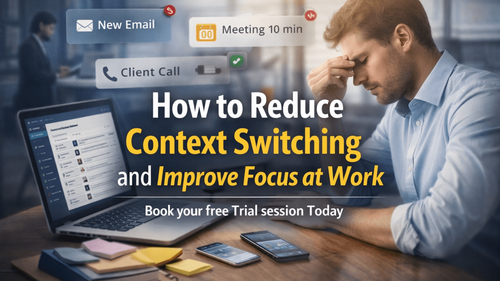

The Ultimate Guide to Minimizing Context Switching and Maximizing Deep Work
You start your workday with a clear plan, but within minutes, emails, messages, and meetings hijack your attention. By the end of the day, you’ve been busy for hours—yet meaningful progress feels minimal. This is not a time management issue. It’s a context switching problem.
Modern professionals are not struggling because they lack discipline or skills. They are struggling because their attention is constantly fragmented. The ability to focus deeply has become rare—and incredibly valuable.
This guide transforms a powerful playbook on reducing context switching into a practical, actionable blog. It helps you reclaim your attention, improve productivity, and produce higher-quality work without working longer hours.
At its core, context switching is costly because your brain does not instantly transition between tasks. Every time you shift from writing a report to checking a message or attending a quick meeting, there is a mental reset period. These small interruptions compound throughout the day, draining cognitive energy and reducing the quality of your output. What feels like quick multitasking is actually a hidden productivity leak that prevents you from reaching a state of deep, meaningful work.
The solution is not to eliminate responsibilities, but to redesign how your workday is structured. By batching similar tasks, setting clear focus blocks, and creating boundaries around interruptions, you can significantly reduce unnecessary switching. When you protect your attention with intention, you not only get more done—you also experience greater clarity, less stress, and a stronger sense of accomplishment at the end of each day.
Book your free trial session today with Planetspark.
Download for more details or PDF file.
Who Is This Blog For?
- Working professionals with 0–15 years of experience seeking higher productivity
- Managers juggling multiple projects and team responsibilities
- Consultants handling multiple clients and deliverables
- Career switchers learning new skills while managing current roles
- Professionals who feel busy all day but struggle to complete meaningful work
Why This Topic Matters Today?
Today’s work environment is designed for distraction. Constant notifications, back-to-back meetings, and multitasking expectations have made fragmented attention the norm.
Research shows that it takes approximately 23 minutes to regain focus after an interruption. Even a few distractions a day can result in hours of lost productivity. Over time, this leads to:
- Lower quality work
- Increased stress and mental fatigue
- Missed deadlines
- Reduced career growth opportunities
Professionals who can protect their attention and focus deeply have a significant competitive advantage. They think better, produce better, and grow faster.
Core Concept or Framework Explained
At the heart of this guide is a simple but powerful idea: your attention is your most valuable professional asset.
Context switching occurs when you shift focus between tasks repeatedly. This creates cognitive residue—mental clutter from previous tasks that reduces your effectiveness in the current one.
There are two types of context switching:
- Voluntary switching: Choosing to check messages, emails, or social media
- Involuntary switching: External interruptions like meetings, calls, or colleague requests
Each switch carries a cost:
- Time cost: ~23 minutes to refocus
- Quality cost: More errors and shallow thinking
- Energy cost: Mental fatigue and reduced stamina
- Career cost: Reduced ability to do strategic, high-impact work
The guide introduces a structured system built on five key pillars:
- Time blocking
- Task batching
- Boundary setting
- Environment design
- Priority management
Together, these create a sustainable focus system.
How This Blog and Guidebook Help You?
This blog helps you:
- Identify your biggest productivity leaks
- Understand when and why you lose focus
- Build a structured workday that supports deep work
- Reduce interruptions without damaging collaboration
- Improve output quality without increasing working hours
The result is a shift from reactive work to intentional, high-impact performance.
Step-by-Step Breakdown
Step 1: Audit Your Context Switching Patterns
Before fixing the problem, you need awareness.
Track your workday and note:
- What task you were doing
- What caused the interruption
- Whether it was voluntary or involuntary
Reflect on patterns:
- When do interruptions happen most?
- What triggers them?
- Who or what causes them?
- How much focus time are you losing daily?
This audit reveals your biggest productivity gaps and gives you a clear starting point.
Step 2: Implement Time Blocking for Structured Work
Time blocking assigns specific tasks to specific time slots in your calendar.
Instead of reacting to tasks, you plan your day in advance.
How to apply it:
- Block fixed commitments first
- Identify your peak energy window
- Reserve 90–120 minutes for deep work
- Add buffer time between tasks
- Treat focus blocks like non-negotiable meetings
This removes decision fatigue and ensures your most important work gets done.
Step 3: Use Task Batching to Reduce Mental Switching
Batching means grouping similar tasks together
Instead of switching between emails, meetings, and deep work, you handle each category in dedicated blocks.
Examples:
- Communication batch: Emails and messages twice a day
- Deep work batch: Strategy, writing, analysis
- Meeting batch: Stack meetings in specific time windows
- Admin batch: Low-effort tasks grouped together
This reduces cognitive friction and improves efficiency.
Step 4: Set Boundaries to Protect Your Focus
Without boundaries, your focus system will collapse.
Practical strategies:
- Turn off non-essential notifications
- Use “Do Not Disturb” during focus time
- Communicate response time expectations
- Push back on unnecessary meetings
- Use the “parking lot” technique for interruptions
Clear boundaries reduce involuntary context switching and protect your productivity.
Step 5: Design Your Environment for Deep Work
Your workspace directly impacts your focus.
Optimise it by:
- Keeping only relevant tabs open
- Using noise-cancelling headphones or background sound
- Clearing physical clutter from your desk
- Keeping your phone out of reach
- Preparing everything needed before starting work
A well-designed environment eliminates distractions before they occur.
Step 6: Prioritise Work Using the Priority Matrix
Not all tasks deserve your attention equally.
Use a structured prioritisation approach to identify:
- Important and strategic work
- Urgent but low-value tasks
- Tasks that can be delayed or delegated
Focus most of your energy on high-impact, long-term work instead of reacting to urgency.
Step 7: Apply the Shutdown Ritual for Mental Clarity
End your day with a structured shutdown process.
This includes:
- Listing unfinished tasks
- Reviewing your schedule
- Identifying the next day’s priority
- Clearing your workspace
- Marking a clear end to your workday
This reduces mental carryover and prepares you for a focused start the next day.
Common Mistakes or Pitfalls to Avoid
- Treating all notifications as urgent
- Confusing busyness with productivity
- Not scheduling deep work
- Failing to communicate boundaries
- Starting the day without a clear plan
- Multitasking during meetings
- Giving up after one unproductive day
Avoiding these mistakes significantly improves focus and output.
How Should You Use This Guidebook Effectively?
To get maximum value:
- Read the guide once to understand the full system
- Conduct a one-day context switching audit
- Implement one strategy at a time
- Allocate 2–3 hours to set up your system
- Follow a weekly planning routine
- Review and refine every 30 days
Consistency matters more than perfection. Small improvements compound over time.
Key Takeaways
- Context switching is a major hidden productivity killer
- Every interruption carries a measurable cognitive cost
- Deep work is a competitive advantage in today’s workplace
- Time blocking and batching reduce unnecessary switching
- Boundaries and environment design protect your attention
- Prioritisation ensures focus on high-impact work
- A daily shutdown ritual improves long-term productivity
Your Next Step: Accelerate Your Career with PlanetSpark
Creating an impact-driven resume is not just about landing your next job—it’s about owning your professional story and presenting it with clarity, confidence, and credibility. When your resume clearly communicates value, results, and impact, opportunities follow naturally.
At PlanetSpark, we are committed to empowering working professionals with practical, outcome-focused resources that drive real career growth. From resume building and workplace communication to leadership presence and professional writing, our programs are designed to help you succeed in today’s fast-evolving job market.
Visit https://www.planetspark.in/resources to explore:
- Career and resume-building guides
- Workplace communication and professional writing resources
- Skill-development tools curated for working professionals
Want a deeper, hands-on experience?
You can also book a free trial session to learn more about PlanetSpark’s Working Professional Courses, designed to accelerate your career through personalised coaching, real-world practice, and expert guidance.
Your career deserves more than generic advice.
It deserves clarity, confidence, and measurable impact.
Start building that advantage today—with PlanetSpark.
Personalized Communication Roadmaps
Record a video to get a AI generated personalized communication reports