
How to Show Business Impact in Your Cover Letter (2026 Guide)
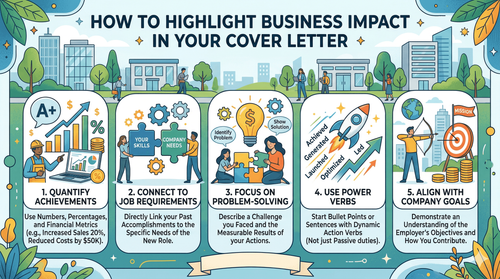

How to Highlight Business Impact in Your Cover Letter and Stand Out to Hiring Managers
Most cover letters fail for a simple reason: they focus too much on the candidate and not enough on the business.
Professionals often write about their interest in the role, their passion for the company, or their years of experience. While these points may be relevant, they rarely answer the most important question hiring managers are asking:
What impact will this person create for us?
In a competitive hiring environment, your cover letter is not just an introduction. It is a positioning tool. It is your opportunity to show that you understand business priorities and can contribute meaningfully from day one.
This is where many strong candidates miss out. They have real achievements, measurable results, and valuable experience, but their cover letter does not communicate that impact clearly.
This guide shows you how to fix that. By using a structured approach, you can transform your cover letter from a generic narrative into a powerful, impact-driven document that captures attention and builds credibility.
Who Is This Blog For?
- Job seekers who want to write stronger, more effective cover letters
- Professionals applying for competitive roles across industries
- Mid-career professionals aiming to demonstrate measurable impact
- Career switchers translating past experience into new contexts
- Consultants and client-facing professionals showcasing value creation
- Anyone whose cover letter feels descriptive but not compelling
Why This Topic Matters Today?
Hiring managers today operate under time constraints and high expectations. They are not reading cover letters to understand your story alone. They are scanning for signals of value.
Several trends make this even more critical:
- Recruiters spend limited time reviewing applications
- Organizations prioritize candidates who can deliver measurable outcomes
- Business impact is becoming a key differentiator in hiring decisions
- Generic cover letters are easily ignored
Common issues seen in cover letters include:
- Overemphasis on personal motivation instead of business contribution
- Repetition of resume content without added insight
- Lack of measurable outcomes or results
- Vague statements such as “I am a hardworking and dedicated professional”
These patterns make it difficult for hiring managers to assess your potential.
A strong cover letter, on the other hand, clearly demonstrates:
- What you have achieved
- How you achieved it
- Why it matters to the business
This shift from self-focused writing to impact-focused communication is what separates average applications from standout ones.
Core Concept or Framework Explained
The foundation of an effective cover letter lies in one key principle:
Your experience must be translated into business impact.
Instead of listing responsibilities or describing roles, your cover letter should highlight how your work has contributed to outcomes such as:
- Revenue growth
- Cost reduction
- Process efficiency
- Customer satisfaction
- Operational improvement
- Strategic outcomes
A simple but powerful structure to achieve this is:
Context + Action + Impact
Context explains the situation or challenge
Action describes what you did
Impact shows the measurable result or outcome
For example:
Instead of writing
I was responsible for managing a marketing campaign
You can write
Led a targeted marketing campaign that increased lead conversion by 35 percent within three months
This structure ensures your writing is outcome-driven, not activity-based.
How This Blog and Guidebook Help You?
This guide helps you move from generic storytelling to strategic communication.
By following this framework, you will learn how to:
- Identify business impact within your past experience
- Translate achievements into clear, compelling statements
- Align your experience with what employers are looking for
- Write cover letters that demonstrate value quickly
- Avoid common mistakes that weaken applications
- Build a consistent professional narrative across resume and cover letter
Instead of describing your career, you will present it as a series of meaningful contributions.
Step-by-Step Breakdown
Step 1: Understand the Role and Business Priorities
Before writing your cover letter, you must understand what the employer values.
Carefully review the job description and identify:
- Key responsibilities
- Desired skills
- Business goals associated with the role
Ask yourself:
- What problems is this role expected to solve?
- What outcomes would define success in this position?
- What language does the company use to describe impact?
This step ensures your cover letter is relevant, not generic.
Step 2: Identify Your Most Relevant Achievements
Next, select 2 to 3 strong examples from your experience that align with the role.
Focus on achievements that demonstrate:
- Measurable results
- Problem-solving ability
- Ownership and initiative
- Cross-functional collaboration
Avoid trying to include everything. Select only the most relevant examples.
For each example, define:
- The challenge or situation
- The action you took
- The outcome achieved
This clarity makes your writing more precise and impactful.
Step 3: Quantify Your Impact
Numbers make your contribution credible and easy to understand.
Whenever possible, include metrics such as:
- Percentage improvements
- Revenue growth
- Cost savings
- Time reduction
- Productivity gains
- Customer metrics
Examples:
- Increased sales by 20 percent
- Reduced processing time by 30 percent
- Improved customer satisfaction scores by 15 percent
If exact numbers are not available, use reasonable estimates or qualitative indicators such as:
- Significantly improved efficiency
- Reduced delays across multiple teams
- Enhanced user engagement
Quantification transforms your statements from claims into evidence.
Step 4: Structure Your Cover Letter for Maximum Impact
A strong cover letter typically includes three key sections.
- Clearly state the role you are applying for
- Briefly position yourself
- Introduce your value proposition
Example:
“I am applying for the Operations Manager role, bringing experience in process optimization and cost reduction across high-growth environments.”
- Highlight 2 to 3 key achievements
- Use the Context + Action + Impact structure
- Align each example with the role requirements
Focus on outcomes rather than responsibilities.
- Reinforce your interest in the role
- Summarize your value
- Express readiness to contribute
This structure ensures clarity and flow.
Step 5: Align Your Language with Business Outcomes
The language you use matters significantly.
Replace generic phrases with outcome-driven language.
Avoid:
- Responsible for
- Assisted with
- Worked on
Use instead:
- Led
- Delivered
- Improved
- Reduced
- Accelerated
- Designed
This shift signals ownership and leadership.
Also, focus on business language rather than personal traits.
Instead of saying
“I am passionate about problem-solving”
Say
“Improved operational efficiency by redesigning workflows, reducing delays across teams”
This makes your contribution tangible.
Step 6: Tailor Each Cover Letter
A one-size-fits-all cover letter rarely works.
Customize each application by:
- Referencing specific company goals or initiatives
- Aligning your examples with the role
- Using keywords from the job description
This shows that you have invested effort and understand the organization.
Even small adjustments can significantly improve relevance.
Step 7: Review and Refine for Clarity
Before submitting your cover letter, review it carefully.
Check for:
- Clarity and readability
- Concise sentences
- Strong action verbs
- Clear outcomes in every example
Ask yourself:
- Does each paragraph demonstrate value?
- Can a recruiter quickly understand my impact?
- Are there any vague or generic statements?
Editing is where good cover letters become great ones.
Common Mistakes or Pitfalls to Avoid
Focusing too much on yourself
A cover letter should not read like a personal statement. It should focus on how you can contribute to the organization.
Repeating your resume
Your cover letter should add context and insight, not duplicate bullet points.
Using vague language
Statements without clear outcomes fail to demonstrate impact.
Overloading with information
Too many examples reduce clarity. Focus on quality over quantity.
Ignoring metrics
Without measurable results, your achievements may feel less credible.
Generic openings
Starting with “I am writing to apply for…” without value positioning weakens your introduction.
How Should You Use This Guidebook Effectively?
To get the most value from this guide, follow a structured workflow.
Start by analyzing the job description and identifying key priorities.
Next, select your strongest and most relevant achievements.
Write a first draft using the Context + Action + Impact structure.
Then refine your language to ensure clarity, brevity, and impact.
Finally, tailor the letter for each application before submitting.
A focused 60 to 90 minute effort can significantly improve the quality of your cover letter.
Over time, you can build a strong base template that can be adapted quickly for different roles.
Key Takeaways
- A strong cover letter focuses on business impact, not just experience
- Hiring managers look for outcomes, not responsibilities
- The Context + Action + Impact framework creates clarity and credibility
- Quantifiable results make your achievements more compelling
- Strong action verbs signal ownership and leadership
- Tailoring your cover letter improves relevance and effectiveness
- Avoid generic language and focus on measurable contributions
- Clear, concise writing improves readability and impact
Your Next Step: Accelerate Your Career with PlanetSpark
Creating an impact-driven resume is not just about landing your next job—it’s about owning your professional story and presenting it with clarity, confidence, and credibility. When your resume clearly communicates value, results, and impact, opportunities follow naturally.
At PlanetSpark, we are committed to empowering working professionals with practical, outcome-focused resources that drive real career growth. From resume building and workplace communication to leadership presence and professional writing, our programs are designed to help you succeed in today’s fast-evolving job market.
Visit https://www.planetspark.in/resources to explore:
- Career and resume-building guides
- Workplace communication and professional writing resources
- Skill-development tools curated for working professionals
Want a deeper, hands-on experience?
You can also book a free trial session to learn more about PlanetSpark’s Working Professional Courses, designed to accelerate your career through personalised coaching, real-world practice, and expert guidance.
Your career deserves more than generic advice.
It deserves clarity, confidence, and measurable impact.
Personalized Communication Roadmaps
Record a video to get a AI generated personalized communication reports