
How to Show Innovation and Initiative in Resume Bullets
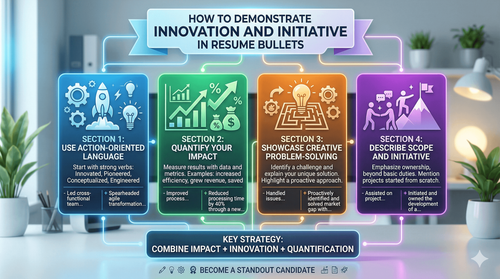

How to Demonstrate Innovation and Initiative in Resume Bullets That Make You Stand Out to Recruiters
Most professionals work hard, solve problems, and improve systems in ways that genuinely move their teams forward. They fix inefficiencies, create smarter workflows, and take ownership beyond what their job description requires.
Yet when it comes to writing resumes, this impact often disappears.
Instead of showcasing initiative, resumes tend to say things like “assisted with projects” or “supported team initiatives.” These statements may be accurate, but they fail to communicate what truly matters: what you built, changed, or drove.
In a hiring environment where recruiters spend only seconds scanning resumes, this gap becomes critical.
This guide helps you close that gap. It provides a structured, practical framework to identify your innovation and initiative, and translate it into compelling resume bullets that clearly demonstrate impact, ownership, and leadership.
Who Is This Blog For?
This blog is designed for professionals who want their resumes to reflect real impact rather than routine tasks.
- Early and mid-career professionals building stronger resumes
- Career switchers repositioning their experience
- Managers who want to highlight leadership and ownership
- Professionals preparing for competitive job applications
- Anyone whose resume feels “accurate but not impressive”
- Job seekers who want to stand out quickly in recruiter scans
Why This Topic Matters Today?
Hiring expectations have evolved significantly. Employers are no longer just evaluating experience; they are evaluating initiative, ownership, and problem-solving ability.
The reality is:
- Recruiters spend roughly 7 seconds scanning a resume :contentReference[oaicite:1]{index=1}
- They look for candidates who “moved the needle,” not just participated
- Generic descriptions make even strong candidates blend in
Common resume problems highlighted in the guide include:
- Vague action verbs such as “helped” or “assisted”
- Missing quantified impact
- Task-focused language instead of outcome-focused storytelling
- Lack of context or scale
The result is a missed opportunity. Professionals who have demonstrated real initiative fail to communicate it clearly.
In today’s competitive job market, the ability to articulate innovation is not optional. It is a key differentiator.
Core Concept or Framework Explained
At the heart of this guide is a simple but powerful idea:
Your resume should show what you built, changed, or drove — not just what you were assigned.
Innovation and initiative are two distinct but complementary signals:
- Innovation: Creating or improving something, such as a process, system, or approach
- Initiative: Acting without being asked, identifying a problem, and taking ownership to solve it.
Together, they signal a professional who leads from any position, not just from a title.
To translate this into resume bullets, the guide introduces a high-impact structure:
Action Verb + What You Built/Changed + Context/Scale + Quantified Result :contentReference[oaicite:3]{index=3}
For example:
Redesigned onboarding workflow for multiple product lines, reducing time-to-productivity and saving operational costs.
This structure ensures every bullet communicates:
- Ownership
- Transformation
- Measurable impact
How This Blog and Guidebook Help You?
This guide helps you uncover and communicate the value you already create in your work.
By applying this framework, you will learn how to:
- Identify hidden examples of innovation in your daily work
- Replace weak, task-based bullets with impact-driven statements
- Use strong action verbs that signal leadership
- Quantify results across time, cost, scale, or efficiency
- Rewrite existing bullets into compelling, outcome-focused narratives
- Align your resume with what recruiters actively look for
Instead of trying to sound impressive, you will accurately present the impressive work you have already done.
Step-by-Step Breakdown
Step 1: Mine Your Innovation and Initiative Moments
Most professionals underestimate their own contributions because they normalize their achievements.
This step focuses on uncovering those hidden moments.
Use four powerful prompts:
- The Before You Test: What changed because you were there?
- The Nobody Asked Test: What did you do without being told?
- The First Time Test: What did you implement for the first time?
- The Multiplier Test: What did you build that made others more effective? :contentReference[oaicite:4]{index=4}
Examples include:
- Automating a manual process
- Creating a new reporting system
- Improving an inefficient workflow
- Identifying and solving an overlooked problem
The goal is to surface raw material before refining it.
Step 2: Use Innovation-Coded Action Verbs
The first word of your bullet shapes how your contribution is perceived.
Weak verbs such as “helped,” “supported,” or “assisted” signal passive involvement.
Strong verbs signal ownership and initiative.
Examples include:
- Built
- Designed
- Spearheaded
- Redesigned
- Optimized
- Initiated
- Engineered :contentReference[oaicite:5]{index=5}
The same experience can sound entirely different depending on the verb used.
For example:
Weak: Helped improve onboarding process
Strong: Redesigned onboarding workflow
This shift immediately communicates leadership.
Step 3: Quantify Your Impact
Many professionals believe their work cannot be quantified. In reality, impact can be measured in multiple ways.
Key dimensions include:
- Time saved
- Cost reduced
- Speed improved
- Scale increased
- Adoption rates
- Accuracy or quality improvements :contentReference[oaicite:6]{index=6}
Ask yourself:
- How much?
- How many?
- How fast?
- Compared to what?
Even estimates are powerful when contextualized.
For example:
- Reduced processing time by 30 percent
- Saved 10 hours per week
- Improved accuracy from 85 percent to 98 percent
Numbers transform abstract work into concrete impact.
Step 4: Apply the Before-and-After Rewrite Method
One of the most effective techniques is rewriting existing bullets.
Start with your current bullet, then improve it using the framework.
Example transformation:
Before
Helped improve onboarding process
After
Redesigned onboarding workflow, reducing time-to-productivity by 40 percent and saving administrative hours
The difference is clarity, ownership, and measurable impact.
The goal is not to exaggerate but to complete the story.
Step 5: Run the Innovation Signal Checklist
Before finalizing your resume, evaluate each bullet using a quality checklist:
- Does it start with a strong action verb?
- Does it show ownership clearly?
- Does it signal something new or improved?
- Does it include at least one number?
- Is it relevant to the target role?
- Is it easy to understand quickly? :contentReference[oaicite:7]{index=7}
If a bullet fails multiple checks, rewrite it.
This step ensures consistency and quality across your resume.
Step 6: Calibrate for Career Stage and Industry
Innovation looks different depending on your experience level.
For example:
- Early career: Focus on tools built and small process improvements
- Mid career: Highlight cross-team initiatives and system redesign
- Senior roles: Emphasize strategic impact and organizational change :contentReference[oaicite:8]{index=8}
Similarly, different industries value different types of impact:
- Technology: Systems, scale, performance
- Marketing: Growth, engagement, conversion
- Operations: Efficiency, process improvement
- Finance: Accuracy, cost savings, methodology
The core action may be the same, but the framing must match the audience.
Common Mistakes or Pitfalls to Avoid
Many professionals weaken their resumes by making predictable mistakes.
Burying the lead
Starting with team context instead of your contribution reduces clarity.
Describing process instead of outcome
Listing steps instead of results hides impact.
Using vague language
Words like “significantly improved” lack credibility without numbers.
Over-crediting the team
Failing to claim ownership reduces perceived leadership.
Missing context
Without scale or scope, impact becomes unclear.
Each of these issues can be fixed by focusing on clarity, ownership, and measurable results.
How Should You Use This Guidebook Effectively?
To get the most value from this guide, use it as a structured working process.
Start by mining your experience using the reflection prompts.
Next, complete a worksheet-style exercise to list your strongest examples of innovation.
Then rewrite your existing resume bullets using the formula:
Action Verb + What You Built/Changed + Context + Quantified Outcome
After drafting, apply the checklist to refine each bullet.
Finally, calibrate your bullets based on your career stage and target role.
You can use this guide in multiple ways:
- Deep review for a full resume overhaul
- Quick reference before submitting an application
- Worksheet mode for immediate rewriting
Even a focused 60–90 minute session can significantly improve your resume quality.
Key Takeaways
- Innovation and initiative are critical signals in hiring decisions
- Most professionals undercommunicate their real impact
- Strong resume bullets focus on what you built, changed, or drove
- Action verbs significantly influence perception of ownership
- Quantification makes your impact credible and visible
- The before-and-after rewrite method improves clarity and strength
- A structured checklist ensures consistency and quality
- The same experience should be framed differently based on context
Your Next Step: Accelerate Your Career with PlanetSpark
Creating an impact-driven resume is not just about landing your next job—it’s about owning your professional story and presenting it with clarity, confidence, and credibility. When your resume clearly communicates value, results, and impact, opportunities follow naturally.
At PlanetSpark, we are committed to empowering working professionals with practical, outcome-focused resources that drive real career growth. From resume building and workplace communication to leadership presence and professional writing, our programs are designed to help you succeed in today’s fast-evolving job market.
Visit https://www.planetspark.in/resources to explore:
- Career and resume-building guides
- Workplace communication and professional writing resources
- Skill-development tools curated for working professionals
Want a deeper, hands-on experience?
You can also book a free trial session to learn more about PlanetSpark’s Working Professional Courses, designed to accelerate your career through personalised coaching, real-world practice, and expert guidance.
Your career deserves more than generic advice.
It deserves clarity, confidence, and measurable impact.
Personalized Communication Roadmaps
Record a video to get a AI generated personalized communication reports