
How to Showcase Certifications and Online Courses on Your Resume Effectively
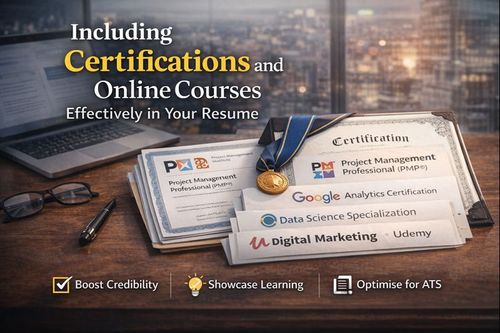

Including Certifications and Online Courses Effectively in Your Resume: A Strategic Guide for Working Professionals
Introduction
Certifications and online courses have become powerful career signals. They reflect adaptability, initiative, and commitment to continuous learning—qualities employers actively look for in today’s fast-changing job market. Yet many professionals dilute their impact by listing credentials incorrectly, burying them in the resume, or presenting them in ways that confuse recruiters and ATS systems.
This guide focuses on one critical question: how do you include certifications and online courses in your resume so they strengthen your candidacy instead of cluttering it? Drawing directly from the PlanetSpark resource, this blog walks you through a clear, strategic approach to showcasing learning in a way that is credible, relevant, and results-oriented.
Who Is This Blog (and Guidebook) For?
This blog and guidebook are designed for:
- Working professionals aiming to stay competitive through continuous learning
- Career changers using certifications to bridge skill gaps
- Early-career professionals compensating for limited work experience
- Mid- to senior-level professionals deciding which credentials still matter
- Job seekers confused about where and how to list certifications and online courses
Why This Topic Matters Today?
Hiring decisions are increasingly influenced by skills, not just job titles. Certifications and online courses often serve as proof points—especially when employers screen resumes using ATS software.
However, as highlighted in the guidebook, simply listing every course you have completed can backfire. Recruiters look for relevance, credibility, and clarity. Poorly formatted or irrelevant credentials can signal lack of focus, outdated skills, or even exaggeration. Strategic placement and accurate representation are no longer optional—they are essential.
Core Concept or Framework Explained
The central idea of the guidebook is strategic credential positioning. Certifications, certificates, and online courses do not all carry the same weight, and they should not be treated equally on a resume.
The guide introduces a clear distinction between:
- Professional certifications issued by recognised bodies, which carry high resume impact
- Certificates of completion, which demonstrate structured learning and moderate value
- Online courses, which signal skill acquisition but require careful curation
To decide what belongs on your resume, the guidebook introduces an assessment framework based on relevance, recency, and credibility. This ensures every credential included strengthens your profile instead of distracting from it.
How This Blog and Guidebook Help You?
This blog and the accompanying guidebook help you:
- Decide which certifications to include, exclude, or move to LinkedIn only
- Choose the right placement strategy based on career stage and role
- Format credentials in an ATS-friendly, recruiter-readable way
- Present in-progress certifications honestly and professionally
- Avoid common mistakes that undermine credibility
The result is a resume that communicates learning strategically rather than defensively.
Step-by-Step Breakdown
Step 1: Assess Your Credentials Before Including Them
Not every certification deserves resume space. The guidebook recommends evaluating each credential using three lenses.
Relevance test: Does this credential directly support your target role or industry?
Recency check: Was it completed within the last 3–5 years, especially in fast-evolving fields?
Credibility evaluation: Is the issuing organisation recognised and respected in your field?
Based on this assessment, credentials fall into four categories: must include, consider including, exclude, or LinkedIn only. This step prevents resume overload and sharpens focus.
Step 2: Understand the Three Strategic Placement Options
Where you place certifications significantly affects how recruiters perceive them. The guidebook outlines three proven placement strategies.
A dedicated certifications section works best when credentials are essential for the role or when you hold multiple high-value certifications.
Placing certifications within the education section suits early-career professionals or those with one or two complementary credentials.
Integrating certifications into experience descriptions is effective when a credential directly enabled results achieved in a role.
Choosing the right placement aligns your learning with your career narrative rather than isolating it.
Step 3: Format Certifications for Maximum Impact and ATS Success
Formatting errors are a common reason certifications are overlooked. The guidebook provides a clear, standardised structure: certification name, issuing organisation, and completion date.
Optional but powerful additions include credential IDs for verifiable certifications and expiry dates for those requiring renewal. Standard section headings and consistent formatting ensure ATS systems can parse your resume correctly while keeping it easy to scan for humans.
Step 4: Include In-Progress Certifications the Right Way
In-progress certifications can strengthen your profile when handled carefully. The guidebook recommends including them only when they are highly relevant, more than halfway complete, and have a confirmed completion timeline.
Clear labels such as “in progress” or “exam scheduled” maintain transparency and trust. Vague phrases or listing planned courses without timelines should be avoided.
Step 5: Showcase Online Courses Without Diluting Credibility
Online courses require more selectivity than formal certifications. The guidebook advises including only substantial, relevant courses from reputable platforms.
Grouping related courses into specialisations, highlighting university or industry-backed providers, and placing them under sections like Professional Development helps maintain professional credibility while demonstrating upskilling.
Step 6: Optimise Certifications for Applicant Tracking Systems
ATS systems scan for exact names, standard terminology, and clean formatting. The guidebook emphasises using full certification names alongside acronyms, avoiding tables or graphics, and ensuring text remains machine-readable.
A simple test—copying resume text into a plain text editor—helps confirm ATS compatibility before submission.
Step 7: Tailor Certifications for Different Career Scenarios
The guidebook highlights that certification strategy changes with career context.
Career changers should prioritise certifications that bridge old and new roles and place them near the top of the resume.
Recent graduates can use certifications to demonstrate practical skills and initiative.
Senior professionals should feature only prestigious, recent credentials that reinforce leadership or strategic expertise.
Common Mistakes or Pitfalls to Avoid
The guidebook identifies frequent errors that weaken resumes:
- Listing irrelevant or excessive courses
- Including outdated or expired certifications without clarity
- Using vague or inflated descriptions
- Omitting issuing organisations, dates, or verification details
Avoiding these mistakes immediately improves credibility and professionalism.
How Should You Use This Guidebook Effectively?
The guidebook works best when used as both a reference and an action tool. Start by auditing credentials, then revise placement and formatting based on your target role. Test ATS compatibility, update LinkedIn accordingly, and revisit your certifications section during every job search cycle.
This process typically requires one focused review session and minor updates thereafter.
Key Takeaways / Summary
- Be selective and strategic, not exhaustive
- Differentiate between certifications, certificates, and online courses
- Place credentials based on career stage and role relevance
- Use standard formatting that works for recruiters and ATS
- Present in-progress learning transparently
- Tailor certifications for each application
Your Next Step: Accelerate Your Career with PlanetSpark
Creating an impact-driven resume is not just about landing your next job—it’s about owning your professional story and presenting it with clarity, confidence, and credibility. When your resume clearly communicates value, results, and impact, opportunities follow naturally.
At PlanetSpark, we are committed to empowering working professionals with practical, outcome-focused resources that drive real career growth. From resume building and workplace communication to leadership presence and professional writing, our programs are designed to help you succeed in today’s fast-evolving job market.
Visit https://www.planetspark.in/resources to explore:
- Career and resume-building guides
- Workplace communication and professional writing resources
- Skill-development tools curated for working professionals
Want a deeper, hands-on experience?
You can also book a free trial session to learn more about PlanetSpark’s Working Professional Courses, designed to accelerate your career through personalised coaching, real-world practice, and expert guidance.
Your career deserves more than generic advice.
It deserves clarity, confidence, and measurable impact.
Start building that advantage today—with PlanetSpark.