
How to Showcase Leadership Growth in Resumes for Career Success
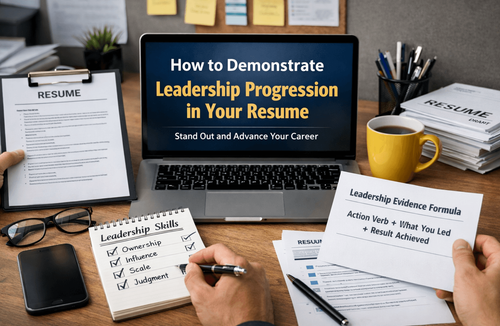

How to Demonstrate Leadership Progression in Your Resume for Faster Career Growth and Better Opportunities
Most resumes fail not because professionals lack experience, but because they fail to communicate growth.
You may have led projects, influenced decisions, and delivered measurable outcomes. Yet, your resume likely reads like a list of tasks instead of a story of leadership progression. This disconnect is exactly why many qualified professionals struggle to get shortlisted for higher roles.
Hiring managers are not just evaluating what you’ve done. They are looking for signals of how you’ve evolved, how you lead, and whether you are ready for the next level.
This is where a structured approach to demonstrating leadership progression becomes essential. The guidebook behind this blog provides a practical system to help you transform your resume into a powerful narrative of growth, impact, and leadership.
Book your free trial session today with Planetspark.
Download for more details or PDF file.
Who Is This Blog For?
This blog is designed for professionals who want to present their experience in a more strategic and impactful way.
- Early to mid-career professionals with 0 to 15 years of experience
- Managers aiming for promotions or leadership roles
- Individual contributors transitioning into leadership positions
- Career switchers who want to highlight transferable leadership skills
- Consultants and professionals applying for high-impact roles
- Anyone whose resume feels repetitive, flat, or task-focused
Why This Topic Matters Today?
The modern job market is more competitive than ever, and expectations from professionals have evolved significantly.
Hiring managers, recruiters, and leadership panels are no longer impressed by job titles alone. They are trained to identify leadership trajectory, which includes:
- Growth in responsibility and scope
- Ability to influence beyond direct roles
- Evidence of decision-making under pressure
- Impact on teams, systems, and outcomes
One of the biggest challenges professionals face is that their resumes fail to reflect this progression. Common issues include:
- Repeating similar responsibilities across roles
- Using vague or passive language
- Not showing measurable impact
- Failing to demonstrate growth between roles
As a result, even strong candidates appear stagnant on paper. This blog addresses that gap by helping you understand and apply leadership progression effectively.
Core Concept or Framework Explained
At the heart of demonstrating leadership progression is a simple but powerful idea. Your resume should show how you have grown across four key dimensions.
These four dimensions define how hiring managers evaluate leadership:
Ownership
This reflects how much responsibility you take and whether you initiate and drive work independently.
Influence
This shows how your impact extends beyond your immediate team, including stakeholders and cross-functional collaboration.
Scale
This represents the size, complexity, or scope of your work, such as team size, budgets, or business impact.
Judgment
This captures your ability to make decisions under pressure, manage ambiguity, and handle complex situations.
Strong resumes clearly show growth across these dimensions over time. Weak resumes focus only on tasks without demonstrating how these dimensions evolved.
Another critical concept is the Leadership Evidence Formula:
Leadership Verb plus What You Led plus Context or Scale plus Outcome or Impact
For example, instead of writing “Managed a team,” a stronger version would describe how the team grew, what challenges were addressed, and what results were achieved.
This shift from task-based writing to evidence-based storytelling is what transforms a resume.
How This Blog and Guidebook Help You?
This blog, based on the guidebook, helps you move from a basic resume to a leadership-focused document that gets noticed.
It enables you to:
- Identify gaps in how your resume presents leadership
- Build a clear narrative of career growth
- Rewrite weak statements into high-impact leadership bullets
- Highlight measurable outcomes and real contributions
- Present your experience in a way hiring managers understand quickly
The result is a resume that reflects not just what you have done, but what you are capable of doing next.
Step-by-Step Breakdown
Step 1: Audit Your Resume for Leadership Signals
The first step is to evaluate your current resume objectively.
Ask yourself:
- Does each bullet show leadership or just participation
- Are outcomes clearly mentioned
- Is there visible growth from one role to the next
- Are scope, scale, or team size included
Most professionals discover that a large portion of their resume lacks leadership signals. This audit helps you identify exactly what needs improvement.
Step 2: Build Your Leadership Narrative Arc
Your resume should tell a story of growth, not just list roles.
Start by defining a one-line leadership theme that connects your career. This could be about building teams, improving systems, or driving growth in challenging environments.
Then structure your roles to reflect:
- Early roles showing initiative and foundational skills
- Mid roles demonstrating growth and increased responsibility
- Recent roles highlighting mastery and strategic leadership
This creates a clear progression that hiring managers can easily follow.
Step 3: Rewrite Your Resume Using Leadership Language
This is where the biggest transformation happens.
Replace weak, generic, or passive bullets with structured leadership statements.
Eliminate:
- Task-based bullets
- Passive phrases like “was responsible for”
- Generic statements without outcomes
Instead, use strong verbs and include context and results. Even if you do not have exact numbers, use indicators of scale or significance.
This step alone can dramatically improve how your resume is perceived.
Step 4: Structure Your Resume for Maximum Impact
Even strong content can fail if the structure is weak.
Use these principles:
- Add a short role summary for each recent position
- Highlight your strongest achievement first in each role
- Give more space to recent roles and less to older ones
- Ensure the progression is visible at a glance
Structure acts as a silent guide for the reader and influences how your resume is interpreted.
Step 5: Show Leadership Without Title Changes
Many professionals believe leadership requires promotions. This is not true.
You can demonstrate leadership through:
- Expanding responsibilities over time
- Leading projects or teams informally
- Improving processes or systems
- Mentoring or developing others
These forms of leadership are highly valued and often more meaningful than titles alone.
Step 6: Translate Leadership Across Industries
If you are switching careers, your challenge is not lack of experience but lack of translation.
Focus on:
- Extracting core leadership skills from your experience
- Removing industry-specific jargon
- Highlighting universal outcomes like growth, efficiency, or impact
Leadership skills are transferable. The key is presenting them in a language that any hiring manager can understand.
Common Mistakes or Pitfalls to Avoid
Many resumes fail due to avoidable mistakes.
- Listing responsibilities instead of leadership actions
- Giving equal importance to all roles regardless of relevance
- Burying the most impactful achievements deep in the resume
- Using weak verbs that dilute impact
- Not including measurable outcomes
- Ignoring people development and mentorship
- Starting without a clear summary or positioning statement
Avoiding these mistakes ensures your resume communicates clarity, impact, and progression.
How Should You Use This Guidebook Effectively?
To get the most value from the guidebook, treat it as a hands-on tool rather than a passive read.
- Set aside 60 to 90 minutes to work through it
- Keep your resume open while applying each step
- Start with the audit before making changes
- Focus on rewriting a few key bullets first
- Gradually restructure your entire resume
- Use the self-evaluation scorecard to assess progress
You can also follow the structured 7-day plan provided in the guide to make consistent improvements without feeling overwhelmed.
Key Takeaways
- Leadership progression is about growth in responsibility, influence, scale, and decision-making
- Hiring managers look for evidence of trajectory, not just job titles
- Strong resumes focus on outcomes, not tasks
- The Leadership Evidence Formula is essential for writing impactful bullets
- Structure and presentation significantly affect how your resume is perceived
- Leadership can be demonstrated even without promotions
- Translating skills is critical for career switchers
- Regular self-evaluation ensures your resume stays competitive
---
Your Next Step: Accelerate Your Career with PlanetSpark
Creating an impact-driven resume is not just about landing your next job—it’s about owning your professional story and presenting it with clarity, confidence, and credibility. When your resume clearly communicates value, results, and impact, opportunities follow naturally.
At PlanetSpark, we are committed to empowering working professionals with practical, outcome-focused resources that drive real career growth. From resume building and workplace communication to leadership presence and professional writing, our programs are designed to help you succeed in today’s fast-evolving job market.
Visit https://www.planetspark.in/resources to explore:
- Career and resume-building guides
- Workplace communication and professional writing resources
- Skill-development tools curated for working professionals
Want a deeper, hands-on experience?
You can also book a free trial session to learn more about PlanetSpark’s Working Professional Courses, designed to accelerate your career through personalised coaching, real-world practice, and expert guidance.
Your career deserves more than generic advice.
It deserves clarity, confidence, and measurable impact.