
How to Showcase Project Ownership in Your Resume Effectively
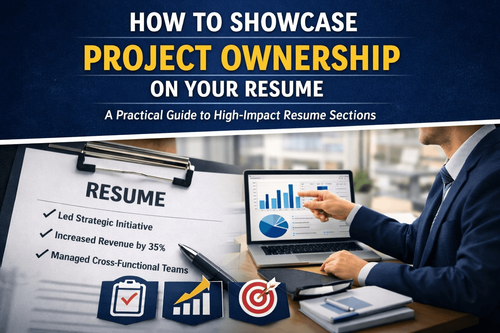

How to Showcase Project Ownership on Your Resume: A Practical Guide to Writing High-Impact Resume Sections
Many professionals spend years leading initiatives, coordinating stakeholders, solving complex problems, and delivering measurable results. Yet when it comes time to write their resumes, those accomplishments often disappear behind generic phrases such as “responsible for managing projects” or “coordinated with teams.”
Recruiters reviewing dozens of resumes every day are not looking for task descriptions. They are looking for proof of ownership. They want to see evidence that you drove outcomes, made decisions, and delivered results that mattered to the business.
The PlanetSpark Career Series guidebook How to Showcase Project Ownership in Resume Sections explains that the biggest gap in most resumes is not experience—it is language. Professionals frequently led meaningful initiatives but fail to communicate the scale, accountability, and results of that work in a way that stands out quickly.
This blog translates the guidebook’s frameworks and worksheets into a practical roadmap. By applying these strategies, you can turn routine project work into compelling resume statements that demonstrate leadership, ownership, and measurable impact. Download the guidebook and worksheet by clicking on the link. Book your free trial today!
Who Is This Blog For?
This blog and the accompanying guidebook
are designed for professionals who want their resumes to reflect real responsibility and measurable outcomes.
- Early-career professionals who have contributed to or led initiatives but struggle to describe them effectively
- Mid-career professionals seeking promotions or leadership roles
- Career changers repositioning themselves for a new industry or function
- Consultants and specialists whose project work deserves clearer visibility
- Job seekers with 0–15 years of experience who want their resume to demonstrate ownership and accountability.
Why This Topic Matters Today?
Hiring decisions are increasingly influenced by evidence of leadership potential and the ability to deliver outcomes. Employers are not just evaluating whether candidates completed tasks; they are evaluating whether candidates owned meaningful work.
According to the guidebook, most resumes fail because they read like job descriptions instead of career stories. They list responsibilities such as managing stakeholders or coordinating deliverables but never answer the key question recruiters care about: What happened because of your work? :contentReference[oaicite:1]{index=1}
Project ownership signals professional maturity. It shows that you were accountable for results, made critical decisions, and coordinated people or resources to deliver outcomes. Recruiters interpret these signals as indicators that a candidate can operate at higher levels of responsibility.
Without this clarity, even strong professionals risk being overlooked because their resumes do not communicate the scale or significance of their work.
Core Concept or Framework Explained:
The guidebook introduces a powerful writing structure called the POW Framework. This framework ensures every resume bullet clearly communicates ownership and measurable results.
POW stands for three essential elements:
Project Context
This describes the scope and significance of the initiative. It explains what the project involved, its scale, and why it mattered.
Ownership Signal
This clarifies your specific role in the initiative. It shows what decisions you made, what responsibilities you held, and how you drove progress.
Win (Result)
This demonstrates the outcome of the work. The result should be measurable whenever possible, using metrics such as revenue growth, efficiency gains, or improved performance.
When these three components appear together in a bullet point, the statement communicates authority and impact. Without them, a bullet often reads like a routine task rather than evidence of leadership.
For example, the guidebook demonstrates the difference clearly.
Weak statement
Responsible for managing a digital transformation project across departments.
Strong POW statement
Led end-to-end delivery of a ₹40L digital transformation initiative spanning Finance, HR, and Operations, owning vendor selection and sprint planning while reducing manual processing time by 62 percent within six months.
The second version provides context, clarifies ownership, and demonstrates a measurable outcome. That combination makes the achievement credible and memorable.
How This Blog and Guidebook Help You?
Understanding project ownership is only the first step. The real challenge is translating your experience into resume language that communicates leadership clearly and concisely.
This blog and the guidebook help you:
- Recognise projects where you demonstrated ownership
- Identify the scale and stakes behind your work
- Convert project experience into clear achievement statements
- Structure resume sections to highlight ownership signals
- Build a reusable bank of powerful bullet points
By applying these frameworks, professionals can transform resumes from simple experience summaries into strategic career narratives.
Step-by-Step Breakdown:
Step 1: Identify What You Actually Owned
Before you can showcase project ownership, you need to recognise it in your own career history.
Many professionals underestimate their contributions because they view their work as simply doing their job. However, ownership often appears in situations where you made decisions, coordinated stakeholders, or were accountable for outcomes.
The guidebook suggests looking for signals such as:
- Decision rights where you determined scope, priorities, or approach
- Stakeholder management involving senior leaders, clients, or cross-functional teams
- Outcome accountability where your work directly influenced success or failure
- Resource coordination such as managing budgets, vendors, timelines, or teams
You only need three to five strong project examples to build a powerful resume narrative. Quality and impact matter far more than quantity.
Step 2: Structure Every Bullet Using the POW Framework
Once you identify key projects, the next step is writing resume bullets that communicate ownership clearly.
The POW framework provides a simple structure:
Project context explains the scale of the initiative.
Ownership signals highlight your leadership and accountability.
Win describes the measurable outcome or business result.
This structure prevents vague or incomplete bullet points. A bullet with only context sounds like a job description. A bullet with only results may appear disconnected from your contribution. Combining all three elements communicates genuine ownership.
Step 3: Place Ownership Signals Strategically Across Your Resume
Project ownership should not appear in only one section of your resume. Instead, it should reinforce your narrative across multiple sections.
Professional Summary
The summary at the top of your resume establishes your professional identity. This section should briefly highlight the type of projects you lead and the results you deliver.
Experience Section
This is where the POW framework becomes most powerful. Each role should contain three to five bullets, with several demonstrating ownership and measurable outcomes.
Projects or Key Initiatives Section
If your work involved multiple complex projects, a dedicated section can highlight them more clearly. This is particularly useful for consultants, career changers, and professionals whose most impressive work does not align neatly with job titles.
Skills and Competencies
Skills such as programme management, cross-functional leadership, and end-to-end delivery reinforce the ownership narrative and align with ATS keywords.
Step 4: Build Your Project Ownership Bullet Bank
The guidebook includes a worksheet designed to help professionals convert project experience into powerful resume bullets.
For each project, you should identify:
- The project name or initiative
- Your official role or title at the time
- Your specific responsibilities or decisions
- The scale of the initiative including team size, budget, or stakeholders
- The measurable outcome or business result
- The broader impact on the organisation
Once these details are documented, you can convert them into a structured POW bullet. Repeating this process across several projects creates a bank of six or more strong statements that can be customised for different job applications.
Step 5: Use Ownership Language That Signals Leadership
Word choice plays a significant role in how recruiters interpret your experience.
The guidebook highlights the importance of starting every bullet with strong action verbs that signal ownership.
Examples include:
- Delivered
- Spearheaded
- Directed
- Championed
- Orchestrated
- Implemented
- Transformed
These verbs immediately communicate leadership and initiative. In contrast, phrases such as “responsible for,” “worked on,” or “assisted with” weaken the perception of ownership.
Step 6: Demonstrate Impact Through Real Results
A powerful resume does more than describe activities. It demonstrates the business impact of your work.
Metrics that strengthen achievement statements include:
- Revenue growth or cost savings
- Time reductions or efficiency gains
- Adoption rates or customer engagement improvements
- Team size or organisational scale
- Quality improvements or risk mitigation
When exact numbers are unavailable, qualitative outcomes can still demonstrate impact by explaining how the initiative changed processes or outcomes within the organisation.
Common Mistakes or Pitfalls to Avoid:
Even experienced professionals make mistakes that weaken otherwise strong resumes.
The guidebook highlights several common pitfalls.
Using weak language
Phrases such as “helped with” or “worked on” dilute ownership and make contributions unclear.
Writing job descriptions instead of achievements
Listing responsibilities without outcomes prevents recruiters from understanding your value.
Avoiding metrics
Numbers provide credibility and help hiring managers quickly assess the scale of your work.
Overusing vague adjectives
Words such as “successfully” or “effectively” add little meaning. Strong verbs and measurable outcomes communicate impact far more clearly.
Failing to highlight scale
Recruiters need to understand the size and stakes of a project. Without this context, achievements appear less significant.
How Should You Use This Guidebook Effectively?
The guidebook is designed as a practical resource rather than a theoretical one.
The recommended approach is straightforward.
- Read the guidebook once to understand the frameworks
- Complete the project ownership worksheet for your top three to five projects
- Write draft POW bullets using the worksheet responses
- Select your strongest statements for the final resume
- Run the audit checklist before submitting applications
This process can often be completed in one focused working session. The guidebook itself suggests that most professionals can implement the full system within approximately 25 minutes of reading and a few hours of focused writing.
Key Takeaways:
- Project ownership is one of the strongest signals of professional maturity on a resume
- Most resumes fail because they describe responsibilities instead of outcomes
- The POW framework ensures every bullet communicates context, ownership, and results
- Strong verbs and measurable metrics dramatically increase credibility
- Ownership signals should appear in the summary, experience section, and project highlights
- A structured worksheet process helps convert real work experience into powerful resume statements.
Your Next Step: Accelerate Your Career with PlanetSpark
Creating an impact-driven resume is not just about landing your next job—it’s about owning your professional story and presenting it with clarity, confidence, and credibility. When your resume clearly communicates value, results, and impact, opportunities follow naturally.
At PlanetSpark, we are committed to empowering working professionals with practical, outcome-focused resources that drive real career growth. From resume building and workplace communication to leadership presence and professional writing, our programs are designed to help you succeed in today’s fast-evolving job market.
Visit https://www.planetspark.in/resources to explore:
- Career and resume-building guides
- Workplace communication and professional writing resources
- Skill-development tools curated for working professionals.
Want a deeper, hands-on experience?
You can also book a free trial session to learn more about PlanetSpark’s Working Professional Courses, designed to accelerate your career through personalised coaching, real-world practice, and expert guidance.
Your career deserves more than generic advice.
It deserves clarity, confidence, and measurable impact.
Start building that advantage today—with PlanetSpark.
Personalized Communication Roadmaps
Record a video to get a AI generated personalized communication reports