
How to Spot Job Offer Red Flags: A Practical Checklist for Professionals
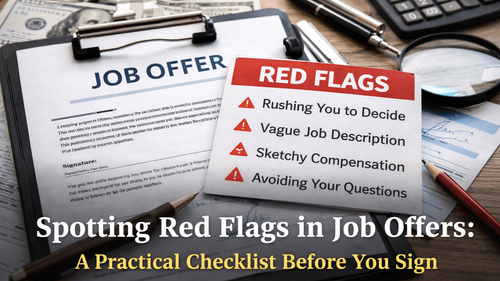

The Ultimate Job Offer Evaluation Checklist: How to Spot Red Flags Before You Accept an Offer
You’ve cleared interviews, impressed hiring managers, and finally received that long-awaited job offer. It feels like a win — the finish line after weeks or months of effort. But here’s the uncomfortable truth: the offer stage is where some of the most expensive career mistakes happen.
Many professionals accept offers based on excitement, urgency, or pressure — only to realise later that the role is misaligned, the compensation is misleading, or the work culture is toxic. According to the PlanetSpark Offer Red Flag Detector Checklist, a poor decision at this stage can set your career back by two to three years.
This blog transforms that checklist into a structured, practical guide — helping you evaluate every job offer with clarity, confidence, and strategic thinking.
Who Is This Blog For?
- Job seekers evaluating multiple offers
- Career changers entering new industries
- Early to mid-career professionals (0–15 years experience)
- Consultants and managers assessing leadership roles
- Professionals preparing for salary negotiation or offer discussions
Why This Topic Matters Today?
Today’s job market is fast-paced, competitive, and often opaque. Companies are moving quickly to close candidates, and professionals feel pressure to decide fast. But speed often comes at the cost of due diligence.
The checklist highlights several critical realities:
- Many offers hide risks in compensation structure, not just salary
- Hiring processes often signal how the company will treat employees
- Poor role clarity can lead to stagnation or burnout
- Contract clauses can restrict your future career mobility
Without a structured evaluation framework, professionals rely on gut feeling — which is unreliable under pressure. This is why having a systematic checklist is no longer optional; it is essential.
Core Concept or Framework Explained
The Offer Red Flag Detector Checklist is built around a five-phase evaluation framework. Each phase focuses on a critical dimension of an offer, ensuring you assess not just the role, but the entire ecosystem around it.
The five phases include:
- Hiring Process Signals
- Compensation Structure
- Company Health
- Role and Growth Potential
- Work Culture and Contract Terms
Instead of evaluating an offer emotionally, this framework encourages a data-driven approach. It treats the hiring process as a preview, compensation as a multi-layered structure, and the role as a long-term investment.
The framework also introduces a scorecard system where you classify signals as green, amber, or red — enabling objective decision-making rather than reactive acceptance.
How This Blog and Guidebook Help You?
This guide does more than highlight red flags — it equips you with a decision-making system.
By applying this framework, you will:
- Identify hidden risks before accepting an offer
- Ask the right questions during negotiations
- Evaluate compensation beyond headline salary
- Avoid roles that harm long-term career growth
- Build confidence to negotiate or decline offers
Ultimately, it helps you shift from being a passive candidate to a strategic decision-maker.
Step-by-Step Breakdown
Before the Offer: What Does the Hiring Process Reveal?
The hiring process is your first data point. According to the checklist, how a company hires you is exactly how it will manage you.
Key red flags include:
- Vague or inconsistent job descriptions across interviews
- Disorganised scheduling and lack of coordination
- Pressure to accept offers within unrealistic timelines
- Evasive answers to direct questions
If interviewers cannot clearly explain the role, expectations, or team culture, it signals deeper organisational issues. A simple but powerful action is to note three things that felt off after each round. Patterns matter more than isolated incidents.
Compensation Red Flags: Do the Numbers Actually Add Up?
Compensation is often misleading when evaluated superficially. The checklist emphasises analysing total compensation, not just base salary.
Critical factors to evaluate:
- Variable pay exceeding 30 percent of total compensation
- No defined salary review timeline
- Equity with long vesting cliffs (for example, 2+ years)
- Benefits with repayment clauses or hidden conditions
For example, a higher salary with heavy variable pay and weak benefits may actually be worth less than a slightly lower fixed salary with strong growth potential.
The key principle here is simple: decode, benchmark, and project before deciding.
Company Health: Is the Organisation Stable?
Joining an unstable company can force you back into job searching within months. The checklist recommends conducting independent due diligence.
Financial signals to investigate:
- Recent layoffs or restructuring news
- Funding stability or profitability
- Leadership turnover within 12–18 months
Cultural signals to assess:
- Employee reviews and ratings
- Average employee tenure
- Transparency in communication
Immediate deal-breakers include:
- Multiple layoffs within a year
- Extremely low employee ratings
- Frequent leadership changes
This phase reinforces that evaluating a company is your responsibility, not the recruiter’s.
Role and Growth: Will This Job Move You Forward?
A job is not just about present compensation — it is an investment in future value.
The checklist focuses on four dimensions:
- Scope: Is the role clearly defined?
- Growth Path: Is there a promotion framework?
- Skill Development: Will you learn relevant future skills?
- Visibility: Will your work be recognised by leadership?
You should also ask:
- Why did the previous person leave this role?
- What does success look like in the first 90 days?
- Will your reporting manager remain consistent?
A lack of clarity in these areas often leads to stagnation or misaligned expectations.
Work-Life and Contract: What Does the Fine Print Say?
Many professionals ignore the contract — until it becomes a problem. The checklist highlights key clauses to scrutinise.
Important contract elements:
- Broad non-compete clauses restricting future jobs
- Notice period imbalance between employer and employee
- Intellectual property ownership over personal work
- Restrictions on freelancing or side income
- Extended probation periods delaying benefits
Cultural expectations to clarify:
- Work hours and after-hours communication
- Weekend workload expectations
- Flexibility during emergencies
If contract terms are unclear, seeking legal advice is strongly recommended.
The Master Scorecard: How Healthy Is Your Offer?
The checklist includes a scoring system to evaluate offers objectively.
- 8–10 green signals indicate a strong offer
- 3–5 amber signals require negotiation
- 2 or more red flags indicate high risk
This structured approach eliminates emotional bias and replaces it with measurable evaluation.
Common Mistakes or Pitfalls to Avoid
- Evaluating salary in isolation instead of total compensation
- Trusting verbal promises without written confirmation
- Ignoring the direct manager’s impact on your experience
- Accepting offers under artificial urgency
- Skipping independent research on the company
- Avoiding negotiation due to discomfort
Each of these mistakes can lead to poor career decisions. The alternative is simple: document everything, validate independently, and negotiate confidently.
How Should You Use This Guidebook Effectively?
To get the maximum value from this checklist:
- First read it fully to understand the framework
- Then apply it section by section to a real offer
- Use it during salary and contract negotiations
- Share it with mentors or peers for a second opinion
Suggested workflow:
- Spend 20–30 minutes completing the checklist per offer
- Use the scorecard to classify risks
- Revisit your evaluation after 24 hours before deciding
Consistency is key. The checklist is designed to be used for every serious offer, not just high-stakes ones.
Key Takeaways
- The hiring process is a preview of company culture
- Always evaluate total compensation, not just salary
- Conduct independent research on company stability
- Prioritise roles that increase your future market value
- Ensure all commitments are documented in writing
- Treat negotiation as a standard professional step
- Use a structured framework instead of relying on intuition
Your Next Step: Accelerate Your Career with PlanetSpark
Creating an impact-driven resume is not just about landing your next job—it’s about owning your professional story and presenting it with clarity, confidence, and credibility. When your resume clearly communicates value, results, and impact, opportunities follow naturally.
At PlanetSpark, we are committed to empowering working professionals with practical, outcome-focused resources that drive real career growth. From resume building and workplace communication to leadership presence and professional writing, our programs are designed to help you succeed in today’s fast-evolving job market.
Visit https://www.planetspark.in/resources to explore:
- Career and resume-building guides
- Workplace communication and professional writing resources
- Skill-development tools curated for working professionals
Want a deeper, hands-on experience?
You can also book a free trial session to learn more about PlanetSpark’s Working Professional Courses, designed to accelerate your career through personalised coaching, real-world practice, and expert guidance.
Your career deserves more than generic advice.
It deserves clarity, confidence, and measurable impact.
Personalized Communication Roadmaps
Record a video to get a AI generated personalized communication reports