
How to Stay Decisive Amid Conflicting Priorities at Work


Staying Decisive When Facing Conflicting Priorities: A Guide for Professionals
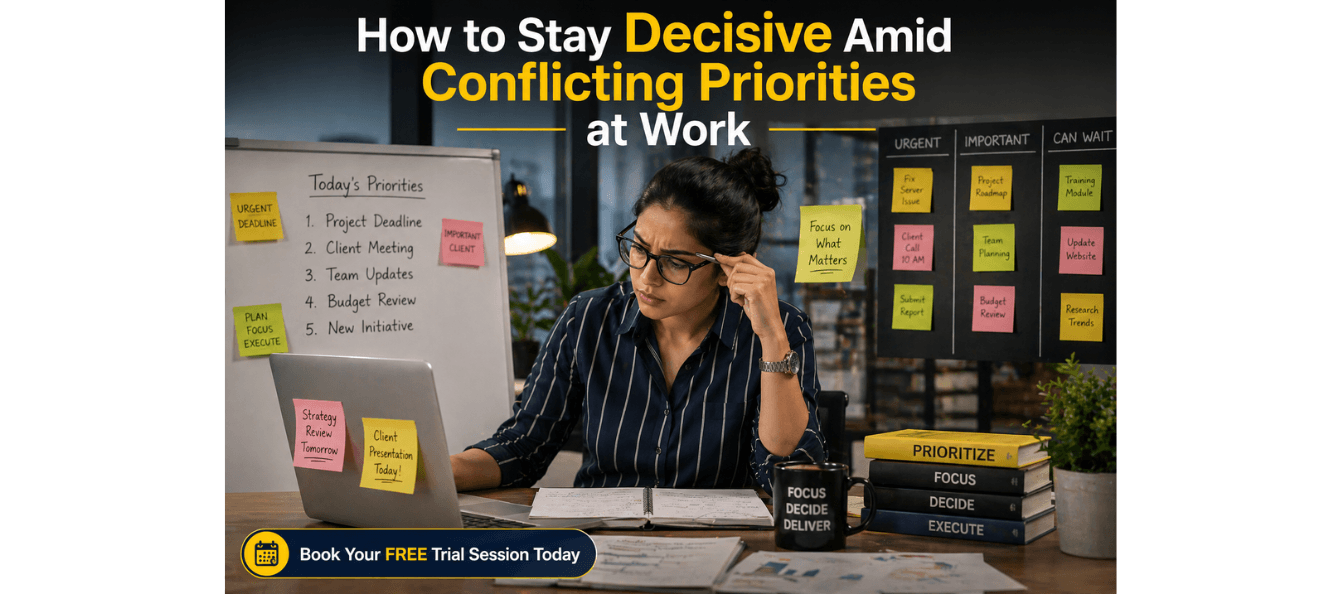
In today’s fast-paced, deadline-driven world, professionals are often expected to juggle multiple competing priorities at once. You may have a packed inbox, multiple meetings to attend, urgent deliverables to submit, and client demands piling up—each feeling just as important as the other. This is the all-too-common scenario of conflicting priorities, and it can easily lead to decision paralysis and burnout.
Being decisive when priorities clash is not just a skill; it’s a career-defining ability. The professionals who succeed aren’t those who avoid conflicting priorities—they are the ones who can cut through the noise, make confident decisions, and move forward without hesitation. If you’re tired of feeling overwhelmed by the weight of multiple priorities, this guide is for you.
Download these resources and apply them alongside your daily work for improved clarity, productivity, and professional growth. You can also book a free trial to gain expert guidance and refine your decision-making under pressure. The materials are designed in a clear, structured format to help professionals learn efficiently and implement insights with confidence.
Who Is This Blog For?
This blog is for professionals who want to make better, faster decisions when faced with conflicting priorities. It is particularly useful for:
- Managers and team leaders who balance multiple demands on their time
- Consultants handling multiple clients with varying needs
- Career changers looking to quickly adapt to a new professional environment
- Early-career professionals learning how to prioritize and make decisions effectively
Why This Topic Matters Today?
The ability to stay decisive under pressure is crucial for success in modern professional environments. When everything feels equally urgent, the ability to prioritize effectively and take action decisively sets successful professionals apart from those who struggle with indecision.
Conflicting priorities can cause stress and burnout, particularly when there’s no clear framework for decision-making. Professionals often fall into the trap of overcommitting, reacting impulsively to the loudest requests, or spending too much time on less impactful tasks. To cut through the noise, you need a reliable system for evaluating and prioritizing your tasks, ensuring that you’re always focused on what matters most.
Core Concept or Framework Explained
The CLEAR Framework is a five-step decision-making model designed to help professionals stay decisive, even when priorities compete. Each letter of the CLEAR framework represents a cognitive action that you can follow in a simple, repeatable sequence to make confident decisions quickly.
1. Clarify: Identify the true stakes of the task or decision at hand.
2. Layer: Sort tasks by their potential impact, not urgency or emotional pull.
3. Eliminate: Cut through false urgency by identifying what really needs your attention.
4. Act: Focus on one task at a time and take action before distractions creep in.
5. Review: Reassess your decisions after a short period to ensure you’re on track.
By following these five steps, you’ll be able to sort through competing demands, make intentional decisions, and avoid wasting time on reactive or low-impact work.
How This Blog and Guidebook Help You?
This guidebook provides a structured approach to handling conflicting priorities and staying decisive when pressure mounts. The benefits include:
- Faster, More Confident Decisions: The CLEAR Framework gives you a reliable mental model for sorting through competing tasks quickly.
- Improved Focus: By understanding the difference between urgency and importance, you can make better decisions and stay on track.
- Reduced Stress: With a clear decision-making process, you can avoid the stress of indecision and unnecessary multitasking.
- Increased Productivity: By focusing on tasks that actually matter, you can achieve better results without burning out.
This resource will help you develop the mental tools needed to handle high-pressure situations and prioritize effectively, without the stress that often comes with them.
Step-by-Step Breakdown
Step 1: Clarify the Stakes — Understand the Real Consequences
Before you begin sorting through priorities, clarify what actually happens if a task is delayed or overlooked. Ask yourself:
- What are the actual consequences if this doesn’t get done?
- Who will be impacted, and to what extent?
- Is there a financial, reputational, or relationship risk?
By clarifying the stakes, you can separate real urgency from perceived urgency. You’ll stop reacting to emotional cues and start focusing on what truly matters.
Step 2: Layer by Impact — Sort by Consequences, Not Urgency
Once the stakes are clear, it’s time to layer tasks based on their impact rather than urgency. This step helps you prioritize what will move the needle the most. Here’s how:
- High Impact + Urgent: Tasks that need immediate attention (e.g., client deliverables, compliance deadlines).
- High Impact + Low Urgency: Important tasks that can be scheduled (e.g., strategic planning, relationship-building).
- Low Impact + High Urgency: Tasks that are urgent but have minimal long-term impact (e.g., minor requests, administrative work).
- Low Impact + Low Urgency: Tasks that can be delegated or deferred (e.g., optional reports, non-critical meetings).
This step shifts your focus from “what needs to be done now” to “what will create the most value.” It’s about aligning your actions with real outcomes, not just responding to what’s loudest.
Step 3: Eliminate the False Urgency — Identify What’s Manufactured
In many organizations, the word “urgent” has lost its meaning. Urgency is often used as a tactic to get attention, but it doesn’t always reflect what truly needs immediate action. To eliminate false urgency:
- Look for signs that urgency is being artificially inflated—like vague deadlines or repeated “urgent” requests.
- Ask: “What specifically happens if this slips by 24 hours?”
- When in doubt, defer decisions that are based on false urgency until you can assess their true impact.
By filtering out false urgency, you’ll have more time and mental energy for what truly matters.
Step 4: Act on One Thing First — The Power of Sequential Focus
Decisiveness is not about doing everything at once—it’s about focusing your attention on one priority at a time. Here’s how:
- Commit to tackling the highest-impact task first, even if other tasks are also urgent.
- Block a specific time window for this task, ensuring you have the focus and energy to complete it without distractions.
- Communicate your decision to stakeholders to set expectations and prevent unnecessary follow-ups.
Focusing on one priority at a time allows you to move quickly and decisively without getting bogged down by the noise.
Step 5: Review — Decisiveness Is a Habit, Not a One-Time Act
After taking action, review your decisions within 24-48 hours. This helps you refine your judgment and ensure you’re on the right track. Use these questions to guide your review:
- Did the priority I chose remain the right one in hindsight?
- What recurring patterns can I identify in my decision-making process?
- Are there any stakeholder dynamics that I need to address for smoother collaboration?
The goal is to continuously improve your decision-making habits and develop a process that works consistently.
Common Mistakes or Pitfalls to Avoid
- Treating All Deadlines as Equal: Not every deadline has the same level of consequence. Perform a quick stakes check before diving into tasks.
- Prioritizing by Seniority: Just because someone is senior doesn’t mean their request should be your top priority. Focus on impact, not hierarchy.
- Choosing the Easiest Task: Resist the urge to complete small, easy tasks first. Tackle the most impactful tasks to create real progress.
- Failing to Communicate Priority Shifts: Always communicate when you change priorities to prevent confusion or resentment from stakeholders.
How Should You Use This Guidebook Effectively?
To make the most of this guide:
- Start with the CLEAR Framework: Apply it to every significant competing priority.
- Use the Reflection Worksheets: Regularly assess how well you’re prioritizing and adjust accordingly.
- Commit to Regular Reviews: Incorporate weekly reviews into your decision-making process to continuously refine your approach.
Key Takeaways
- Conflicting priorities are structural, not personal. They arise from misalignment, inflated urgency, and the lack of a personal decision system.
- Use the CLEAR Framework to clarify, layer, eliminate, act, and review decisions quickly and confidently.
- Recognize false urgency and separate it from real priority conflicts to focus on what truly matters.
- Act on one priority at a time to ensure focused, intentional progress.
- Build decisiveness into your daily habits through reflection and continuous improvement.
Your Next Step: Accelerate Your Career with PlanetSpark
Creating an impact-driven resume is not just about landing your next job—it’s about owning your professional story and presenting it with clarity, confidence, and credibility. When your resume clearly communicates value, results, and impact, opportunities follow naturally.
At PlanetSpark, we are committed to empowering working professionals with practical, outcome-focused resources that drive real career growth. From resume building and workplace communication to leadership presence and professional writing, our programs are designed to help you succeed in today’s fast-evolving job market.
Visit https://www.planetspark.in/resources to explore:
- Career and resume-building guides
- Workplace communication and professional writing resources
- Skill-development tools curated for working professionals
Want a deeper, hands-on experience?
You can also book a free trial session to learn more about PlanetSpark’s Working Professional Courses, designed to accelerate your career through personalised coaching, real-world practice, and expert guidance.
Your career deserves more than generic advice.
It deserves clarity, confidence, and measurable impact.
Start building that advantage today—with PlanetSpark.
Personalized Communication Roadmaps
Record a video to get a AI generated personalized communication reports