
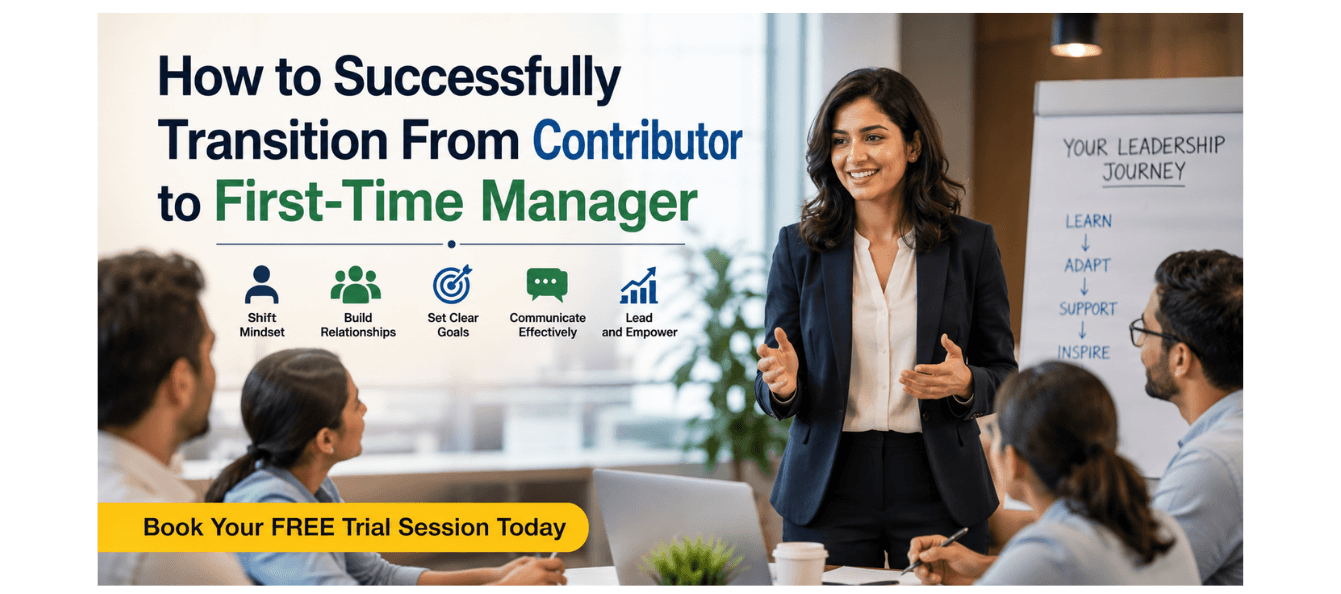
How to Successfully Transition From Contributor to First-Time Manager


First-Time Manager Success Guide: How to Transition from Individual Contributor to Leader
Stepping into a managerial role for the first time is often seen as a well-deserved promotion—but it quickly becomes clear that it’s not just a step up, it’s a completely different job. The skills that helped you succeed as an individual contributor—execution, speed, and technical expertise—are no longer enough to define your success.
Suddenly, you’re expected to lead people, make decisions with incomplete information, manage expectations from both your team and senior leadership, and deliver results through others. This shift can feel overwhelming, especially when there is little formal training or guidance provided.
Many first-time managers struggle in silence. They continue doing the work themselves because it feels faster. They hesitate to delegate because they fear losing control. They avoid difficult conversations because they don’t want to damage relationships. Over time, this leads to burnout, reduced team performance, and frustration on all sides.
What makes this transition even more challenging is that the expectations are often unspoken. You are assumed to “figure it out” as you go. But without a clear framework, most professionals end up reacting to situations instead of leading with intention and clarity.
This is exactly why a structured, practical guide is essential. The resource “How to Transition From Individual Contributor to First-Time Manager” is designed to help you navigate this shift with confidence. It provides a clear roadmap, actionable frameworks, and real-world tools to help you build strong leadership foundations from day one.
Instead of relying on trial and error, you gain a step-by-step approach to understanding your new role, managing people effectively, and driving consistent team performance. Whether you are preparing for your first managerial role or already in it, this guide helps you move from uncertainty to control.
Download these resources and apply them alongside your daily work for improved clarity, productivity, and professional growth. You can also book a free trial to gain expert guidance and enhance your communication, problem-solving, and decision-making skills. The materials are designed in a clear, structured format to help professionals learn efficiently and implement insights with confidence.
Who Is This Blog For?
- Professionals with 0–15 years of experience stepping into their first managerial role
- High-performing individual contributors preparing for leadership positions
- Newly promoted managers feeling overwhelmed or unsure of expectations
- Team leads responsible for managing people for the first time
- Professionals looking to build strong leadership and management skills early
Why This Topic Matters Today?
In today’s fast-moving work environment, managers are expected to do more than just oversee tasks—they are responsible for driving team performance, engagement, and long-term growth. However, most organisations still promote top performers into managerial roles without equipping them with the necessary leadership skills.
This creates a critical gap.
New managers often continue to operate like individual contributors. They focus on doing rather than enabling. They struggle with delegation, hesitate to give feedback, and lack structured systems for managing their teams.
The result is predictable:
- Overworked managers
- Underdeveloped teams
- Misaligned goals
- Reduced productivity
The transition to management is not just about learning new skills—it requires a fundamental shift in mindset. Without this shift, even the most capable professionals can struggle to succeed.
Core Concept or Framework Explained
At the heart of this guide is a simple but powerful idea: your role as a manager is to multiply impact, not just deliver it yourself.
As an individual contributor:
- Success is measured by your personal output
- You are responsible for completing tasks efficiently
- Your focus is on execution and problem-solving
As a manager:
- Success is measured by your team’s performance
- You are responsible for enabling others to succeed
- Your focus shifts to direction, support, and development
To help you navigate this transition, the guide introduces a structured 5-phase roadmap:
- Accept the Shift
- Listen First
- Build Systems
- Develop People
- Lead Strategically
Each phase represents a critical stage in your first six months and provides clear direction on what to prioritise.
How This Blog and Guidebook Help You?
This blog and the accompanying guidebook give you a practical, no-nonsense approach to becoming an effective manager.
You will gain:
- Clarity on what your new role actually requires
- A structured plan for your first 30, 60, and 90 days
- Tools to manage people, performance, and expectations effectively
- Frameworks to build trust and improve communication
- Confidence in handling real-world leadership challenges
Instead of guessing your way through management, you can apply proven methods that accelerate your effectiveness.
Step-by-Step Breakdown
Accept the Shift
The first step is internal. You must redefine how you see your role.
Your value is no longer based on how much work you do, but on how effectively your team performs.
Many new managers fall into the trap of continuing to do individual contributor work. This may feel productive in the short term, but it limits team growth and creates long-term dependency.
The Identity Audit in the guide helps you reflect on what behaviours you need to let go of and what you need to adopt.
Listen First
In the early stages, your priority is to understand—not to act immediately.
Use structured one-on-one conversations to:
- Learn what your team members are working on
- Identify what is going well
- Understand challenges and concerns
- Build trust and rapport
Listening creates the foundation for better decisions and stronger relationships.
Build Systems
Once you understand your team, the next step is to create structure.
Effective managers rely on systems, not just effort.
Key systems include:
- Regular team meetings with clear agendas
- Defined goals and performance expectations
- Consistent feedback mechanisms
- Clear decision-making processes
These systems reduce confusion and improve accountability.
Develop People
Your long-term success depends on your team’s growth.
The guide introduces the GROW coaching model:
- Goal: What does the team member want to achieve?
- Reality: What is their current situation?
- Options: What are the possible paths forward?
- Will: What actions will they take?
This framework helps you guide rather than instruct, building ownership and capability within your team.
Lead Strategically
As you grow in your role, your focus shifts beyond daily tasks.
You begin to:
- Align team efforts with organisational goals
- Advocate for your team
- Build a strong team culture
- Make decisions with long-term impact in mind
This is where you move from managing to leading.
Common Mistakes or Pitfalls to Avoid
Many first-time managers struggle because of avoidable mistakes:
- Trying to do everything themselves instead of delegating
- Avoiding difficult conversations
- Managing all team members the same way
- Focusing on being liked rather than respected
- Failing to communicate clearly with stakeholders
- Neglecting their own development as a manager
A better approach is to be intentional, structured, and consistent in how you lead.
How Should You Use This Guidebook Effectively?
To get the most value from this guide:
- Read the entire guide once to understand the full roadmap
- Complete reflection exercises to build self-awareness
- Apply one phase at a time based on your current stage
- Implement systems gradually
- Revisit the guide regularly to refine your approach
Time investment:
- 2–3 hours for initial understanding
- Ongoing application in daily work
- Monthly reflection and improvement
This is not a one-time read—it is a working tool for your leadership journey.
Key Takeaways
- The transition to management is an identity shift
- Success depends on team performance, not personal output
- Listening builds trust and clarity early on
- Systems create consistency and reduce chaos
- Coaching is essential for developing team members
- Avoiding difficult conversations creates bigger issues later
- Strategic thinking is key to long-term success
Your Next Step: Accelerate Your Career with PlanetSpark
Creating an impact-driven resume is not just about landing your next job—it’s about owning your professional story and presenting it with clarity, confidence, and credibility. When your resume clearly communicates value, results, and impact, opportunities follow naturally.
At PlanetSpark, we are committed to empowering working professionals with practical, outcome-focused resources that drive real career growth. From resume building and workplace communication to leadership presence and professional writing, our programs are designed to help you succeed in today’s fast-evolving job market.
Visit https://www.planetspark.in/resources to explore:
- Career and resume-building guides
- Workplace communication and professional writing resources
- Skill-development tools curated for working professionals
Want a deeper, hands-on experience?
You can also book a free trial session to learn more about PlanetSpark’s Working Professional Courses, designed to accelerate your career through personalised coaching, real-world practice, and expert guidance.
Your career deserves more than generic advice.
It deserves clarity, confidence, and measurable impact.
Start building that advantage today—with PlanetSpark.
Personalized Communication Roadmaps
Record a video to get a AI generated personalized communication reports