
How to Track Career Transition Experiments and Measure Their Outcomes

How to Track Career Experiments and Measure Progress for Smarter Career Decisions
Making a successful career transition is not about taking one big leap—it is about running small, intentional experiments and learning from them. Many professionals explore new career paths, take courses, or try side projects, but fail to track what actually works. As a result, they repeat mistakes, lose direction, and struggle to make informed decisions.
Without a structured way to track your efforts, career exploration becomes scattered and ineffective. You may feel busy, but not necessarily productive. Over time, this leads to confusion, lack of clarity, and delayed progress.
The key to overcoming this challenge is simple: treat your career transition like a series of experiments—and track them systematically. When you document your actions, evaluate outcomes, and learn from patterns, you transform random efforts into a strategic, data-driven process.
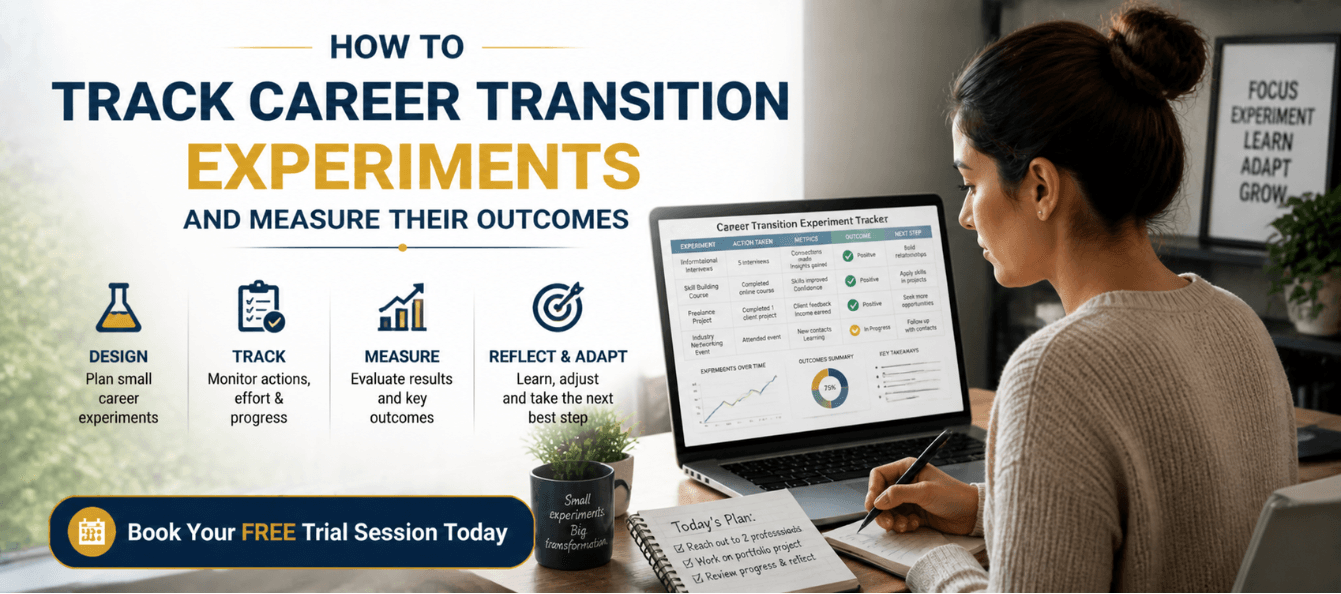
Download these resources and apply them alongside your daily work for improved clarity, productivity, and professional growth. You can also book a free trial to gain expert guidance and enhance your communication, problem-solving, and decision-making skills. The materials are designed in a clear, structured format to help professionals learn efficiently and implement insights with confidence.
Who Is This Blog For?
- Professionals exploring new career paths through projects or experiments
- Individuals struggling to measure progress during career transitions
- Mid-career professionals seeking structured learning and growth tracking
- Job seekers who want to improve decision-making through data and insights
- Anyone looking to turn trial-and-error into a systematic process
Why This Topic Matters Today?
In today’s dynamic job market, career transitions are rarely linear. Professionals are encouraged to experiment—through freelancing, side projects, and self-initiated work—to discover what fits best.
However, experimentation without tracking creates several problems:
- Lack of clarity on what is working and what is not
- Repetition of ineffective strategies
- Difficulty in demonstrating progress to employers
- Increased frustration due to unclear outcomes
Many professionals invest time and effort but fail to extract meaningful insights because they do not document or evaluate their experiences.
Tracking career experiments ensures that every effort contributes to learning, clarity, and better decision-making.
Core Concept or Framework Explained
Tracking career experiments involves systematically documenting, analysing, and learning from your transition-related activities over time.
This framework is built on three core elements:
Experiment Design
Each activity—whether a project, course, or freelance task—is treated as an experiment with a clear objective. For example: “Test my interest and ability in content strategy.”
Outcome Measurement
You evaluate both qualitative and quantitative outcomes, such as:
- Level of interest and engagement
- Performance and results achieved
- Feedback received from others
- Skills developed
Pattern Recognition
Over time, you identify trends across multiple experiments. This helps you understand:
- Which career paths align with your strengths
- What types of work energise or drain you
- Where you consistently perform well
This structured approach transforms exploration into actionable insight.
How This Blog and Guidebook Help You?
This guide helps you move from unstructured trial-and-error to strategic career experimentation.
By applying this framework, you will:
- Gain clarity from your experiences instead of feeling confused
- Identify patterns that guide better career decisions
- Improve your ability to evaluate opportunities objectively
- Build a record of work that supports your transition
- Make faster and more confident career choices
The goal is to ensure that every experiment contributes to your long-term direction.
Step-by-Step Breakdown
Step 1: Define Each Experiment Clearly
Before starting any activity, define it as an experiment.
Ask:
- What am I testing?
- What skills or interests am I exploring?
- What outcome do I expect?
For example, instead of casually taking a course, define it as: “Testing my ability to apply data analysis in business scenarios.”
Step 2: Set Clear Evaluation Criteria
Decide how you will measure success.
Common criteria include:
- Interest level
- Performance quality
- Ease of learning
- Feedback from others
- Practical applicability
Clear criteria ensure consistent evaluation across experiments.
Step 3: Document Actions and Inputs
Track what you actually do during the experiment.
This includes:
- Tasks completed
- Tools or frameworks used
- Time invested
- Challenges faced
Detailed documentation creates a reliable record for reflection.
Step 4: Capture Outcomes and Results
At the end of each experiment, record outcomes.
For example:
- What did you achieve?
- What worked well?
- What did not work?
- What feedback did you receive?
This step ensures that learning is captured, not lost.
Step 5: Reflect on Learnings
Go beyond surface-level observations.
Ask:
- Did I enjoy this work?
- Was I effective in performing it?
- What surprised me?
- Would I want to pursue this further?
Reflection converts experience into insight.
Step 6: Identify Patterns Over Time
After multiple experiments, review your data.
Look for patterns such as:
- Consistent strengths
- Recurring challenges
- Preferred types of work
- Areas of improvement
Patterns provide direction and clarity.
Step 7: Adjust Your Strategy
Use insights to refine your approach.
This may involve:
- Focusing on high-alignment career paths
- Improving specific skill gaps
- Eliminating less suitable options
Continuous adjustment ensures progress.
Step 8: Build a Transition Record
Your tracked experiments become valuable assets.
They can be used to:
- Create a portfolio
- Support job applications
- Demonstrate practical experience
- Communicate your career journey effectively
This adds credibility to your transition.
Common Mistakes or Pitfalls to Avoid
- Treating experiments casually without clear objectives
- Failing to document actions and outcomes
- Relying only on memory instead of written records
- Ignoring patterns and repeating mistakes
- Overtracking without taking meaningful action
- Not using insights to adjust future decisions
Avoiding these mistakes ensures that tracking remains useful and actionable.
How Should You Use This Guidebook Effectively?
To maximise results:
- Maintain a simple tracking system such as a spreadsheet or journal
- Update your records immediately after each experiment
- Review your progress weekly or bi-weekly
- Focus on quality insights rather than excessive detail
- Use your findings to guide next steps
A practical workflow could be:
- Week 1: Define and start an experiment
- Week 2: Document actions and challenges
- Week 3: Record outcomes and reflect
- Week 4: Review patterns and adjust strategy
Consistency in tracking leads to clarity over time.
Key Takeaways
- Career transitions should be treated as a series of experiments
- Tracking ensures that every effort contributes to learning
- Clear criteria improve evaluation and decision-making
- Reflection and pattern recognition drive clarity
- Documented experiments build credibility and evidence
- Continuous improvement leads to better career outcomes
Your Next Step: Accelerate Your Career with PlanetSpark
Creating an impact-driven resume is not just about landing your next job—it’s about owning your professional story and presenting it with clarity, confidence, and credibility. When your resume clearly communicates value, results, and impact, opportunities follow naturally.
At PlanetSpark, we are committed to empowering working professionals with practical, outcome-focused resources that drive real career growth. From resume building and workplace communication to leadership presence and professional writing, our programs are designed to help you succeed in today’s fast-evolving job market.
Visit https://www.planetspark.in/resources to explore:
- Career and resume-building guides
- Workplace communication and professional writing resources
- Skill-development tools curated for working professionals
Want a deeper, hands-on experience?
You can also book a free trial session to learn more about PlanetSpark’s Working Professional Courses, designed to accelerate your career through personalised coaching, real-world practice, and expert guidance.
Your career deserves more than generic advice.
It deserves clarity, confidence, and measurable impact.
Start building that advantage today—with PlanetSpark.
Personalized Communication Roadmaps
Record a video to get a AI generated personalized communication reports