
How to Track Remote Work Feedback for Better Performance

10 Follow-Up Email Templates That Instantly Improve Remote Feedback, Communication, and Career Growth
In today’s remote-first work environment, communication gaps are no longer small inconveniences—they are career blockers. You may be doing excellent work, contributing to projects, and meeting deadlines, but without structured feedback and consistent follow-ups, your efforts can go unnoticed or misunderstood.
Remote work removes the natural flow of in-person communication. There are no hallway conversations, quick clarifications, or spontaneous feedback moments. As a result, many professionals struggle with unclear expectations, delayed responses, and missed opportunities for growth.
The real difference between professionals who grow quickly and those who stagnate lies in how effectively they communicate, follow up, and close feedback loops. Without a system, feedback becomes inconsistent, vague, or forgotten. With the right templates and frameworks, however, every interaction becomes purposeful, trackable, and impactful.
This is exactly where structured follow-up systems and feedback templates make a difference. Instead of reacting randomly, you can rely on proven communication models that help you deliver, receive, and act on feedback with clarity and confidence.
Download these resources and apply them alongside your daily work for improved clarity, productivity, and professional growth. You can also book a free trial to gain expert guidance and enhance your communication, problem-solving, and decision-making skills. The materials are designed in a clear, structured format to help professionals learn efficiently and implement insights with confidence.
Who Is This Blog For?
- Remote working professionals navigating distributed teams
- Managers and team leads responsible for performance feedback
- Freelancers and consultants handling multiple client relationships
- Early-career professionals adapting to remote work environments
- Professionals aiming to improve communication and accountability
Why This Topic Matters Today?
Remote work has fundamentally changed how feedback is given, received, and acted upon. Unlike traditional office environments, where feedback happens organically, remote settings require intentional communication.
Many professionals face challenges such as:
- Feedback that is delayed or never delivered
- Vague comments that lack actionable direction
- No system to track feedback or measure improvement
- Difficulty addressing sensitive topics over digital channels
- Lack of follow-through after feedback conversations
In this environment, professionals who build structured follow-up habits stand out significantly. They are perceived as proactive, reliable, and growth-oriented—qualities that directly impact career progression.
Core Concept or Framework Explained
The guide introduces a complete system for managing feedback effectively in remote environments. This system is built on three core pillars: preparation, structured delivery, and consistent follow-through.
Structured Communication Frameworks
Two key frameworks ensure clarity and effectiveness:
- SBI Framework
Situation: Define when and where the issue occurred
Behaviour: Describe the observable action
Impact: Explain the outcome of that behaviour
- COIN Framework
Context: Set the stage
Observation: Describe what happened
Impact: Share the consequences
Next Step: Define a clear action
These frameworks eliminate ambiguity and ensure feedback remains factual and constructive.
Preparation Before Feedback
Effective feedback begins before the conversation:
- Identify the exact behaviour observed
- Understand the impact on team or outcomes
- Define the desired change or result
- Choose the right communication channel
Without preparation, feedback often becomes reactive and ineffective.
Follow-Up and Feedback Loop System
The most critical part of feedback is what happens after the conversation:
- Day 1: Send a written summary
- Day 3–5: Conduct an informal check-in
- Week 2: Observe behaviour changes
- Week 4: Close the loop with a formal discussion
This system ensures accountability and continuous improvement.
Receiving Feedback with the HEAR Model
To handle feedback effectively:
- Hold space before reacting
- Enquire with curiosity
- Acknowledge what is valid
- Respond with a clear action
This transforms feedback into growth rather than resistance.
How This Blog and Guidebook Help You?
This blog and resource provide a practical system that helps you:
- Deliver feedback confidently using structured frameworks
- Avoid miscommunication in remote environments
- Track progress and ensure accountability
- Build a reputation as a reliable and proactive professional
- Improve both giving and receiving feedback skills
By applying these principles, you create a consistent communication system that drives measurable career growth.
Step-by-Step Breakdown
Step 1: Prepare Before Giving Feedback
Preparation determines the success of any feedback conversation.
Key actions:
- Document specific behaviours with examples
- Identify when and where the situation occurred
- Clarify the impact on outcomes or team dynamics
- Decide the desired result of the conversation
This ensures your feedback is clear, objective, and actionable.
Step 2: Choose the Right Communication Channel
The medium you choose directly affects how feedback is received.
Best practices:
- Use asynchronous communication for positive feedback
- Use video calls for critical or developmental feedback
- Ensure both parties are focused and distraction-free
Choosing the wrong channel can damage trust and reduce clarity.
Step 3: Use a Structured Feedback Framework
Avoid improvisation and rely on proven structures.
Example using SBI:
- Situation: During a client meeting
- Behaviour: You interrupted multiple times
- Impact: The client disengaged from the discussion
Structured frameworks keep feedback professional and focused.
Step 4: Deliver Feedback Effectively
During the conversation:
- Keep the session focused (20–30 minutes)
- Maintain a calm and neutral tone
- Allow pauses for reflection
- Invite the other person to respond
Silence can be powerful—it gives space for understanding.
Step 5: Send a Written Follow-Up
After the conversation:
- Summarise key points discussed
- Highlight agreed actions
- Reinforce clarity and expectations
This step converts conversation into commitment.
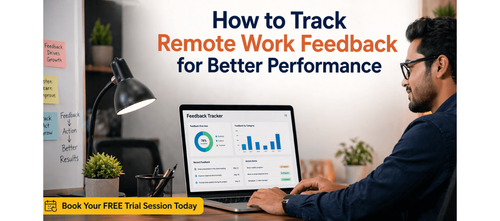
Step 6: Track Feedback Using a System
Use a feedback tracker to log:
- Date and context
- Person involved
- Summary of feedback
- Agreed action
- Current status
Tracking ensures nothing is forgotten and progress is visible.
Step 7: Follow a Consistent Follow-Up Cadence
Maintain momentum through structured follow-ups:
- Day 3–5: Informal check-in
- Week 2: Observe progress
- Week 4: Close the loop
Consistency builds accountability and trust.
Step 8: Learn to Receive Feedback Effectively
When receiving feedback:
- Pause before responding
- Ask clarifying questions
- Accept valid points
- Commit to a specific action
This mindset accelerates professional growth.
Step 9: Use Checklists for Consistency
Before, during, and after feedback:
- Confirm you have clear observations
- Use a structured framework
- Agree on next steps
- Follow up consistently
Checklists reduce errors and improve quality.
Step 10: Apply in Real-World Scenarios
A structured approach can transform outcomes.
Example:
- A manager identified performance issues
- Used preparation and COIN framework
- Agreed on a clear improvement plan
- Followed up consistently
Result: Improved performance, better communication, and stronger accountability.
Common Mistakes or Pitfalls to Avoid
Many professionals struggle due to avoidable mistakes:
- Giving feedback without preparation
- Using vague statements without examples
- Choosing the wrong communication channel
- Avoiding follow-ups after conversations
- Reacting defensively to feedback
Better alternatives include:
- Being specific and factual
- Using structured frameworks
- Scheduling feedback intentionally
- Tracking progress consistently
- Responding with curiosity and openness
How Should You Use This Guidebook Effectively?
To maximise results, follow a simple workflow:
- Identify the feedback scenario
- Use the preparation worksheet
- Apply SBI or COIN framework
- Conduct the conversation
- Send a written summary
- Log the interaction in a tracker
- Follow up based on the defined timeline
Time investment:
- 5–10 minutes for preparation
- 20–30 minutes for conversation
- 3 minutes for tracking
Consistency over time leads to significant improvement.
Key Takeaways
- Feedback is a continuous system, not a one-time activity
- Preparation is essential for meaningful conversations
- Structured frameworks improve clarity and effectiveness
- Choosing the right communication channel is critical
- Follow-ups ensure accountability and real progress
- Tracking feedback builds long-term professional growth
- Receiving feedback with openness accelerates learning
Your Next Step: Accelerate Your Career with PlanetSpark
Creating an impact-driven resume is not just about landing your next job—it’s about owning your professional story and presenting it with clarity, confidence, and credibility. When your resume clearly communicates value, results, and impact, opportunities follow naturally.
At PlanetSpark, we are committed to empowering working professionals with practical, outcome-focused resources that drive real career growth. From resume building and workplace communication to leadership presence and professional writing, our programs are designed to help you succeed in today’s fast-evolving job market.
Visit https://www.planetspark.in/resources to explore:
- Career and resume-building guides
- Workplace communication and professional writing resources
- Skill-development tools curated for working professionals
Want a deeper, hands-on experience?
You can also book a free trial session to learn more about PlanetSpark’s Working Professional Courses, designed to accelerate your career through personalised coaching, real-world practice, and expert guidance.
Your career deserves more than generic advice.
It deserves clarity, confidence, and measurable impact.
Start building that advantage today—with PlanetSpark.
Personalized Communication Roadmaps
Record a video to get a AI generated personalized communication reports