
How to Track Team Metrics That Drive Performance in 2026
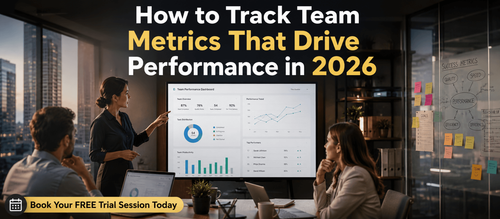

How to Track Team Performance Metrics That Actually Improve Results
Many managers track performance constantly but still struggle to understand whether their teams are genuinely improving. Dashboards fill with activity numbers, spreadsheets grow more complicated every quarter, and performance reviews become stressful conversations based on incomplete information.
The problem is not a lack of data. The problem is measuring the wrong things.
Many organisations focus heavily on visible activity metrics such as hours worked, tasks completed, or meetings attended while overlooking the indicators that truly drive business outcomes, collaboration quality, and long-term team performance.
The guidebook on tracking team performance metrics provides a practical system for identifying, measuring, and reviewing metrics that actually matter. Instead of overwhelming teams with endless KPIs, the framework helps managers create focused performance systems that improve accountability, trust, clarity, and results.
Download these resources and apply them alongside your daily work for improved clarity, productivity, and professional growth. You can also book a free trial to gain expert guidance and enhance your communication, problem-solving, and decision-making skills. The materials are designed in a clear, structured format to help professionals learn efficiently and implement insights with confidence.
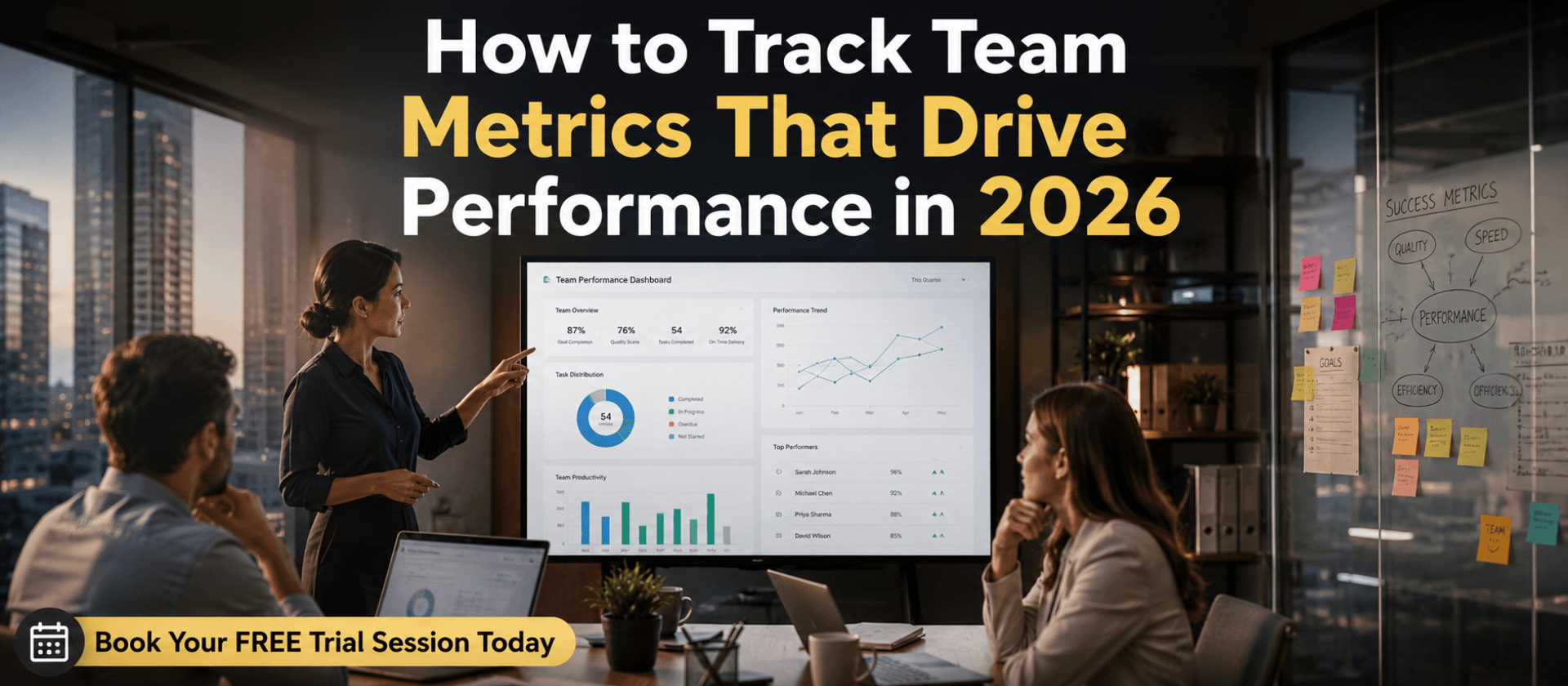
Who Is This Blog For?
- First-time managers building performance systems
- Team leads responsible for employee accountability
- Consultants advising organisational leaders
- Startup founders scaling operations
- HR professionals managing performance frameworks
- Operations and project managers
- Customer success and sales leaders
- Professionals struggling with unclear KPIs and team measurement
Why This Topic Matters Today?
Modern workplaces generate more data than ever before. However, more data does not automatically create better decisions.
The guidebook highlights a major performance management problem:
Most teams are measured, but very few teams feel measured fairly or meaningfully.
Managers often focus on activity metrics because they are easy to collect. However, activity alone rarely predicts long-term success.
This creates several workplace problems:
- Employees feel micromanaged
- Teams focus on quantity over impact
- Performance conversations become defensive
- Managers make decisions using incomplete signals
- Accountability systems lose credibility
Today’s organisations need performance systems that balance:
- Results
- Collaboration
- Growth
- Team contribution
- Business impact
Strong performance tracking improves:
- Decision-making
- Team alignment
- Accountability
- Employee trust
- Organisational clarity
- Leadership confidence
Core Concept or Framework Explained
The guidebook introduces a practical performance management framework built around focused measurement rather than excessive tracking.
The core philosophy is simple:
Track metrics that move the organisation forward, not just metrics that are easy to count.
The framework includes several major components.
The Four-M Filter
The guidebook explains that effective metrics must be:
- Meaningful
- Measurable
- Motivating
- Manageable
This filter helps leaders eliminate vanity metrics and focus on indicators that genuinely influence outcomes.
The Performance Metric Stack
The guidebook categorises metrics into three levels.
Impact Metrics
These measure organisational outcomes such as:
- Revenue
- Retention
- Customer satisfaction
- Net promoter scores
Output Metrics
These evaluate deliverables and execution quality such as:
- Project completion
- Delivery rates
- Client satisfaction
- Quality scores
Activity Metrics
These measure inputs such as:
- Calls made
- Hours logged
- Tasks completed
The framework emphasises that activity metrics matter least unless they translate into meaningful outcomes.
Leading and Lagging Indicators
The guidebook also distinguishes between:
Leading indicators
Metrics that predict future outcomes and allow course correction early.
Lagging indicators
Metrics that confirm results after outcomes are already determined.
Balanced tracking requires both.
How This Blog and Guidebook Help You?
This blog and guidebook help professionals build smarter, more focused performance systems.
By applying these frameworks, managers can:
- Choose better KPIs
- Reduce unnecessary reporting
- Improve accountability conversations
- Increase team transparency
- Align performance with business goals
- Improve employee trust
- Create clearer review systems
- Make stronger data-informed decisions
The guidebook is highly practical because it includes:
- Tracker templates
- Metric frameworks
- Conversation scripts
- Review structures
- Team measurement systems
Step-by-Step Breakdown
Step 1: Define What Success Actually Looks Like
Before tracking anything, managers must define success clearly.
The guidebook explains that many organisations inherit performance systems without evaluating whether they still support current goals.
Managers should ask:
- What outcomes matter most?
- What behaviours support those outcomes?
- Which metrics actually reflect progress?
The guidebook strongly warns against creating overloaded dashboards with too many KPIs.
Instead, professionals should prioritise a small number of high-value metrics.
Step 2: Apply the Four-M Filter
Every metric should pass the Four-M framework.
Meaningful
Does the metric connect directly to organisational success?
Measurable
Can the metric be tracked consistently with available data?
Motivating
Can employees see progress and influence outcomes?
Manageable
Is the number of tracked metrics realistic and sustainable?
The guidebook recommends removing metrics that fail multiple criteria.
This improves clarity and focus.
Step 3: Build a Balanced Performance Metric Stack
The framework explains that not all metrics carry equal strategic value.
Managers should build balanced tracking systems across:
- Impact metrics
- Output metrics
- Activity metrics
Examples include:
Impact metrics
- Retention rates
- Revenue growth
- Customer satisfaction
Output metrics
- Sprint delivery rate
- Project completion
- Product quality scores
Activity metrics
- One-on-one completion
- Training hours
- Client calls
The guidebook recommends prioritising impact and output metrics while using activity metrics as supporting indicators.
Step 4: Create a Shared Team Tracker
The guidebook provides a practical performance tracker structure that includes:
- Metric name
- Category
- Target
- Weekly performance
- Trend
- Ownership
- Notes and actions
The framework stresses that performance trackers should function as decision-making tools rather than passive reporting systems.
Managers are encouraged to review trackers weekly or fortnightly.
The guidebook also recommends limiting trackers to no more than eight metrics at one time.
Step 5: Balance Individual and Team Metrics
One of the guidebook’s most valuable insights is the difference between individual and team-level performance measurement.
Individual metrics may include:
- Task completion
- Quality of work
- Communication responsiveness
- Skill development
Team metrics may include:
- Collective delivery rate
- Team satisfaction scores
- Cross-functional outcomes
- Shared goal attainment
The guidebook recommends a 70/30 split:
- 70% team-level metrics
- 30% individual metrics
This encourages collaboration while still maintaining accountability.
Step 6: Conduct Better Performance Conversations
The guidebook explains that data becomes useful only when conversations around it are constructive.
A five-step conversation framework includes:
Anchor to the metric
Start with specific performance data.
Invite employee analysis
Ask for their perspective first.
Offer observations
Share objective insights and context.
Co-create solutions
Identify shared improvement actions.
Confirm and document
Summarise commitments clearly.
This approach transforms reviews from blame-focused discussions into collaborative growth conversations.
Common Mistakes or Pitfalls to Avoid
Tracking too many metrics
Overloaded dashboards create confusion rather than clarity.
Focusing only on activity
High activity does not guarantee meaningful results.
Ignoring team-level performance
Overemphasis on individual metrics weakens collaboration.
Using metrics without context
Numbers alone rarely tell the full story.
Holding infrequent review conversations
Performance systems require consistent discussion and adjustment.
Treating performance reviews as punishment
The guidebook encourages growth-focused dialogue rather than fear-based accountability.
Failing to involve teams in metric selection
Employees engage more when they help define success measures.
How Should You Use This Guidebook Effectively?
The guidebook works best when implemented gradually.
Week 1
- Define team success outcomes
- Audit current metrics
Week 2
- Apply the Four-M filter
- Remove weak or unnecessary KPIs
Week 3
- Build performance tracker
- Introduce weekly review rhythm
Week 4
- Begin structured performance conversations
- Evaluate trends and team feedback
The guidebook also encourages managers to:
- Review metrics quarterly
- Adjust KPIs as business priorities change
- Maintain qualitative notes alongside numbers
- Keep performance systems simple and actionable
Consistency is more valuable than complexity.
Key Takeaways
- Strong performance systems focus on meaningful outcomes
- Too many KPIs reduce clarity and engagement
- The Four-M filter improves metric quality
- Impact metrics matter more than activity metrics
- Balanced tracking includes both team and individual performance
- Leading indicators help managers course-correct early
- Performance conversations should build trust and accountability
- Shared trackers improve transparency and alignment
- Metrics require context to remain fair and useful
- Effective measurement systems support growth, not micromanagement
Your Next Step: Accelerate Your Career with PlanetSpark
Creating an impact-driven resume is not just about landing your next job—it’s about owning your professional story and presenting it with clarity, confidence, and credibility. When your resume clearly communicates value, results, and impact, opportunities follow naturally.
At PlanetSpark, we are committed to empowering working professionals with practical, outcome-focused resources that drive real career growth. From resume building and workplace communication to leadership presence and professional writing, our programs are designed to help you succeed in today’s fast-evolving job market.
Visit https://www.planetspark.in/resources to explore:
- Career and resume-building guides
- Workplace communication and professional writing resources
- Skill-development tools curated for working professionals
Want a deeper, hands-on experience?
You can also book a free trial session to learn more about PlanetSpark’s Working Professional Courses, designed to accelerate your career through personalised coaching, real-world practice, and expert guidance.
Your career deserves more than generic advice.
It deserves clarity, confidence, and measurable impact.
Personalized Communication Roadmaps
Record a video to get a AI generated personalized communication reports