
How to Transition From Job to Freelance: Part-Time Guide
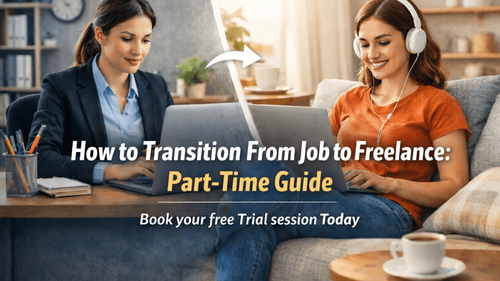

How to Transition from Job to Freelance Part Time A Practical Roadmap for Working Professionals
Every working professional reaches a point where they start asking a powerful question Can I earn independently using my skills The idea of freelancing feels exciting more control additional income and the possibility of building something of your own But almost immediately that excitement is followed by hesitation
These concerns are valid and they are exactly why most professionals never take the first step The problem is not lack of skill The real gap is lack of structure No one teaches you how to package your skills find your first client manage time alongside a full time job or build income without taking unnecessary risks
Most advice online assumes you are ready to quit your job But that is not practical for most professionals The smarter approach is to start part time build gradually and create income stability before making any major decisions
This guide provides a structured low risk roadmap to transition from employee to freelancer without disrupting your current career Instead of taking a leap you follow a system that helps you build clarity confidence and income step by step
Download these resources and apply them alongside your daily work for improved clarity productivity and professional growth You can also book a free trial to gain expert guidance and enhance your communication problem solving and decision making skills The materials are designed in a clear structured format to help professionals learn efficiently and implement insights with confidence
Who Is This Blog For
Working professionals exploring freelancing opportunities
Individuals who want to earn extra income without quitting their job
Employees unsure how to get their first freelance client
Professionals seeking a structured transition plan
Anyone who wants to reduce risk while building independent income
Why This Topic Matters Today
In today’s evolving work environment freelancing is becoming a mainstream opportunity across industries According to the framework
- Professionals struggle not because of lack of opportunity but lack of execution
- Many do not know where to start
- Overthinking delays action
- Lack of structure creates confusion
At the same time
- Demand for specialised skills is increasing
- Companies prefer flexible project based hiring
- Professionals want more financial control
The cost of not taking structured action includes
- Missing opportunities for additional income
- Staying dependent on a single income source
- Delaying career flexibility and independence
- Losing momentum due to indecision
In contrast a structured transition approach
- Reduces risk while exploring freelancing
- Builds clarity and confidence step by step
- Enables consistent progress alongside your job
- Creates a stable foundation before scaling
Core Concept or Framework Explained
The transition from job to freelance is not a sudden leap it is a structured shift According to the framework
- Freelancing requires a change in mindset not just skill
- Each stage builds on the previous one
- Consistency matters more than speed
The roadmap follows six phases
- Mindset shift from employee to service provider
- Identifying your skill and market
- Setting up tools and systems
- Client outreach and acquisition
- Delivering and managing work
- Scaling your freelance income
This system ensures that your transition is
- Controlled and low risk
- Structured and actionable
- Focused on steady progress
Instead of guessing you follow a clear roadmap
How This Blog and Guidebook Help You
This framework gives you a practical execution path
You will be able to
Start freelancing without quitting your job
Build a clear and marketable service
Get your first clients with confidence
Manage time effectively
Scale your freelance work gradually
You move from hesitation to structured action
Step by Step Breakdown
Step 1 Shift Your Mindset from Employee to Freelancer
The biggest change is internal Employees are assigned work but freelancers create opportunities You must start thinking like a service provider responsible for finding clients defining value and delivering results
This mindset shift is the foundation for all future steps and determines how you approach freelancing
Step 2 Identify Your Freelance Skill and Market
Start by identifying skills you already use professionally and the problems you can solve Focus on areas where you have proven results and confidence
This clarity makes it easier to position yourself and identify the right clients
Step 3 Define a Clear Service Offer
Avoid vague descriptions and define your service in terms of outcome Include target audience problem and result
A clear offer makes your service easier to understand and increases your chances of getting clients
Step 4 Set Up Basic Tools and Systems
You do not need complex systems Start with a simple portfolio a strong LinkedIn profile and basic communication tools
This ensures that you are ready to engage with clients without unnecessary complexity
Step 5 Start Client Outreach
Begin with your existing network and expand through platforms like LinkedIn Focus on conversations rather than direct selling
Consistent outreach helps you build relationships and generate opportunities
Step 6 Deliver High Quality Work
Your first clients are critical Focus on delivering strong results communicating clearly and meeting expectations
This builds trust and leads to repeat clients referrals and testimonials
Step 7 Build a Weekly Workflow
Balance is essential Create a structured schedule with dedicated time for outreach delivery and communication
Consistency ensures steady progress without burnout
Step 8 Scale Gradually
Once you gain traction improve pricing focus on better clients and refine your processes
Growth should be intentional and sustainable rather than rushed
Common Mistakes or Pitfalls to Avoid
Waiting too long before starting
Overlearning without action
Keeping your offer unclear
Avoiding outreach
Overcommitting and burning out
Underpricing your work
Ignoring client feedback
Fix take structured and consistent action
How Should You Use This Guidebook Effectively
Read the framework fully once
Focus on one step at a time
Take action immediately
Allocate 5 to 10 hours per week
Review progress regularly
Consistency drives results
Key Takeaways
You do not need to quit your job to start
Structure reduces risk
Clear offers attract clients
Outreach drives opportunities
Early clients build momentum
Consistency creates growth
Systems lead to long term success
Your Next Step Accelerate Your Career with PlanetSpark
Creating an impact driven resume is not just about landing your next job it is about owning your professional story and presenting it with clarity confidence and credibility When your resume clearly communicates value results and impact opportunities follow naturally
At PlanetSpark we are committed to empowering working professionals with practical outcome focused resources that drive real career growth From resume building and workplace communication to leadership presence and professional writing our programs are designed to help you succeed in today’s fast evolving job market
Visit https://www.planetspark.in/resources to explore
Career and resume building guides
Workplace communication and professional writing resources
Skill development tools curated for working professionals
For a deeper hands on experience you can book a free trial session to explore working professional courses designed to accelerate your career through personalised coaching real world practice and expert guidance
Your career deserves clarity confidence and measurable impact
Personalized Communication Roadmaps
Record a video to get a AI generated personalized communication reports