
How to Turn Volunteer Work into Resume-Winning Skills
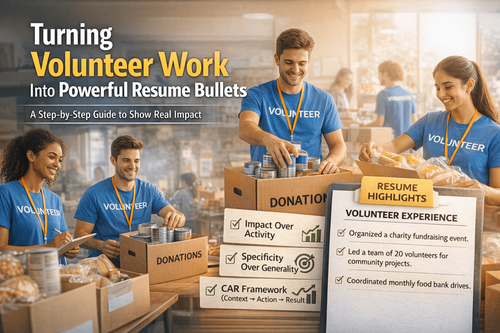

Turning Volunteer Work Into Powerful Resume Bullets: A Step-by-Step Guide to Show Real Impact
Many professionals underestimate one of the most valuable parts of their experience: volunteer work.
You might have organised a community fundraiser, mentored students on weekends, coordinated a charity event, or supported a local non-profit campaign. Yet when it comes time to write your resume, these experiences often appear as vague lines like “Volunteered at an NGO” or “Helped organise events.”
This is where most professionals unintentionally weaken their profile.
Volunteer work often involves the same skills required in paid roles: project management, stakeholder coordination, leadership, communication, and operational execution. The problem is not the experience itself — it is how that experience is translated into resume language that recruiters understand.
Recruiters spend only a few seconds scanning a resume. If your volunteer work is described casually or vaguely, it gets skipped instantly.
But when written strategically, volunteer experience can become a powerful proof of leadership, initiative, and measurable impact. This guide explains how to transform unpaid experience into strong, interview-ready resume bullets that strengthen your professional narrative.
Who Is This Blog For?
This guide is especially useful for professionals who want to strengthen their resume using meaningful experience that may not have been part of a formal job.
- Career changers transitioning into a new industry
- Fresh graduates with limited paid work experience
- Professionals returning to work after a career break
- Job seekers building a stronger resume profile
- Consultants and freelancers showcasing project experience
- Managers highlighting community leadership or board work
Why This Topic Matters Today?
Today’s hiring landscape is highly competitive. Recruiters receive hundreds of resumes for a single role, and most are scanned in less than ten seconds.
In this environment, vague resume bullets rarely stand out.
Many professionals make three common mistakes when listing volunteer experience:
- They assume unpaid work does not count professionally
- They describe activities instead of outcomes
- They use casual language instead of professional framing
As a result, valuable experiences remain invisible to recruiters.
The difference between a weak and strong bullet can be dramatic. For example:
Weak version
“Volunteered at an animal shelter on weekends.”
Strong version
“Coordinated a team of 12 weekend volunteers at a 200-animal shelter, reducing staff overtime costs by 18 percent over six months.”
Both statements describe the same work. The difference lies in specificity, measurable impact, and professional framing.
When volunteer work is written strategically, it becomes a competitive advantage rather than an afterthought.
Core Concept Explained: The Three Principles of Strong Resume Bullets
Before writing resume bullets, it is important to understand the principles that make them effective.
Impact Over Activity
Recruiters are not interested in simply knowing what you did. They want to understand what changed because of your work.
Instead of describing tasks, highlight results.
For example:
Activity-focused statement
“Organised community events.”
Impact-focused statement
“Organised a community fundraising campaign that raised ₹4 lakh for local education programmes.”
Specificity Over Generality
Specific numbers, timelines, and scale make bullets credible and memorable.
Compare the following:
“Managed volunteers.”
Versus:
“Managed a team of eight volunteers across three departments to deliver a city-wide fundraising event.”
Specificity demonstrates competence and professionalism.
Language Alignment
Your resume language should match the job you are applying for.
The same volunteer experience can be framed differently depending on the role.
For example, a charity fundraiser could highlight:
- Marketing skills
- Project management experience
- Budget management capability
- Leadership and team coordination
Aligning the language with the job description dramatically improves both recruiter engagement and ATS performance.
How This Blog and Guidebook Help You?
The framework in this guide provides a structured process for converting volunteer work into strong resume content.
It helps professionals:
- Audit their volunteer experience effectively
- Identify transferable professional skills
- Structure resume bullets using proven frameworks
- Quantify impact even when exact metrics are unavailable
- Tailor resume bullets to different job roles
- Position volunteer experience strategically on a resume
Instead of leaving volunteer work as a minor section, this approach turns it into a powerful professional asset.
Step-by-Step Breakdown
Step 1: Audit Your Volunteer History
The first step is to capture every relevant volunteer experience you have had.
Most professionals underestimate how much experience they actually possess. Volunteer work includes many types of contributions, such as:
- Non-profit roles
- Community leadership initiatives
- Mentoring or coaching
- Event organisation
- Professional association work
- Board or committee membership
- Online advocacy projects
Create a list of each volunteer role and capture key details such as:
- Organisation name
- Your role or title
- Duration of involvement
- Team size you worked with
- Key responsibilities
- Major projects or events
- Outcomes or measurable impact
- Skills used or developed
This step helps uncover the raw material needed to craft strong resume bullets.
Step 2: Extract Transferable Skills
Volunteer experience becomes powerful when it is translated into professional skills.
For example, helping at a food bank may actually demonstrate:
- Operations management
- Supply chain coordination
- Volunteer leadership
- Community engagement
Similarly, volunteering for an event might reflect skills such as:
- Project management
- Stakeholder communication
- Budget oversight
- Marketing or content creation
By identifying the professional competencies behind each volunteer activity, you create the strategic foundation for stronger resume bullets.
Step 3: Use the CAR Framework for Bullet Writing
One of the most effective methods for writing resume bullets is the CAR framework:
Context → Action → Result
Context
Briefly explain the situation or challenge.
Example
“In response to declining donor engagement…”
Action
Describe what you specifically did.
Example
“…redesigned the organisation’s email outreach campaign using A/B testing.”
Result
Highlight the measurable outcome.
Example
“…recovering 28 percent of lapsed donors within one quarter.”
This structure ensures that every bullet tells a complete professional story.
Step 4: Quantify Impact Even Without Exact Data
Many professionals hesitate to quantify volunteer work because they lack formal metrics.
However, several techniques can still communicate credible impact.
Estimate Scale
If you organised an event, estimate attendance.
Example
“Coordinated a community health event attended by approximately 300 residents.”
Use Team Size or Duration
Example
“Led a volunteer team of 15 across four city districts for eight months.”
Highlight Before-and-After Change
Example
“Implemented a structured volunteer onboarding process that reduced orientation time from three hours to 45 minutes.”
Reference External Recognition
Example
“Programme recognised by the district education board for community literacy impact.”
These techniques allow you to communicate meaningful outcomes even without exact numbers.
Step 5: Tailor Bullets to the Job Description
One of the most important strategies in resume writing is alignment with the target role.
The same experience can be reframed to highlight different competencies.
Example: Charity Fundraiser
For a project management role
“Managed end-to-end logistics for a 500-person annual fundraiser, coordinating three vendor contracts, a 20-member volunteer team, and a ₹4 lakh event budget.”
For a marketing role
“Led digital promotion for a charity fundraiser, driving 12,000 social media impressions and increasing early ticket sales by 22 percent.”
Both bullets describe the same event, but each emphasises different professional strengths.
Step 6: Position Volunteer Work Strategically on Your Resume
Where volunteer work appears on your resume also matters.
Career Changers
Create a “Relevant Experience” section that includes both paid and volunteer work.
Job Seekers With Career Gaps
Include volunteer roles in your main experience section with dates.
Established Professionals
Add a “Community Leadership” or “Volunteer Experience” section below your main work history.
Regardless of placement, ensure your bullets include industry keywords to improve ATS visibility.
Common Mistakes or Pitfalls to Avoid
Using Weak Verbs
Words such as “helped,” “assisted,” or “participated” weaken your contribution.
Start bullets with strong verbs like:
- Led
- Coordinated
- Implemented
- Designed
- Delivered
Skipping Numbers
Bullets without numbers feel vague and unconvincing.
Always include at least one measurable element.
Explaining the Organisation Instead of Your Role
Recruiters care about your contribution, not the organisation’s mission statement.
Using Generic Bullets for Every Job
Tailor bullets for each role instead of copying the same lines.
Hiding Volunteer Work
Strong volunteer experience should never be buried in a footnote section.
How Should You Use This Guidebook Effectively?
To get the most value from this framework, treat it as an active writing tool.
Follow this process:
- List every volunteer experience from the last five to seven years
- Draft three to five bullets per role using the CAR framework
- Evaluate each bullet using a quality checklist
- Create a “bullet bank” with multiple variations of strong bullets
- Tailor your bullets for each job application
Building a bullet bank allows you to customise resumes quickly without starting from scratch every time.
Key Takeaways
- Volunteer work is real professional experience and should be treated that way
- Strong resume bullets focus on impact, not activities
- Specific numbers and measurable outcomes strengthen credibility
- The CAR framework provides a reliable structure for writing powerful bullets
- Volunteer experiences often demonstrate highly transferable professional skills
- Tailoring bullets to the job description improves both recruiter engagement and ATS performance
- Strategic placement of volunteer experience increases visibility on your resume
- Maintaining a bullet bank allows faster and more effective resume customization
Your Next Step: Accelerate Your Career with PlanetSpark
Creating an impact-driven resume is not just about landing your next job—it’s about owning your professional story and presenting it with clarity, confidence, and credibility. When your resume clearly communicates value, results, and impact, opportunities follow naturally.
At PlanetSpark, we are committed to empowering working professionals with practical, outcome-focused resources that drive real career growth. From resume building and workplace communication to leadership presence and professional writing, our programs are designed to help you succeed in today’s fast-evolving job market.
Visit https://www.planetspark.in/resources to explore:
- Career and resume-building guides
- Workplace communication and professional writing resources
- Skill-development tools curated for working professionals
Want a deeper, hands-on experience?
You can also book a free trial session to learn more about PlanetSpark’s Working Professional Courses, designed to accelerate your career through personalised coaching, real-world practice, and expert guidance.
Your career deserves more than generic advice.
It deserves clarity, confidence, and measurable impact.
Personalized Communication Roadmaps
Record a video to get a AI generated personalized communication reports