
Understanding Employer Pain Points from Job Ads
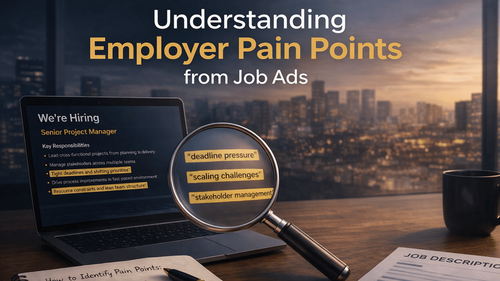

How to Decode Employer Pain Points from Job Ads and Position Yourself as the Perfect Candidate
Most professionals read job descriptions the
wrong way.
They scan for eligibility, check qualifications, and decide whether to apply. But in doing so, they miss the most critical insight hidden in plain sight—what the employer actually needs solved.
Behind every job posting is a set of business problems, performance gaps, and expectations that are rarely stated directly. Recruiters are not just hiring for skills; they are hiring solutions.
If your application does not clearly show how you solve those problems, it gets ignored—no matter how strong your experience is.
This is where understanding employer pain points becomes a game-changer.
This guide shows you how to go beyond surface-level reading and decode the real expectations behind job ads—so you can position yourself as the obvious solution.
Who Is This Blog For?
This blog and guidebook are designed for professionals who want to apply smarter, not harder.
- Working professionals aiming to improve interview conversion rates
- Job seekers struggling to stand out despite strong qualifications
- Career switchers trying to align experience with new roles
- Mid-level professionals targeting promotions or strategic roles
- Consultants and specialists building a strong positioning narrative
Why This Topic Matters Today?
The hiring process has become faster, more competitive, and more outcome-driven.
Recruiters often review hundreds of applications for a single role. In this environment, they are not looking for candidates who “fit the description”—they are looking for candidates who clearly solve their problems.
The guidebook highlights a crucial reality:
Most job descriptions are written as lists of responsibilities, but what they truly represent are business challenges.
For example:
- “Manage cross-functional teams” often signals coordination issues
- “Improve operational efficiency” indicates existing inefficiencies
- “Drive revenue growth” points to unmet business targets
Candidates who fail to interpret these signals submit generic applications.
Candidates who decode them create highly targeted, compelling applications that stand out instantly.
Core Concept or Framework Explained
The central idea of this guide is simple but powerful:
Every job description is a problem statement in disguise.
To decode it effectively, the guidebook introduces a structured interpretation model based on three layers:
- Surface Layer: The visible job description including responsibilities and requirements
- Signal Layer: Repeated keywords, emphasis areas, and priority skills
- Pain Layer: The underlying business challenges and performance gaps
By analysing all three layers, you move from passive reading to strategic understanding.
This allows you to align your experience directly with what the employer truly values.
How This Blog and Guidebook Help You?
This guide helps you transform how you approach job applications.
You will learn how to:
- Identify hidden expectations within job descriptions
- Translate responsibilities into business problems
- Align your resume with employer priorities
- Craft stronger, more relevant application narratives
- Increase your chances of getting shortlisted and interviewed
The result is a sharper, more strategic approach that saves time and delivers better outcomes.
Step-by-Step Breakdown
Step 1: Read the Job Description with Intent
Start by shifting your mindset.
Do not read the job description as a checklist. Read it as a diagnostic tool.
Ask yourself:
- What is the company trying to achieve with this role?
- What challenges might they currently be facing?
- Why does this role exist now?
This shift helps you focus on meaning rather than wording.
Step 2: Identify High-Frequency Signals
Job descriptions often repeat certain skills, tools, or outcomes.
These repetitions are not accidental—they indicate priority areas.
Look for:
- Frequently mentioned responsibilities
- Repeated tools, technologies, or skills
- Core competencies highlighted across sections
These signals reveal what matters most to the employer.
Step 3: Translate Responsibilities into Pain Points
This is the most critical step.
Convert each responsibility into an underlying problem.
For example:
- “Streamline operations” becomes inefficient processes
- “Enhance customer experience” becomes low satisfaction or retention
- “Lead digital transformation” becomes outdated systems or slow adoption
This translation allows you to see the role from the employer’s perspective.
Step 4: Categorise Pain Points into Themes
Once identified, group pain points into key categories such as:
- Growth challenges
- Efficiency gaps
- Process issues
- Team or leadership gaps
- Customer or market challenges
This helps you prioritise which problems to address in your application.
Step 5: Map Your Experience to Each Pain Point
Now shift focus to your own experience.
For each identified pain point, ask:
- Have I solved a similar problem before?
- What actions did I take?
- What measurable results did I achieve?
Create clear connections between your past achievements and the employer’s needs.
Step 6: Build a Targeted Application Narrative
Use your insights to craft a compelling narrative.
Your resume, cover letter, and interview responses should:
- Directly address key pain points
- Highlight relevant achievements
- Use language aligned with the job description
This creates immediate relevance and credibility.
Step 7: Validate Through Research and Networking
Job descriptions do not tell the full story.
Strengthen your understanding by:
- Researching company news, strategy, and performance
- Speaking to current or former employees
- Analysing industry trends
This ensures your interpretation is accurate and informed.
Common Mistakes or Pitfalls to Avoid
Even experienced professionals make critical errors when analysing job ads.
- Treating job descriptions as static checklists
- Ignoring repeated signals and priority areas
- Focusing only on qualifications instead of outcomes
- Submitting generic resumes for multiple roles
- Failing to connect experience with employer needs
Avoiding these mistakes significantly improves your application quality.
How Should You Use This Guidebook Effectively?
To get the best results, follow a structured workflow:
- Select one target role instead of applying randomly
- Analyse the job description using the three-layer model
- Identify and categorise key pain points
- Map your experience to those needs
- Tailor your resume and application accordingly
Allocate focused time for each step:
- 1 hour for job description analysis
- 1–2 hours for experience mapping
- 1 hour for application refinement
Repeat this process for each high-priority role.
Key Takeaways
- Job descriptions are problem statements, not just requirement lists
- Hidden employer pain points determine hiring decisions
- Repeated signals highlight what matters most
- Translating responsibilities into challenges gives you an edge
- Mapping your experience to pain points creates relevance
- Tailored applications outperform generic ones
- Strategic analysis leads to higher interview success
Your Next Step: Accelerate Your Career with PlanetSpark
Creating an impact-driven resume is not just about landing your next job—it’s about owning your professional story and presenting it with clarity, confidence, and credibility. When your resume clearly communicates value, results, and impact, opportunities follow naturally.
At PlanetSpark, we are committed to empowering working professionals with practical, outcome-focused resources that drive real career growth. From resume building and workplace communication to leadership presence and professional writing, our programs are designed to help you succeed in today’s fast-evolving job market.
Visit https://www.planetspark.in/resources to explore:
- Career and resume-building guides
- Workplace communication and professional writing resources
- Skill-development tools curated for working professionals
Want a deeper, hands-on experience?
You can also book a free trial session to learn more about PlanetSpark’s Working Professional Courses, designed to accelerate your career through personalised coaching, real-world practice, and expert guidance.
Your career deserves more than generic advice.
It deserves clarity, confidence, and measurable impact.
Start building that advantage today—with PlanetSpark.
Personalized Communication Roadmaps
Record a video to get a AI generated personalized communication reports