
How to Use a Career Risk Opportunity Tracker for Growth


Tracker For Career Risk & Opportunity
In today’s unpredictable professional landscape, relying solely on hard work and performance is no longer enough. Many professionals find themselves stuck, overlooked, or suddenly disrupted—not because they lack capability, but because they lack a structured way to think about their career strategically.
You might be performing well in your current role, yet feel uncertain about your future. Perhaps your industry is changing, your role feels stagnant, or you’re unsure what your next move should be. The problem isn’t a lack of ambition—it’s a lack of clarity and direction.
Most professionals operate reactively. They respond to job losses, missed promotions, or industry changes only after they occur. But the most successful professionals take a different approach: they proactively manage their career risks and opportunities before they become urgent.
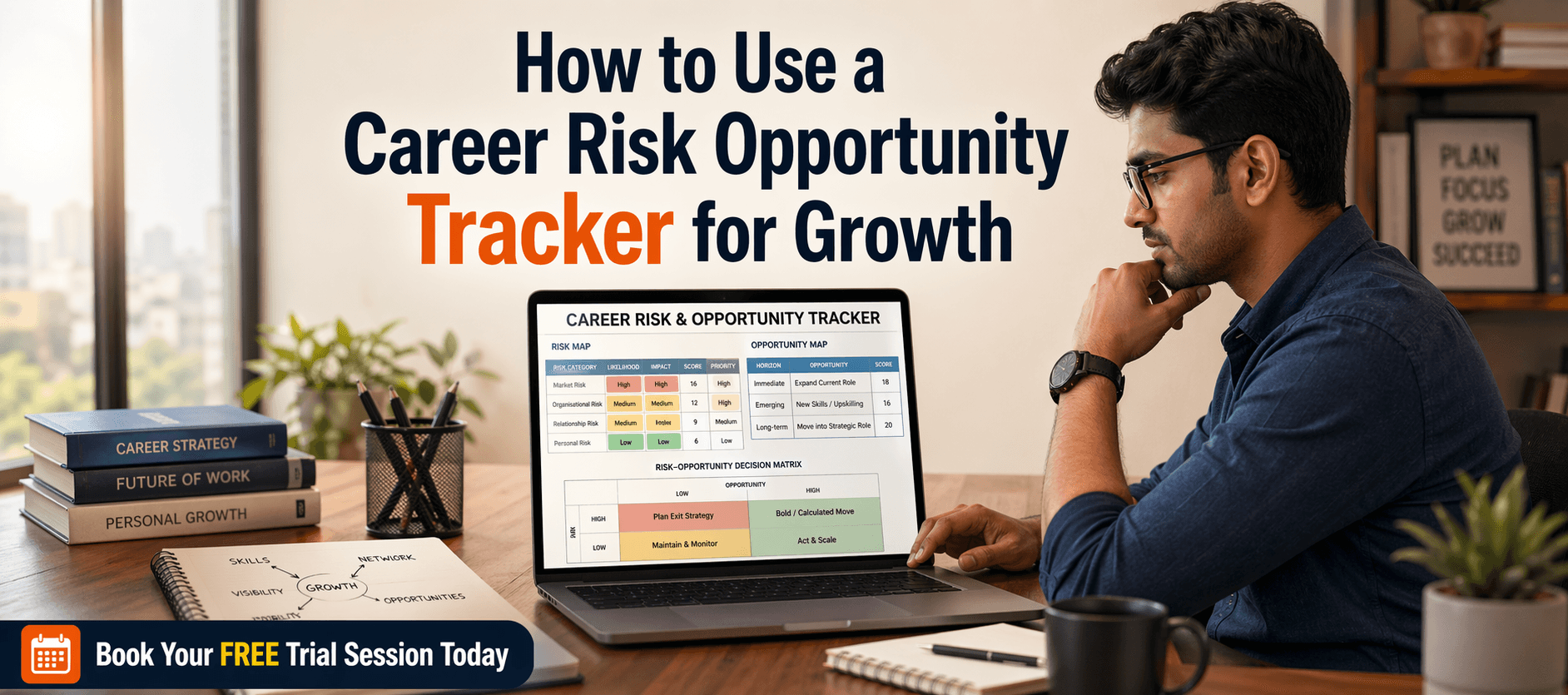
This is where a structured system like a Career Risk & Opportunity Tracker becomes invaluable. Instead of leaving your career to chance, it helps you map your current position, anticipate risks, identify opportunities, and make informed decisions with confidence.
Download these resources and apply them alongside your daily work for improved clarity, productivity, and professional growth. You can also book a free trial to gain expert guidance and enhance your communication, problem-solving, and decision-making skills. The materials are designed in a clear, structured format to help professionals learn efficiently and implement insights with confidence.
Who Is This Blog For?
- Working professionals navigating career growth or transitions
- Individuals feeling stuck, uncertain, or underutilised in their roles
- Managers and leaders aiming to future-proof their career trajectory
- Career switchers exploring new industries or opportunities
- Freelancers and consultants managing long-term professional stability
Why This Topic Matters Today?
The modern workplace is evolving faster than ever. Automation, industry disruptions, and shifting business priorities are redefining what it means to stay relevant.
Many professionals face common challenges:
- Skills becoming outdated without warning
- Limited visibility despite strong performance
- Weak professional networks when opportunities arise
- Lack of clarity about future career direction
The biggest issue is not external change—it is the absence of a structured approach to managing that change. Without a system, professionals rely on assumptions, intuition, and delayed reactions.
Career growth today depends on:
- Proactive risk identification rather than reactive problem-solving
- Continuous opportunity scanning across short and long-term horizons
- Strategic decision-making supported by clear frameworks
A career is no longer a linear journey—it is a dynamic portfolio that requires active management.
Core Concept or Framework Explained
At the heart of this guide is a powerful idea: your career is a portfolio of assets, risks, and opportunities. Just like financial portfolios, it requires consistent evaluation and strategic decisions.
The framework operates through four interconnected components.
Career Audit as a Baseline
Before making decisions, you must understand where you stand. This includes:
- Skills assessment based on market relevance
- Visibility to decision-makers
- Strength and diversity of your professional network
This creates a realistic foundation for all future actions.
Risk Mapping with Structured Evaluation
Risks are categorised into four areas:
- Market risks such as automation or industry decline
- Organisational risks like restructuring or leadership changes
- Relationship risks including overdependence on specific individuals
- Personal risks such as skill stagnation or burnout
Each risk is evaluated using a likelihood and impact scoring system to prioritise action.
Opportunity Mapping Across Time Horizons
Opportunities are not random—they can be systematically identified across:
- Immediate opportunities in the current role
- Emerging opportunities in the near future
- Long-term opportunities aligned with industry trends
Each opportunity is evaluated based on alignment, feasibility, and long-term leverage.
Risk–Opportunity Decision Framework
Decisions are guided by a matrix that balances risk severity with opportunity potential, helping professionals choose between:
- Bold moves
- Strategic exits
- Growth opportunities
- Stable monitoring positions
This transforms decision-making from emotional to analytical.
How This Blog and Guidebook Help You?
This blog and the underlying tracker provide a structured system to take control of your career.
You gain:
- A clear understanding of your current professional position
- A method to identify and prioritise career risks
- A framework to discover and evaluate opportunities
- A decision-making model that reduces uncertainty
- Practical tools to take consistent, strategic action
The outcome is greater clarity, confidence, and control over your career trajectory.
Step-by-Step Breakdown
Step 1: Audit Your Current Career Position
Start by building a clear and honest baseline.
Focus on three areas:
- Skills Inventory: Categorise skills into growing, stable, or declining
- Visibility Quotient: Evaluate how well decision-makers recognise your capabilities
- Network Health: Assess the strength of your inner circle, mid-level contacts, and broader network
This step replaces assumptions with evidence-based insights.
Step 2: Map Your Career Risks
Identify potential threats that could impact your career.
Key actions:
- Categorise risks into market, organisational, relationship, and personal
- Assign a likelihood and impact score to each risk
- Prioritise risks with higher combined scores
- Define one clear action to reduce each major risk
This converts uncertainty into a manageable strategy.
Step 3: Identify and Score Opportunities
Shift from reactive to proactive opportunity creation.
Break opportunities into three horizons:
- Immediate opportunities within your current environment
- Emerging opportunities in your industry or organisation
- Long-term opportunities tied to future trends
Evaluate each based on:
- Alignment with your goals
- Feasibility of execution
- Potential to unlock future growth
Focus your energy on high-scoring opportunities.
Step 4: Apply the Risk–Opportunity Decision Framework
Use a structured matrix to guide career decisions.
Based on risk and opportunity levels:
- High risk and high opportunity: Make bold, calculated moves
- High risk and low opportunity: Plan an exit strategy
- Low risk and high opportunity: Act quickly and scale
- Low risk and low opportunity: Maintain and monitor
This helps you make decisions with clarity rather than hesitation.
Step 5: Use Action Tools and Reflection Prompts
Turn insights into consistent action.
Use tools like:
- Quarterly audit checklists
- Risk tracking logs
- Reflection questions to uncover hidden patterns
Regular reflection transforms awareness into progress.
Step 6: Learn from Real-World Application
A practical example shows how structured tracking leads to results.
A professional facing automation risks:
- Identified declining skill relevance
- Took targeted upskilling action
- Leveraged internal opportunities
- Improved visibility and expanded network
Within months, they repositioned their career into a more secure and growth-oriented role.
Common Mistakes or Pitfalls to Avoid
Many professionals undermine their progress through avoidable mistakes.
Common pitfalls include:
- Treating career planning as a one-time activity
- Identifying risks without taking action
- Ignoring long-term opportunities in favour of short-term comfort
- Keeping career strategy entirely private
- Overcommitting to opportunities without testing them
Better alternatives:
- Conduct regular quarterly reviews
- Assign one clear action to every major risk
- Explore opportunities through small, low-risk experiments
- Seek external feedback from trusted professionals
How Should You Use This Guidebook Effectively?
To maximise results, use the tracker as an ongoing practice rather than a one-time exercise.
Recommended workflow:
- Block 90 minutes every quarter for a career review
- Complete your skills, visibility, and network audit
- Update your risk and opportunity map
- Identify one priority action for the next 30 days
- Discuss your insights with a mentor or trusted peer
Time investment:
- Initial setup: 60–90 minutes
- Quarterly updates: 60–90 minutes
- Weekly opportunity scanning: 20–30 minutes
Consistency is more valuable than intensity.
Key Takeaways
- Your career should be managed like a strategic portfolio
- Regular audits provide clarity and direction
- Risk identification reduces uncertainty and improves decision-making
- Opportunities exist across short, medium, and long-term horizons
- Structured frameworks lead to better career decisions
- Small, consistent actions create long-term impact
- External perspectives help uncover blind spots
- Career growth is a continuous, proactive process
Your Next Step: Accelerate Your Career with PlanetSpark
Creating an impact-driven resume is not just about landing your next job—it’s about owning your professional story and presenting it with clarity, confidence, and credibility. When your resume clearly communicates value, results, and impact, opportunities follow naturally.
At PlanetSpark, we are committed to empowering working professionals with practical, outcome-focused resources that drive real career growth. From resume building and workplace communication to leadership presence and professional writing, our programs are designed to help you succeed in today’s fast-evolving job market.
Visit https://www.planetspark.in/resources to explore:
- Career and resume-building guides
- Workplace communication and professional writing resources
- Skill-development tools curated for working professionals
Want a deeper, hands-on experience?
You can also book a free trial session to learn more about PlanetSpark’s Working Professional Courses, designed to accelerate your career through personalised coaching, real-world practice, and expert guidance.
Your career deserves more than generic advice.
It deserves clarity, confidence, and measurable impact.
Personalized Communication Roadmaps
Record a video to get a AI generated personalized communication reports