
How to Use Networking Scripts for Professional Career Growth


Professional Networking Introduction Scripts That Help Working Professionals Build Strong Career Opportunities
Most professionals do not struggle with networking because they lack experience, intelligence, or ambition. They struggle because they do not know how to introduce themselves in a way that immediately communicates value. In many professional settings, the first 20 to 30 seconds of interaction determine whether a conversation continues meaningfully or fades into polite silence.
That first introduction often carries more weight than professionals realise. It shapes credibility, influences memory, and determines whether someone sees you as another attendee in the room or as someone worth remembering. Yet many people still improvise introductions, rely only on job titles, or speak too broadly to leave any lasting impression.
This is exactly why structured networking scripts matter. A well-prepared introduction is not artificial. It is a professional asset that helps you present your work clearly, position your expertise effectively, and invite real conversation with confidence. The Professional Networking Introduction Scripts guidebook provides a practical system for doing exactly that across multiple networking situations, from conferences and LinkedIn outreach to internal conversations and career transitions.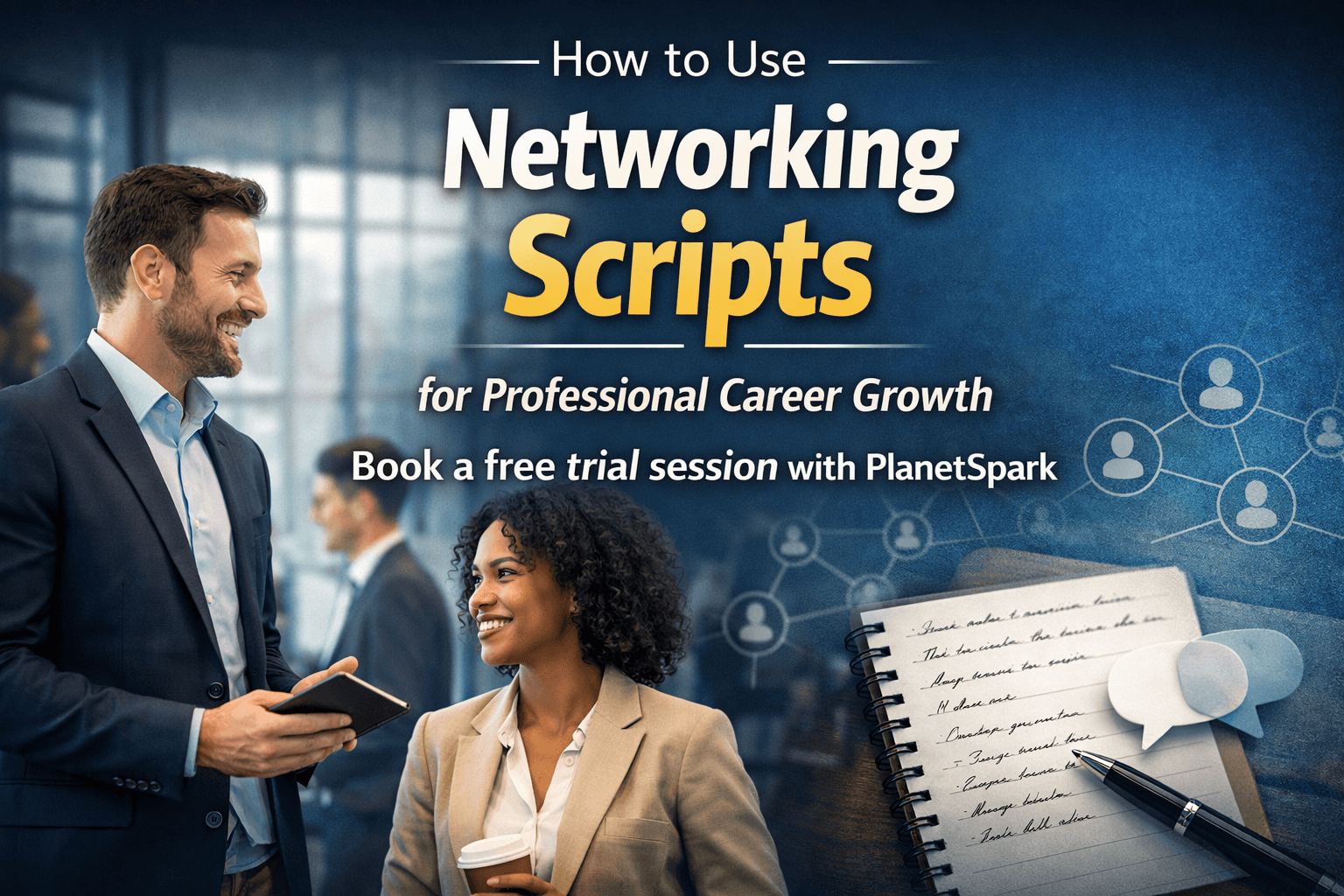
Book your free trial session today with Planetspark !
Download for more details or PDF file
Who Is This Blog For?
- Working professionals who want to
improve networking confidence in formal and informal settings
- Career switchers who need to explain a professional transition clearly
- Consultants, specialists, and managers building stronger professional visibility
- Mid-career professionals aiming to create stronger industry relationships
- Job seekers who want introductions that generate better conversations and opportunities
Why This Topic Matters Today?
Professional networking has changed significantly in recent years. Conversations now happen across multiple platforms: in-person events, virtual calls, LinkedIn messages, internal meetings, and cold outreach emails. In every one of these environments, professionals are judged quickly based on clarity, relevance, and confidence.
A weak introduction creates immediate friction. A job title alone does not explain value. A long life story loses attention. A vague statement creates uncertainty. In contrast, a strong introduction quickly answers three questions every professional listener subconsciously asks:
- Who are you professionally?
- Why are you relevant to this conversation?
- Why should I continue listening?
The guidebook makes an important point: introductions are not social pleasantries. They are positioning statements. For career switchers, they reframe your professional narrative. For consultants, they signal expertise. For managers, they reflect executive presence. For job seekers, they often decide whether someone remembers you later.
In a professional market where relationships increasingly influence opportunities, mastering introductions is no longer optional.
Core Concept or Framework Explained
At the centre of the guidebook is the V-A-C Framework, a simple but highly effective structure that explains why some introductions work immediately while others fail.
V stands for Value
This is the first and most important part of any introduction. Instead of starting with a title, you begin by explaining what value you create.
A strong value statement focuses on outcomes rather than labels. For example, saying you help fintech companies navigate regulatory complexity immediately communicates relevance more clearly than simply stating a designation.
A stands for Angle
This is what makes your introduction memorable. Your angle is the specific perspective, niche, background, or professional distinction that separates you from others in similar roles.
A professional with a journalism background entering UX research, for example, has a powerful angle because the intersection of communication and research creates uniqueness.
C stands for Connection
A great introduction should not end as a statement. It should invite dialogue.
The connection element usually takes the form of a thoughtful question, contextual reference, or conversation opener that encourages the other person to engage naturally.
Together, Value, Angle, and Connection create introductions that feel concise, clear, and conversational.
How This Blog and Guidebook Help You?
This blog and the original guidebook help professionals move from awkward, forgettable introductions to structured professional conversations that create stronger networking outcomes.
The frameworks help you:
- Replace generic introductions with value-based statements
- Adapt your script across multiple networking contexts
- Build confidence through repeatable structure
- Present career transitions with clarity
- Improve follow-up quality after first interactions
The goal is not memorisation. The goal is professional clarity that feels natural.
Step-by-Step Breakdown
Step 1: Understand Why Most Professional Introductions Fail
Before building stronger scripts, it is necessary to understand what weakens most introductions.
The guidebook identifies five recurring patterns.
The Job Title Dump
Many professionals stop after saying their designation and employer.
This creates little curiosity because job titles explain hierarchy, not value.
The Life Story Spiral
Some professionals over-explain every role, transition, and career stage.
Too much information reduces attention.
The Vague Value Statement
Statements such as "I work in marketing" are technically correct but professionally weak because they do not explain impact.
The Desperation Signal
Leading with immediate need such as asking for job help too early creates imbalance.
The One-Size Script
Using the same wording everywhere ignores context.
Recognising these mistakes immediately improves awareness.
Step 2: Build Introductions Using the V-A-C Framework
The guidebook recommends structuring every introduction around three short beats.
Start with Value
Explain what you help achieve.
Example:
"I help early-stage startups build investor-ready financial models by simplifying complex data."
Add Your Angle
Explain what makes your approach distinctive.
Example:
"My background in journalism helps me simplify complex narratives for investors."
Create Connection
End with an opener that feels natural.
Example:
"I have been curious how investors in this space are evaluating AI-driven forecasting right now."
This creates flow and keeps introductions under 40 seconds.
Step 3: Use Context-Specific Scripts Instead of One Universal Script
One of the strongest practical insights from the guidebook is that context determines tone, length, and style.
In-Person Event Script
This version should feel conversational and concise.
Example structure:
- Introduce your name
- Explain what you do
- Mention why you are at the event
- Ask what brings them there
LinkedIn Connection Script
This must be highly specific.
Mentioning a recent post or idea from the other person makes the request feel intentional.
Virtual Networking Script
A virtual conversation benefits from warmth because screens naturally create distance.
A brief acknowledgment, personalised reason for reaching out, and open question improve early rapport.
Cold Email Script
The guidebook recommends a simple sequence:
- Subject line
- Specific hook
- Value statement
- Soft ask
Career Switcher Script
This requires a narrative bridge.
You explain previous field, transferable skill, reason for transition, and unique intersection.
Internal Networking Script
This focuses on collaboration rather than self-promotion.
The emphasis stays on how your work connects to theirs.
Step 4: Build Your Own Personal Script Through Structured Reflection
The guidebook includes a worksheet that helps professionals build authentic scripts rather than copying templates mechanically.
Block 1: Your Value Statement
Complete:
"I help ______ to ______ by ______."
Block 2: Your Angle
Identify your professional differentiator.
Block 3: Your Connection Opener
Write a natural question that invites dialogue.
Block 4: Assemble Your Full Script
Read it aloud and remove unnecessary words.
The guidebook strongly recommends recording yourself once because awkward phrasing becomes obvious immediately.
Step 5: Use Reflection Questions to Strengthen Professional Self-Awareness
Strong introductions come from clarity, not just wording.
The guidebook recommends asking:
- What do people usually seek my help for?
- What problem have I solved recently that matters?
- What surprises people about my background?
- What do I want others to remember about me?
- What relationship am I trying to build through networking?
These answers often reveal stronger angles than professionals initially expect.
Step 6: Move From Script to Real Conversation
A script opens a conversation but does not complete it.
The guidebook breaks networking into three stages.
Before the Conversation
- Research the event or person
- Define your goal
- Say your script aloud once
During the Conversation
- Deliver the introduction
- Stop talking
- Listen actively
The guidebook recommends a 40/60 ratio.
You speak 40 percent of the time.
They speak 60 percent.
After the Conversation
Apply the 24-hour rule.
A follow-up message within one day improves relationship continuity dramatically.
A simple structure works:
- Mention the context
- Reference something specific discussed
- Add one value-driven follow-up
Step 7: Learn from Real Transformation
The guidebook shares Neha’s example.
Her original introduction focused on title, broad responsibilities, and uncertainty.
Her improved version became:
- Specific
- Niche-driven
- Intentional
- Industry-aware
The transformation came not from personality change but from structure.
This is important because many professionals assume networking confidence is personality-based when it is often structure-based.
Common Mistakes or Pitfalls to Avoid
The guidebook highlights ten highly practical mistakes.
- Memorising exact words instead of understanding structure
- Skipping follow-up entirely
- Using jargon unfamiliar to listeners
- Apologising for non-linear career paths
- Speaking too long without inviting response
- Networking only when immediate need appears
- Sending identical outreach messages
- Avoiding clear asks out of fear
- Maintaining inconsistent professional messaging across platforms
- Never updating introductions as career goals evolve
Each mistake reduces networking effectiveness even when the script itself is strong.
How Should You Use This Guidebook Effectively?
The guidebook works best when treated as a practical system rather than reading material.
Recommended workflow:
- Read the full framework once
- Complete the worksheet in one sitting
- Draft at least three context-specific scripts
- Rehearse aloud for 15 to 20 minutes
- Test scripts in one real conversation within the same week
- Review every quarter
This process usually takes less than one focused hour initially but creates long-term networking advantages.
Key Takeaways
- Professional introductions are positioning tools, not casual formalities
- The V-A-C Framework gives every introduction immediate clarity
- Value should always come before title
- Your unique background often creates your strongest angle
- Context determines script style and length
- Listening matters more than over-speaking
- Follow-up within 24 hours creates stronger professional continuity
- Career transitions become stronger when framed intentionally
- Networking confidence improves through preparation, not personality
- Your introduction should evolve as your career evolves
Your Next Step: Accelerate Your Career with PlanetSpark
Creating an impact-driven resume is not just about landing your next job—it’s about owning your professional story and presenting it with clarity, confidence, and credibility. When your resume clearly communicates value, results, and impact, opportunities follow naturally.
At PlanetSpark, we are committed to empowering working professionals with practical, outcome-focused resources that drive real career growth. From resume building and workplace communication to leadership presence and professional writing, our programs are designed to help you succeed in today’s fast-evolving job market.
Visit https://www.planetspark.in/resources to explore:
- Career and resume-building guides
- Workplace communication and professional writing resources
- Skill-development tools curated for working professionals
Want a deeper, hands-on experience?
You can also book a free trial session to learn more about PlanetSpark’s Working Professional Courses, designed to accelerate your career through personalised coaching, real-world practice, and expert guidance.
Your career deserves more than generic advice.
It deserves clarity, confidence, and measurable impact.
Start building that advantage today—with PlanetSpark.
Personalized Communication Roadmaps
Record a video to get a AI generated personalized communication reports