
How to Write a Strong Cover Letter Opening That Gets Noticed
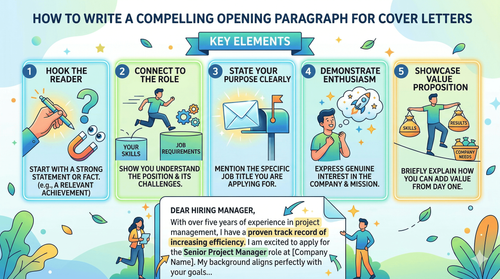

How to Write a Compelling Opening Paragraph for Your Cover Letter: A Guide for Job Seekers
Your cover letter's opening paragraph is the first and most critical opportunity to grab a recruiter’s attention. In the first 7 seconds, recruiters decide whether your application will move forward. But most candidates fail to make the most of this opportunity, often starting with weak, generic statements. This guide will teach you how to craft an opening that makes recruiters lean in and want to read more. Whether you’re pivoting careers or seeking advancement, a strong opening sets the tone for a standout cover letter.
Who Is This Blog For?
- Career changers looking to stand out with their cover letter
- Early- to mid-career professionals eager to make a strong first impression
- Consultants, managers, and professionals applying for new roles
- Anyone struggling to write an engaging cover letter opening
Why This Topic Matters Today?
The job market is competitive, and recruiters only spend a few seconds on each cover letter before making a decision. In this window, your opening paragraph plays a huge role in whether you’ll advance in the hiring process. A weak or generic opening paragraph fails to show that you understand the employer’s needs or convey your value. On the other hand, a compelling opening that leads with specific value, demonstrates proof, and aligns with the firm’s goals immediately captures attention and sets you apart.
Core Concept or Framework Explained
The key to a strong opening paragraph lies in specificity, relevance, and clarity. To make your opening compelling, you need to use the **SPARK Framework**—a simple and effective structure that helps you craft an engaging and personalized opening:
1. Specificity: Name something concrete about the company, role, or industry.
2. Proof Point: Provide a relevant achievement or credential to establish credibility.
3. Alignment: Show the connection between your experience and the employer’s needs.
4. Relevance: Focus on what the employer needs, not what you want.
5. Keep Reading Hook: End with a statement that compels the reader to continue.
By following this framework, you can ensure that your opening paragraph is sharp, clear, and directly relevant to the role and firm.
How This Blog and Guidebook Help You
This blog and guidebook help you:
- Build an engaging opening paragraph that captures attention immediately
- Avoid common mistakes like generic openings, hollow compliments, or resume repetition
- Use research and proof points to tailor your opening to the specific firm or role
- Structure your opening with the SPARK framework for maximum impact
Step-by-Step Breakdown
Step 1: Start Before You Write—The Pre-Draft Research Sprint
The most common reason cover letter openings fail is that they are generic. Before writing, do a 10-minute research sprint to gather the necessary information:
- Understand the role: Don’t just focus on the job title—dive into what the team does, the challenges they face, and the specific responsibilities of the role.
- Firm-specific differentiators: Identify unique aspects of the firm, such as recent initiatives, culture, or strategic priorities.
- Your proof point: Choose a specific, measurable achievement that connects naturally to the role and the firm’s work.
This research gives you the building blocks for your opening. With these three pieces of information—role specifics, firm differentiators, and your proof point—you can quickly craft a compelling opening paragraph.
Step 2: Choose Your Opening Strategy
The best opening strategy depends on your professional background and the role you’re applying for. Here are four proven strategies:
1. The Achievement Lead: Best for applicants with directly relevant experience and strong outcomes. Lead with your most impressive, relevant accomplishment.
Example: “In my last role at [Company], I increased sales by 30% in 12 months by implementing a new customer engagement strategy. I’m excited to bring that same growth mindset to [Target Company].”
2. The Shared Mission Lead: Best for career changers or mission-driven organizations. Connect the company’s mission or values to your own professional experience and aspirations.
Example: “When [Company] announced [specific initiative], it resonated deeply with my own professional journey. For the last 5 years, I’ve worked to [relevant achievement], which aligns perfectly with your firm’s focus on [shared value].”
3. The Problem-Solver Lead: Best for senior professionals or applicants targeting firms facing a specific challenge. Frame your opening around a visible business challenge you’ve successfully addressed.
Example: “As [Industry] faces [specific challenge], companies that [solution approach] will excel. My background in [X] equips me to drive results in exactly this type of environment.”
4. The Referred Connection Lead: Best for candidates with an internal referral. Open with the referral’s name and transition quickly to your value proposition.
Example: “[Name], your Head of [Department], recommended I reach out about the [Role] opening based on my experience in [relevant project].”
Step 3: Construct Your Opening—A Sentence-by-Sentence Blueprint
Your opening paragraph should typically run 3-4 sentences. Each sentence serves a distinct function:
1. Sentence 1: The Hook
Lead with your most compelling asset or observation. Make this sentence specific, confident, and immediately relevant to the role or company.
2. Sentence 2: The Credential
Establish who you are and what you’ve done. This is where you provide a proof point that adds credibility, ideally with a number or measurable outcome.
3. Sentence 3: The Bridge
Connect your experience explicitly to the employer’s need. This is the alignment sentence that makes the “so what?” of your value clear to the recruiter.
4. Sentence 4: The Pull-Forward (Optional)
End with a forward-facing statement that creates momentum into the rest of the letter. This keeps the recruiter engaged and wanting to read more.
Step 4: Edit for Impact—The Self-Review Protocol
After writing your first draft, review it to ensure clarity and impact. Run your opening through a self-editing protocol:
- The "So What?" Test: Make sure every sentence answers the question, “Why does this matter to the employer?”
- First-Word Check: If your opening starts with “I,” rewrite it to lead with value.
- The 80-Word Rule: Keep your opening under 100 words to maintain concision.
- The Specificity Scan: Ensure every detail (company name, role, achievement) is specific and tailored to the firm.
Step 5: Use Templates and Worksheets for Personalization
To make the process even easier, use templates and worksheets for different scenarios. These tools help you structure your opening and ensure that you’re using firm-specific insights and compelling proof points.
Key Takeaways
- Start Strong: Your opening paragraph must immediately communicate your value, without filler or vague statements.
- Use the SPARK Framework: Apply the five elements—Specificity, Proof Point, Alignment, Relevance, and Keep Reading Hook—to craft a powerful opening.
- Tailor to the Firm: Always include firm-specific details and link them to your experience and expertise.
- Edit Ruthlessly: Make sure your opening is tight, direct, and free from unnecessary content.
Your Next Step: Accelerate Your Career with PlanetSpark
Creating an impact-driven resume is not just about landing your next job—it’s about owning your professional story and presenting it with clarity, confidence, and credibility. When your resume clearly communicates value, results, and impact, opportunities follow naturally.
At PlanetSpark, we are committed to empowering working professionals with practical, outcome-focused resources that drive real career growth. From resume building and workplace communication to leadership presence and professional writing, our programs are designed to help you succeed in today’s fast-evolving job market.
Visit https://www.planetspark.in/resources to explore:
- Career and resume-building guides
- Workplace communication and professional writing resources
- Skill-development tools curated for working professionals
Want a deeper, hands-on experience?
You can also book a free trial session to learn more about PlanetSpark’s Working Professional Courses, designed to accelerate your career through personalised coaching, real-world practice, and expert guidance.
Your career deserves more than generic advice.
It deserves clarity, confidence, and measurable impact.
Personalized Communication Roadmaps
Record a video to get a AI generated personalized communication reports