
How Working Professionals Can Overcome Interview Anxiety
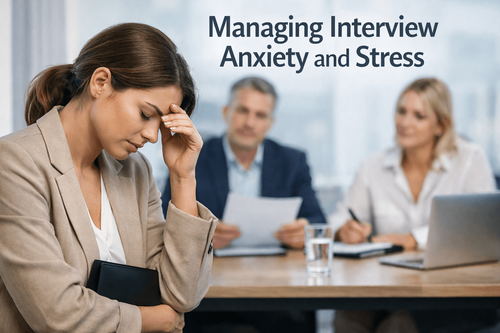

How to Stay Calm, Focused, and Confident to Manage Interview Anxiety and Stress
You prepared thoroughly. You reviewed your
resume. You practiced answers. Yet minutes before the interview, your heartbeat accelerates, your palms sweat, and your mind starts racing.
Interview anxiety is not a sign of incompetence. It is a natural stress response triggered by high-stakes evaluation.
The problem is not nervousness itself. The problem is unmanaged anxiety that affects clarity, memory, and communication.
The Managing Interview Anxiety and Stress guide provides a structured approach to understanding, controlling, and transforming interview stress into focused energy. This blog converts that guide into a practical system you can apply immediately before your next interview.
Who Is This Blog For?
This blog and guidebook are designed for:
- Professionals who feel nervous before interviews
- Candidates who experience blank moments under pressure
- High performers who struggle with confidence despite strong preparation
- Job seekers returning after a career break
- Anyone who wants to perform at their true potential during interviews
Why This Topic Matters Today?
Interviews today are highly competitive and performance-driven. Hiring managers evaluate not just skills, but composure, clarity, and confidence.
Common anxiety-driven problems include:
- Forgetting prepared answers
- Speaking too fast
- Rambling without structure
- Avoiding eye contact
- Negative self-talk before the interview
In a virtual interview setting, nervousness can appear amplified on camera. Since employers often interpret calmness as competence, managing stress becomes a strategic advantage.
The ability to regulate anxiety is now a professional skill.
Core Concept or Framework Explained
The guide approaches interview anxiety in three layers:
Understanding the Stress Response
Pre-Interview Preparation Rituals
In-Interview Regulation Techniques
First, anxiety is reframed as energy rather than weakness. Stress activates the body’s fight-or-flight system, increasing alertness. When controlled, this energy improves focus.
Second, preparation reduces uncertainty. Structured rehearsal, checklist-based preparation, and mental visualisation reduce cognitive overload.
Third, active regulation techniques help you stay calm in real time.
The framework emphasises control over three elements:
- Thoughts
- Breathing
- Body posture
By managing these, you manage stress.
How This Blog and Guidebook Help You?
By following this system, you will:
- Recognise early signs of anxiety
- Reduce negative thinking patterns
- Improve breathing control
- Maintain steady voice tone
- Recover quickly from mistakes
- Project calm confidence even under pressure
The result is not elimination of nervousness, but mastery over it.
Step-by-Step Breakdown
Step 1: Recognise and Reframe Anxiety
Instead of thinking “I am nervous,” shift to “My body is preparing me to perform.”
Reframing changes emotional intensity.
Write down:
- What specifically worries you?
- Is it fear of judgement?
- Fear of forgetting answers?
- Fear of rejection?
Clarity reduces vague anxiety.
Replace negative internal dialogue such as:
“I will mess this up.”
With performance-focused statements such as:
“I am prepared and capable.”
“I will focus on one question at a time.”
Self-talk directly influences performance.
Step 2: Build a Pre-Interview Calm Routine
Consistency reduces stress.
Create a 20–30 minute ritual before interviews:
- Review key achievements
- Read structured answer frameworks
- Practice 2–3 high-impact answers aloud
- Check technical setup
- Organise documents
Avoid cramming new information at the last minute. Overloading increases anxiety.
Prepare physically as well:
- Dress professionally
- Maintain good posture
- Stay hydrated
- Avoid excessive caffeine
Control what you can. Preparation builds confidence.
Step 3: Practice Controlled Breathing
Breathing regulates the nervous system.
Use simple box breathing:
- Inhale for 4 seconds
- Hold for 4 seconds
- Exhale for 4 seconds
- Hold for 4 seconds
Repeat for 2–3 minutes.
This reduces heart rate and stabilises voice.
If anxiety spikes mid-interview, pause briefly before answering. A short pause signals thoughtfulness, not weakness.
Step 4: Use Grounding Techniques During the Interview
If your mind races:
- Focus on the interviewer’s question
- Restate it briefly before answering
- Take one deep breath
- Begin structured response
If you forget a detail:
- Stay calm
- Provide partial answer
- Offer to clarify later
Perfection is not required. Composure is more important.
Step 5: Strengthen Physical Presence
Body language influences mental state.
Maintain:
- Upright posture
- Relaxed shoulders
- Steady eye contact
- Controlled hand movements
Avoid:
- Crossing arms tightly
- Fidgeting
- Looking down constantly
- Rapid speech
Slowing your speech slightly improves clarity and perceived confidence.
Common Mistakes or Pitfalls to Avoid
- Suppressing anxiety instead of managing it
- Last-minute cramming
- Excessive caffeine consumption
- Overanalysing every answer
- Assuming minor mistakes ruined the interview
- Comparing yourself to other candidates
Remember, interviews are conversations, not interrogations.
How Should You Use This Guidebook Effectively?
For best results:
- Read the guide at least one week before interviews
- Practice breathing exercises daily
- Conduct mock interviews to reduce uncertainty
- Develop a consistent pre-interview ritual
- Reflect after each interview to improve future performance
Managing anxiety is a skill built over repetition.
Key Takeaways
- Interview anxiety is normal and manageable
- Reframing thoughts reduces emotional intensity
- Structured preparation builds confidence
- Controlled breathing stabilises performance
- Body language influences mental state
- Calmness communicates competence
Your Next Step: Accelerate Your Career with PlanetSpark
Creating an impact-driven resume is not just about landing your next job—it’s about owning your professional story and presenting it with clarity, confidence, and credibility. When your resume clearly communicates value, results, and impact, opportunities follow naturally.
At PlanetSpark, we are committed to empowering working professionals with practical, outcome-focused resources that drive real career growth. From resume building and workplace communication to leadership presence and professional writing, our programs are designed to help you succeed in today’s fast-evolving job market.
Visit https://www.planetspark.in/resources to explore:
- Career and resume-building guides
- Workplace communication and professional writing resources
- Skill-development tools curated for working professionals
Want a deeper, hands-on experience?
You can also book a free trial session to learn more about PlanetSpark’s Working Professional Courses, designed to accelerate your career through personalised coaching, real-world practice, and expert guidance.
Your career deserves more than generic advice.
It deserves clarity, confidence, and measurable impact.
Start building that advantage today—with PlanetSpark.