
How Working Professionals Can Use a Quarterly Career Review Checklist
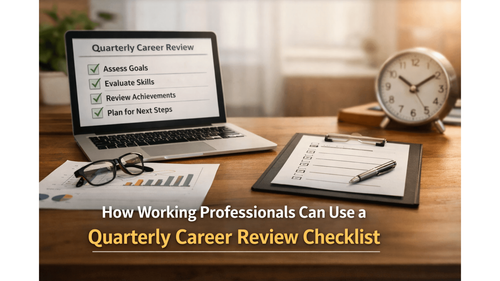

The High Performer’s 90-Day Career Review for Turning Progress into Momentum
Many professionals work hard every day
yet feel their careers are moving slower than expected. Promotions take longer, opportunities seem unpredictable, and long-term goals remain vague ambitions rather than measurable progress. The real problem is rarely a lack of effort. It is a lack of structured reflection and intentional planning.
Most people spend more time planning short vacations than reviewing their professional direction. Without a consistent system to assess progress, months quietly pass, opportunities go unnoticed, and career growth becomes reactive instead of deliberate.
A quarterly career progress review changes this dynamic completely. By introducing a simple 90-day review cycle, professionals can measure progress, identify gaps early, and make focused decisions that accelerate career momentum. This blog transforms the Quarterly Career Progress Review Checklist into a practical, actionable framework you can apply immediately to take ownership of your professional growth.
Who Is This Blog For?
This blog and guidebook are designed for professionals who want structured, intentional career advancement, including:
- Early-career professionals seeking clarity and direction
- Mid-career managers navigating increasing complexity and expectations
- Consultants and specialists building a strong personal brand
- Professionals preparing for promotions or leadership transitions
- Individuals feeling stuck despite consistent effort
- Ambitious professionals who want measurable progress every quarter
Why This Topic Matters Today?
Modern careers no longer follow predictable, linear paths. Industries evolve quickly, skill requirements shift rapidly, and visibility often matters as much as performance. Professionals who rely only on annual appraisals risk falling behind because feedback arrives too late to correct course effectively.
The guidebook highlights a critical gap between ambition and execution. Many professionals have clear aspirations such as leadership roles, career transitions, or financial growth, but lack a structured system to translate goals into consistent action.
A quarterly review solves this problem by creating intentional checkpoints every 90 days. This timeframe is powerful because it balances strategy and execution. It is long enough to produce meaningful results yet short enough to adjust before small misalignments become major setbacks.
Instead of drifting through the year, professionals begin operating in focused cycles of reflection, planning, and execution. Over time, this rhythm compounds into faster career momentum and clearer decision-making.
Core Concept or Framework Explained:
The foundation of the Quarterly Career Progress Review is simple: growth improves when it is measured regularly and acted upon deliberately.
The guidebook introduces a three-phase system supported by structured reflection domains and a focused planning model.
The Three Phases of the Quarterly Review:
Phase 1: Preparation Before the Review
Gather evidence and context before reflection begins.
Phase 2: Core Assessment During the Review
Evaluate career health across five essential professional domains.
Phase 3: Planning After the Review
Convert insights into a focused 90-day action plan.
The 90-Day Advantage:
A 90-day cycle creates urgency without overwhelm. It allows professionals to:
- Track progress consistently
- Course-correct quickly
- Maintain motivation through visible wins
- Build momentum quarter after quarter.
The 3-3-3 Planning Framework:
At the heart of the planning phase is the 3-3-3 framework:
- Three areas to double down on for growth
- Three areas to monitor without over-investing
- Three specific actions to complete within 90 days
This structure prevents overplanning while ensuring meaningful progress.
How This Blog and Guidebook Help You:
By applying this framework, professionals can:
- Gain clarity about career direction
- Identify hidden performance patterns
- Detect skill gaps early
- Strengthen strategic relationships
- Improve professional visibility
- Maintain sustainable energy and performance
- Translate reflection into measurable action
The result is a career managed intentionally rather than left to circumstance.
Step-by-Step Breakdown:
Step 1: Prepare Before the Review
A successful quarterly review begins before reflection itself. Preparation determines the quality of insights you generate.
Start by scheduling 60 to 90 minutes in a distraction-free environment at least one week before your review session.
Key preparation actions include:
- Gathering completed projects and achievements
- Collecting feedback and performance notes
- Creating or updating a personal wins file
- Reviewing goals from the previous quarter
- Scanning industry trends and market shifts
- Choosing a focused environment for reflection
Think of this phase as collecting evidence for an honest conversation with your future self.
Step 2: Conduct the Core Career Assessment
The guidebook recommends evaluating your career across five critical domains. Each domain reveals a different dimension of professional growth.
Goals and Milestones:
Reflect on outcomes rather than effort:
- Which goals were completed fully?
- Which remained partial and why?
- Which goals were abandoned intentionally?
- What surprised you about your performance?
Skills and Knowledge:
Assess whether learning aligns with future opportunities:
- What new skills were developed?
- Which skill gaps limited progress?
- Are you growing at the pace required by your industry?
Relationships and Network:
Career growth rarely happens alone. Evaluate:
- Relationships strengthened during the quarter
- Missed networking opportunities
- Whether you added value to others
- Presence of mentors or advocates supporting your growth
Visibility and Personal Brand:
Impact must be seen to influence career advancement:
- Was your work visible to decision-makers?
- Did you present, publish, or share insights?
- Does your reputation match your intended professional identity?
Energy and Wellbeing:
Sustainable performance is a strategic advantage:
- What activities drained your energy?
- What motivated and energised you?
- Is your current pace sustainable long term?
After reflection, rate yourself across all five domains to identify priority areas instead of spreading effort too thin.
Step 3: Transform Insights into a 90-Day Plan
Reflection without action creates awareness but not progress. This phase converts insights into execution.
Apply the 3-3-3 planning structure:
Three Areas to Double Down On
Select growth areas that will unlock the highest career value.
Three Areas to Monitor
Maintain performance without overcommitting time.
Three Specific 90-Day Actions
Define measurable actions with deadlines and clear success outcomes.
Each action should answer three questions:
- What will be completed?
- By when?
- How will success be measured?
Monthly check-ins ensure progress stays on track throughout the quarter.
Step 4: Use the Complete Quarterly Checklist
The guidebook provides a master checklist covering the entire process.
Pre-Review Tasks
- Block dedicated review time
- Update wins documentation
- Review previous goals
- Collect feedback
- Conduct industry scan
- Seek external perspective
Assessment Activities
- Evaluate project outcomes
- Identify key successes and misses
- Review learning progress
- Assess network strength
- Evaluate visibility actions
- Review energy sustainability
Working systematically through the checklist ensures consistency across every quarterly review.
Step 5: Learn from Real-World Application
The guidebook shares the example of Priya, a marketing professional aiming to transition into product marketing.
Her review revealed:
- Strong brand strategy skills but weak product analytics knowledge
- Limited industry networking
- Low professional visibility despite strong performance
- Moderate energy levels caused by unclear direction
Using the 3-3-3 framework, she focused on:
- Building product thinking skills
- Expanding industry connections
- Increasing LinkedIn visibility
Within one quarter, targeted networking and skill development resulted in two interviews sourced through new professional relationships. The structured review transformed intention into action.
Common Mistakes or Pitfalls to Avoid
Several common errors reduce the effectiveness of quarterly reviews:
- Reviewing only during career crises instead of consistently
- Setting too many priorities instead of focusing on three
- Conducting reviews entirely alone without external feedback
- Ignoring achievements and skipping wins reflection
- Confusing activity with real progress
The better approach is to calendar quarterly reviews in advance, celebrate wins first, and maintain disciplined focus on high-leverage actions.
How Should You Use This Guidebook Effectively?
To gain maximum value, follow a structured workflow:
- Read the guide once to understand the full framework
- Schedule quarterly sessions at the start of the year
- Allocate about two focused hours per quarter
- Complete preparation before reflection begins
- Translate insights into calendar-based actions
- Conduct brief monthly check-ins
- Revisit past reviews to track long-term patterns
A quarterly review is not a one-time exercise. Its power comes from repetition and compounding insight over time.
Key Takeaways
- Career growth accelerates when reviewed intentionally every 90 days
- Reflection must lead to concrete action plans
- Assess progress across goals, skills, relationships, visibility, and energy
- Use the 3-3-3 framework to maintain focus
- Limit priorities to high-impact actions
- Make professional contributions visible consistently
- Treat energy and wellbeing as strategic career assets
- Consistency in quarterly reviews creates long-term momentum
Your Next Step: Accelerate Your Career with PlanetSpark
Creating an impact-driven resume is not just about landing your next job—it’s about owning your professional story and presenting it with clarity, confidence, and credibility. When your resume clearly communicates value, results, and impact, opportunities follow naturally.
At PlanetSpark, we are committed to empowering working professionals with practical, outcome-focused resources that drive real career growth. From resume building and workplace communication to leadership presence and professional writing, our programs are designed to help you succeed in today’s fast-evolving job market.
Visit https://www.planetspark.in/resources to explore:
- Career and resume-building guides
- Workplace communication and professional writing resources
- Skill-development tools curated for working professionals
Want a deeper, hands-on experience?
You can also book a free trial session to learn more about PlanetSpark’s Working Professional Courses, designed to accelerate your career through personalised coaching, real-world practice, and expert guidance.
Your career deserves more than generic advice.
It deserves clarity, confidence, and measurable impact.
Start building that advantage today—with PlanetSpark.
Personalized Communication Roadmaps
Record a video to get a AI generated personalized communication reports