
How Working Professionals Prioritize Skills for Career Growth
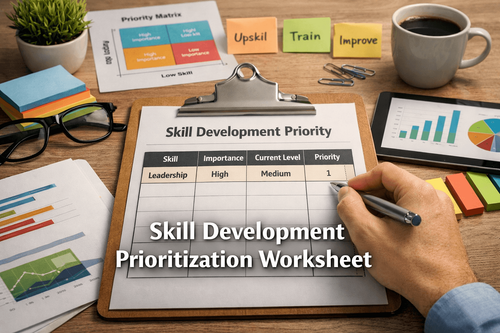

Skill Development Prioritization to Choose the Right Skills for Career Growth
Every working professional has faced this
situation: dozens of bookmarked courses, half-finished certifications, and a constant feeling of “I should be learning something.” Yet, despite all this effort, career growth feels slow or unclear.
The problem is not a lack of motivation. It is a lack of prioritization.
In today’s fast-changing job market, learning everything is impossible. The professionals who grow fastest are not the ones who learn the most, but the ones who learn the right skills at the right time. This Skill Development Prioritization Worksheet provides a structured, practical system to help you stop guessing and start making focused, career-aligned decisions.
Who Is This Blog For?
- Working professionals feeling overwhelmed by too many learning options
- Individuals planning a career switch or role transition
- Employees aiming for promotions or leadership roles
- Freelancers and consultants building specialised expertise
- Professionals struggling with consistency in learning and development
Why This Topic Matters Today?
The modern workplace is evolving rapidly, and the half-life of skills is shrinking. What you learned a few years ago may no longer be enough to stay competitive.
Many professionals face three major challenges:
- The overwhelm problem: Too many skills to choose from, leading to inaction
- The misalignment problem: Learning skills that do not contribute to career growth
- The consistency problem: Starting strong but failing to follow through
Without a structured approach, professional development becomes reactive rather than strategic. This is why prioritising the right skills is no longer optional—it is essential for long-term career success.
Core Concept or Framework Explained
At the heart of this guide is a simple but powerful idea: skill development should be intentional, goal-driven, and structured.
The framework follows five key steps:
- Audit your current skills honestly
- Define your career North Star
- Use a Priority Matrix to evaluate skill gaps
- Build a 90-day skill sprint plan
- Choose the right learning channels
This system ensures that every hour you invest in learning directly contributes to your career goals.
How This Blog and Guidebook Help You?
This guide helps you:
- Gain clarity on which skills actually matter for your career
- Eliminate wasted effort on low-impact learning
- Build a focused, realistic learning plan
- Stay consistent through structured execution
- Translate learning into visible career outcomes
Instead of random learning, you create a clear, repeatable system for growth.
Step-by-Step Breakdown
Step 1: Audit Where You Stand Today
Before deciding what to learn, you need an honest understanding of your current skills.
Start by listing 15–25 skills across three categories:
- Technical skills such as tools, software, or domain expertise
- Transferable skills such as communication, leadership, and problem-solving
- Emerging skills that are becoming important in your industry
Next, rate your proficiency:
- Beginner (1–2)
- Competent (3)
- Advanced (4–5)
Finally, identify market demand by reviewing job postings for your target role. Mark skills that appear frequently as high demand.
This step creates a clear baseline and highlights your strongest assets.
Step 2: Define Your Career North Star
Skill development without a goal leads to wasted effort.
Your North Star is your 12-month career objective. It should be specific and measurable.
For example:
- Get promoted to a senior role
- Transition into a new industry
- Secure your first consulting client
Define success clearly. Instead of saying “I want to improve,” say “I want to be promoted to Senior Manager within 12 months.”
A clear goal ensures that every skill you choose directly supports your desired outcome.
Step 3: Map Skills Using the Priority Matrix
Once you know your current skills and your goal, the next step is prioritisation.
Use a 2×2 matrix based on:
- Impact: How much the skill contributes to your goal
- Effort: How much time and energy it requires
This creates four categories:
- Quick Wins: High impact, low effort. Start here for fast progress
- Strategic Investments: High impact, high effort. Focus on these long-term
- Fill Gaps Later: Low impact, low effort. Do only after priorities are complete
- Deprioritise: Low impact, high effort. Avoid for now
This matrix removes guesswork and ensures your focus stays on what truly matters.
Step 4: Build Your 90-Day Skill Sprint Plan
A plan is only useful if it leads to action.
The guide recommends working in 90-day sprints because they balance focus and realism.
The sprint is divided into three phases:
- Days 1–30: Focus on quick wins and build momentum
- Days 31–60: Deep dive into strategic skills and apply learning
- Days 61–90: Consolidate, review, and showcase progress
Limit your focus to 2–3 skills per sprint to avoid overwhelm.
Also define:
- Weekly time commitment (even 3–5 hours is effective)
- Fixed learning time slots
- An accountability partner for regular check-ins
This structure turns learning into a disciplined, repeatable process.
Step 5: Select Your Learning Channels Strategically
Not all learning methods are equally effective for every skill.
Choose the right channels based on your goal:
- Structured courses for foundational knowledge
- On-the-job projects for real-world application
- Mentoring and coaching for high-level skills
- Self-directed reading for strategic thinking
- Communities and peer learning for networking and insights
The most effective approach is a blend of these methods, tailored to your priorities.
Real-World Application: A Case Study
Consider the example of a marketing professional aiming to move into a growth strategy role.
She identified gaps in analytics and product thinking. Using the Priority Matrix, she focused on:
- Quick wins like learning growth frameworks
- Strategic investments like SQL and A/B testing
Within 90 days, she applied her learning at work, shared insights, and gained visibility. This led to new opportunities and accelerated her transition.
The key takeaway is clear: focused learning, combined with real-world application, creates tangible career impact.
Common Mistakes or Pitfalls to Avoid
Even with a strong plan, professionals often make these mistakes:
- Chasing trending skills instead of goal-aligned skills
- Mistaking learning activity for actual progress
- Keeping learning invisible instead of showcasing it
- Trying to learn too many skills at once
- Skipping regular review and reflection
- Waiting for the perfect resource instead of starting
Avoiding these pitfalls ensures consistent and meaningful progress.
How Should You Use This Guidebook Effectively?
To get the most value from this worksheet:
- Spend time reflecting honestly during each step
- Complete all sections instead of skipping ahead
- Limit your focus to a few high-impact skills
- Block dedicated time in your calendar
- Review your progress every 30 days
- Revisit and update your plan every 90 days
Even a small, consistent time investment of 3–4 hours per week can lead to significant growth when applied correctly.
Key Takeaways
- Start with a clear career goal before choosing skills
- Conduct an honest skill audit to establish your baseline
- Use the Priority Matrix to focus on high-impact skills
- Work in 90-day sprints for structured progress
- Apply your skills in real-world scenarios to accelerate growth
- Stay consistent with small weekly time commitments
- Review and adapt your plan regularly
Your Next Step: Accelerate Your Career with PlanetSpark
Creating an impact-driven resume is not just about landing your next job—it’s about owning your professional story and presenting it with clarity, confidence, and credibility. When your resume clearly communicates value, results, and impact, opportunities follow naturally.
At PlanetSpark, we are committed to empowering working professionals with practical, outcome-focused resources that drive real career growth. From resume building and workplace communication to leadership presence and professional writing, our programs are designed to help you succeed in today’s fast-evolving job market.
Visit https://www.planetspark.in/resources to explore:
- Career and resume-building guides
- Workplace communication and professional writing resources
- Skill-development tools curated for working professionals
Want a deeper, hands-on experience?
You can also book a free trial session to learn more about PlanetSpark’s Working Professional Courses, designed to accelerate your career through personalised coaching, real-world practice, and expert guidance.
Your career deserves more than generic advice.
It deserves clarity, confidence, and measurable impact.
Start building that advantage today—with PlanetSpark.
Personalized Communication Roadmaps
Record a video to get a AI generated personalized communication reports