
How Working Professionals Showcase Problem-Solving on Resumes
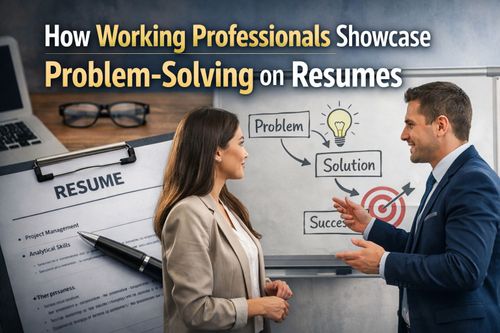

Impact-Driven Resume Writing to Transform Your Resume Into a Powerful Problem-Solving Narrative That Gets Interviews
Many professionals spend years building strong
experience but struggle to translate that experience into interview opportunities. The problem is rarely a lack of skills. The real issue is how those skills are presented.
Most resumes read like job descriptions. They list responsibilities, tools, and tasks. But hiring managers are not looking for task lists. They are looking for professionals who can solve problems, deliver results, and create measurable impact.
This is exactly where a problem-solving resume narrative becomes a career advantage. Instead of showing what you were assigned, it shows what you achieved. Instead of listing duties, it demonstrates value.
The Problem Solver’s Resume Narrative guide addresses this gap by helping professionals reposition their experience as evidence of impact, ownership, and strategic thinking. By applying the frameworks in this guide, you can transform your resume from a passive document into a compelling professional story.
Who Is This Blog For?
This guide is especially valuable for professionals who want to position themselves as high-impact contributors rather than task executors.
This blog and guidebook are ideal for:
- Early career professionals who want to stand out despite limited experience
- Mid-career professionals targeting promotions or leadership roles
- Career switchers trying to translate transferable skills
- Consultants and freelancers building a results-focused portfolio
- Job seekers struggling to get interview callbacks
- Professionals whose resumes currently sound generic or responsibility-focused
If your resume currently says what you did but not why it mattered, this framework is designed for you.
Why This Topic Matters Today?
Today’s hiring environment is more competitive than ever. Recruiters often scan resumes in seconds, not minutes. This means clarity and impact matter more than length or detail.
One of the biggest mistakes professionals make is writing resumes that describe responsibilities instead of results. Statements like “managed a team” or “worked on projects” fail to communicate impact because they lack context, scale, and outcomes.
Common resume problems highlighted in the guide include:
- Resumes that read like job descriptions instead of value stories
- Professionals underselling their real achievements
- Lack of measurable outcomes
- Generic language that blends into other applications
- No clear career narrative
The shift from a duty-based resume to a problem-solving narrative is not just a writing improvement. It is a positioning strategy. When your resume shows how you identify challenges, take ownership, and deliver measurable results, you become more attractive to employers.
Core Concept or Framework Explained
At the heart of the guide is the P-A-R-I framework. This structure helps professionals convert everyday work into compelling achievement stories.
What P-A-R-I stands for?
Problem → Action → Result → Impact
Each resume bullet should ideally reflect at least three of these four elements.
Problem
This defines the challenge you faced. It explains what was broken, inefficient, risky, or unclear. Strong resumes clearly establish the context and stakes.
Action
This explains what you specifically did. The focus should be on your decisions and contributions rather than general team activity.
Result
This shows measurable outcomes. Numbers, percentages, timelines, and scope make your contributions tangible and credible.
Impact
This connects your result to broader business outcomes. It shows why your work mattered beyond your immediate task.
This structure works because it mirrors how hiring decisions are made. Employers want to understand the challenge, your thinking, your execution, and the value created.
How This Blog and Guidebook Help You?
This guide helps professionals reposition their experience strategically. Instead of asking, “What were my responsibilities?” it encourages a more powerful question: “What problems did I solve?”
By applying this approach, professionals can:
- Demonstrate measurable value instead of vague contributions
- Build a strong personal brand around problem-solving
- Show progression and career growth clearly
- Increase interview callback rates through better positioning
- Translate experience across industries
The biggest benefit is clarity. When your resume clearly shows how you create value, hiring managers can quickly see your potential contribution.
Step-by-Step Breakdown
Step 1: Audit Your Experience for Problem-Solving Moments
The first step is to rethink how you view your past roles. Instead of seeing them as responsibilities, you should view them as problems you were hired to solve.
To identify these moments, ask yourself:
- What was broken when I joined?
- What would have gone wrong without my involvement?
- What processes did I improve?
- What results did my manager appreciate?
- What did I fix or prevent?
The goal is to identify at least three problem-solving examples per role. This creates a strong inventory of stories that can later be tailored to different job applications.
Step 2: Quantify the Problem and the Result
Vague language weakens resumes. Statements like “improved efficiency” or “supported growth” do not create impact because they lack evidence.
Strong resumes quantify both the problem and the outcome.
Examples of measurable impact include:
- Revenue generated or costs reduced
- Time saved or efficiency improved
- Growth in customers, users, or markets
- Improvements in quality or accuracy
For example:
Weak statement:
Improved onboarding process
Strong statement:
Reduced onboarding time by 50 percent and increased retention by 15 percent
Numbers transform claims into proof. Even estimates, ranges, and scale indicators are better than no data.
Step 3: Write Strong Problem-Solving Bullet Points
Once you identify problems and results, the next step is turning them into concise bullets.
A useful formula is:
Strong verb + What you did + How you did it + Result with number
For example:
Weak:
Responsible for managing social media accounts
Strong:
Grew LinkedIn engagement by 45 percent by launching a weekly thought leadership series
A critical rule is to lead with action and highlight results early. Since recruiters scan quickly, your impact must be immediately visible.
Step 4: Build a Coherent Career Narrative
A strong resume is not just a collection of achievements. It is a story of growth and specialization.
Your narrative should answer three implicit questions:
- What types of problems do you consistently solve?
- What is your typical approach?
- How has your impact grown over time?
When done correctly, a hiring manager should be able to describe your professional identity in one sentence after reading your resume.
This narrative coherence often separates average resumes from standout ones.
Step 5: Tailor Your Narrative to Each Role
One of the most powerful insights from the guide is that tailoring is not optional. It is the strategy.
Instead of rewriting your entire resume each time, maintain a master version and adjust the most relevant bullets.
Effective tailoring involves:
- Reading the job description as a problem statement
- Matching your top achievements to employer priorities
- Using relevant keywords naturally
- Adjusting examples based on scale and relevance
Even 20 minutes of tailoring can significantly improve response rates because it signals alignment with employer needs.
Step 6: Craft a Strong Resume Summary
Your summary statement is your narrative headline. It frames how the rest of your resume is interpreted.
A strong summary typically includes:
- Your professional identity
- Types of problems you solve
- Signature achievements
- Your next career direction
A good summary immediately positions you as someone who delivers outcomes rather than someone who simply performs tasks.
Use Strong Action Verbs
The verbs you choose shape perception. Words like “assisted” or “worked on” weaken impact, while verbs like “led,” “rebuilt,” “streamlined,” and “launched” communicate ownership.
Different verbs can highlight different strengths:
- Fixing problems: Diagnosed, resolved, stabilized
- Driving growth: Expanded, accelerated, scaled
- Building systems: Designed, launched, developed
- Improving processes: Optimized, automated, simplified
- Leading teams: Mobilized, coached, aligned
Using varied, strong verbs signals initiative and leadership.
For career changers, the guide emphasizes leading with the problem solved rather than the industry context.
For example:
Industry-focused:
Managed retail store team
Problem-focused:
Led 15-member team in high-pressure operations maintaining 97 percent fulfillment accuracy
This approach highlights universal business challenges such as revenue, cost, process, people, and risk. These exist in every industry.
Common Mistakes or Pitfalls to Avoid
Even experienced professionals make avoidable errors that weaken their resume narrative.
Common mistakes include:
- Writing responsibilities instead of accomplishments
- Using weak verbs like assisted or worked on
- Omitting measurable results
- Listing tools instead of outcomes
- Using the same resume for every application
Better alternatives include:
- Showing outcomes instead of tasks
- Using strong verbs
- Adding measurable context
- Highlighting organizational impact
- Tailoring each application strategically
Avoiding these mistakes ensures your resume communicates ownership and results.
How Should You Use This Guidebook Effectively?
To get the most value from this resource, it should be used as a working document rather than just reading material.
A suggested workflow includes:
- Spend 20 to 30 minutes identifying problem-solving examples
- Schedule weekly one-hour resume improvement sessions
- Rewrite bullets using the P-A-R-I structure
- Tailor applications weekly
- Track application outcomes
A practical four-week improvement approach could look like:
Week 1:
Create your problem inventory
Week 2:
Rewrite your strongest bullets
Week 3:
Build your summary and narrative
Week 4:
Tailor applications and submit confidently
Consistency matters more than speed. Even short, focused improvement sessions can create strong momentum.
Key Takeaways / Summary
- Hiring managers hire problem-solvers, not task performers
- Every bullet should show a problem and a measurable result
- The P-A-R-I framework creates clear achievement stories
- Numbers strengthen credibility and visibility
- A strong narrative shows career progression
- Tailoring significantly improves interview chances
- Your resume should be continuously updated
Your Next Step: Accelerate Your Career with PlanetSpark
Creating an impact-driven resume is not just about landing your next job—it’s about owning your professional story and presenting it with clarity, confidence, and credibility. When your resume clearly communicates value, results, and impact, opportunities follow naturally.
At PlanetSpark, we are committed to empowering working professionals with practical, outcome-focused resources that drive real career growth. From resume building and workplace communication to leadership presence and professional writing, our programs are designed to help you succeed in today’s fast-evolving job market.
Visit https://www.planetspark.in/resources to explore:
- Career and resume-building guides
- Workplace communication and professional writing resources
- Skill-development tools curated for working professionals
Want a deeper, hands-on experience?
You can also book a free trial session to learn more about PlanetSpark’s Working Professional Courses, designed to accelerate your career through personalised coaching, real-world practice, and expert guidance.
Your career deserves more than generic advice.
It deserves clarity, confidence, and measurable impact.
Personalized Communication Roadmaps
Record a video to get a AI generated personalized communication reports