
How Working Professionals Sustain Career Comeback Momentum
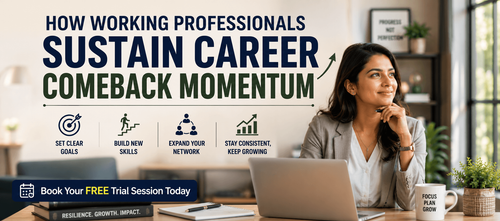

Building Sustainable Career Growth After a Professional Comeback: A Practical Guide for Long-Term Growth
Career recovery is often celebrated as a major milestone. Whether it follows a job loss, a difficult professional phase, burnout, or a stalled career path, regaining stability is a significant achievement. But many professionals encounter a new challenge immediately after recovery: maintaining momentum.
Initial recovery can feel energising because it is driven by urgency and clear goals. The focus is often on securing stability—finding a new role, rebuilding confidence, or regaining financial security. However, once that immediate pressure fades, many professionals unknowingly return to reactive work patterns. Without a clear system to maintain growth, progress slows and careers plateau exactly when they should be accelerating.
This transition period is where many professionals lose momentum. Recovery restores stability, but sustained growth requires intentional direction. Professionals need to shift from **survival mode to strategy mode**—moving beyond short-term fixes and focusing on long-term career positioning, skill development, and opportunity creation.
This is why structured guidance becomes critical. Sustained career growth requires deliberate systems, consistent habits, and strategic relationship-building. Developing a routine for learning, reflecting on progress, and expanding professional networks can help maintain forward momentum. Equally important is identifying the skills and capabilities that will remain valuable in a changing professional landscape.
Practical tools can make this process easier. Templates, frameworks, and guided exercises help professionals clarify their goals, prioritise the right actions, and track meaningful progress. These resources turn abstract career advice into clear steps that can be implemented alongside daily work responsibilities.
Download these resources and apply them consistently to improve clarity, productivity, and professional growth. You can also book a free trial to receive expert guidance and strengthen key capabilities such as communication, problem-solving, and decision-making. The materials are designed in a clear, structured format so professionals can learn efficiently, apply insights quickly, and build the confidence needed to sustain long-term career progress.
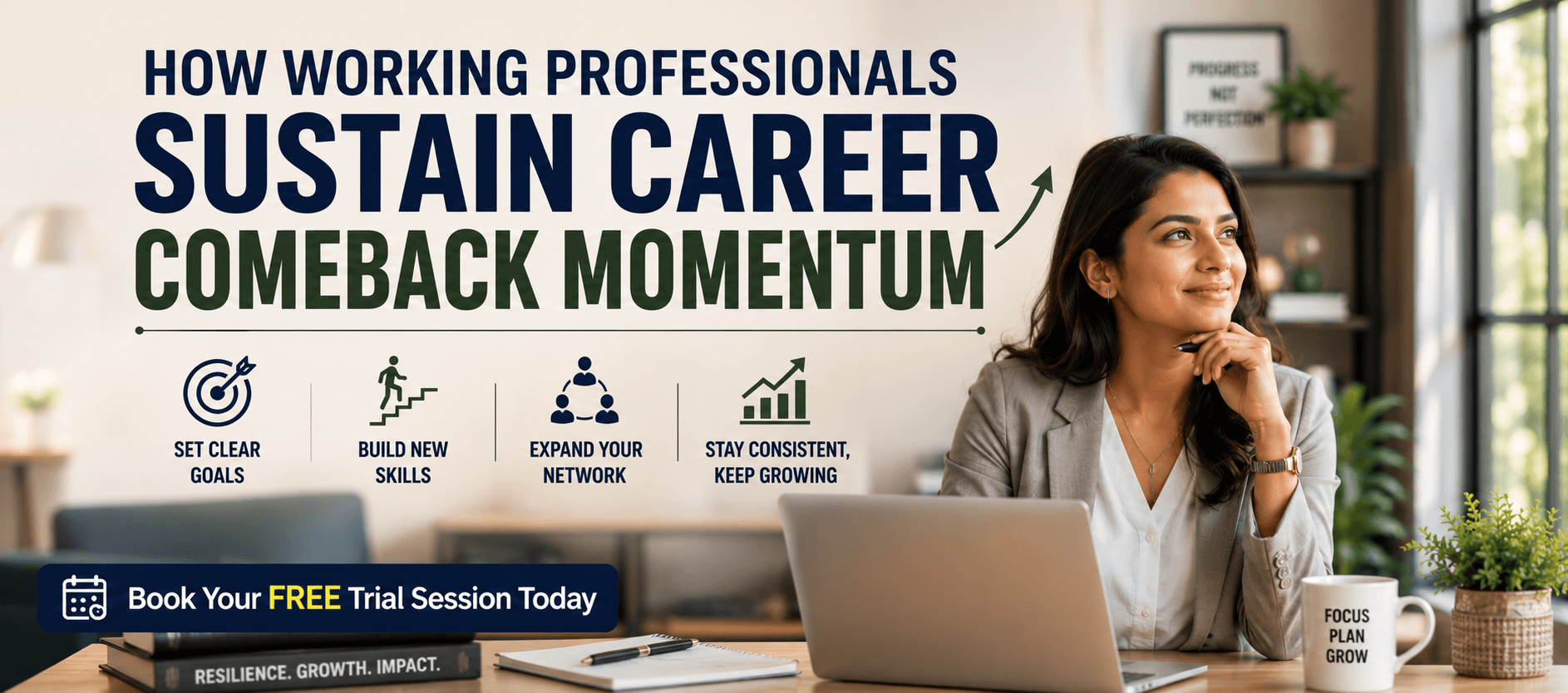
Who Is This Blog For?
- Professionals who recently overcame a career setback and want to maintain progress
- Employees aiming to avoid career stagnation after achieving stability
- Mid-career professionals seeking long-term acceleration and leadership opportunities
- Individuals rebuilding confidence and professional reputation after a challenging phase
- Ambitious professionals who want a system for consistent career growth
Why This Topic Matters Today?
The modern professional landscape is more dynamic and competitive than ever. Roles evolve quickly, industries shift rapidly, and opportunities increasingly favour those who remain visible, adaptable, and proactive.
One of the biggest mistakes professionals make after recovering from a career setback is assuming that stability equals progress. Being busy, delivering consistent work, and maintaining routine can create the illusion of forward movement. However, activity alone does not guarantee growth.
Without clear signals of progress—such as expanding responsibilities, greater trust from leadership, increased visibility, or growing professional relationships—it becomes easy to drift into a comfortable plateau.
Sustained career growth requires intentional momentum. Professionals must continuously evaluate whether their opportunities are expanding, their capabilities are increasing, and their professional reputation is strengthening.
Those who actively design their growth trajectory are far more likely to transform temporary recovery into lasting career advancement.
Core Concept or Framework Explained
The central framework of sustaining career progress revolves around designing momentum rather than hoping it continues naturally. The guide introduces several interconnected ideas that help professionals maintain upward movement.
The Horizon Goal
Every professional needs a clear direction. A written 12-month horizon goal acts as the anchor for all career decisions and activities.
Without a defined goal, professionals often drift. They respond to daily tasks without evaluating whether those actions move them toward meaningful growth.
Breaking this 12-month vision into smaller 90-day milestones creates manageable checkpoints. These milestones ensure consistent progress and provide opportunities to reassess direction when necessary.
The Career Growth Engine
Momentum is not created by occasional bursts of effort. It emerges from consistent habits repeated over time.
The guide recommends four weekly actions that serve as the engine of professional growth:
- One visibility action that demonstrates your expertise or contribution
- A focused learning session to strengthen skills and market value
- A relationship-building outreach to expand professional networks
- A short reflection period to evaluate progress and adjust priorities
These actions may seem small individually, but together they create compounding momentum.
Identity Upgrade
Another powerful concept introduced in the guide is the shift from a “recovery identity” to a “growth identity.”
Professionals who recently overcame challenges often continue to view themselves through the lens of that struggle. However, sustainable progress requires a shift in perspective.
Instead of identifying as someone recovering from setbacks, professionals must see themselves as individuals with resilience, expanded capabilities, and valuable experience.
This identity shift influences how you communicate, how you pursue opportunities, and how others perceive your professional potential.
How This Blog and Guidebook Help You?
This blog translates the guidebook’s practical frameworks into clear, actionable insights that professionals can apply immediately.
By following these strategies, you can:
- Maintain momentum after overcoming career setbacks
- Build habits that support long-term professional growth
- Increase visibility within your organization and industry
- Strengthen relationships that open new opportunities
- Prevent stagnation through regular self-assessment
Instead of relying on motivation alone, the guide provides a structured system for sustained career advancement.
Step-by-Step Breakdown
Step 1: Define Your 12-Month Career Horizon
The first step in sustaining progress is clarity. Professionals must establish a clear vision of where they want to be within the next year.
Your horizon goal should describe a meaningful outcome such as:
- A promotion or expanded leadership role
- Mastery of a new professional skill
- Transition into a new department or industry
- Increased influence within your organization
Once defined, break this goal into quarterly milestones so progress can be measured every 90 days.
Step 2: Build a Weekly Growth Engine
Career growth rarely happens through occasional intense effort. Instead, it is driven by consistent habits.
A simple weekly system can create powerful long-term impact:
- Share one professional insight or contribution to increase visibility
- Dedicate focused time to skill development or learning
- Reach out to one professional contact to strengthen relationships
- Reflect briefly on your progress and adjust priorities
These small actions compound into stronger professional momentum over time.
Step 3: Upgrade Your Professional Identity
After overcoming challenges, professionals often carry a narrative centered on recovery.
However, sustained success requires reframing that story. Instead of focusing on the setback, emphasize the strengths developed during that period—resilience, adaptability, problem-solving, and perspective.
When communicated thoughtfully, your recovery story becomes a powerful differentiator rather than a limitation.
Step 4: Protect Your Gains from Hidden Career Traps
Even strong momentum can erode if professionals become complacent.
The guide identifies five common traps that quietly weaken progress:
- Comfort Collapse, where stability leads to complacency
- Network Neglect, where relationships are ignored once stability returns
- Learning Stop, where professionals stop investing in skill development
- Story Hiding, where valuable experiences remain unshared
- Solo Navigation, where individuals attempt to grow without guidance
Recognizing these traps early allows professionals to correct course before progress stalls.
Step 5: Build a Three-Tier Support System
Sustained career growth rarely happens alone. The guide recommends maintaining three types of professional relationships:
- Mentor: someone with greater experience who offers guidance
- Peer Partner: a colleague who supports accountability and shared growth
- Sponsor: a senior professional who advocates for your advancement
Together, these relationships form a support structure that accelerates career development.
Step 6: Track Momentum Through Clear Indicators
Because progress can be difficult to evaluate day-to-day, professionals need external signals that confirm growth.
Examples of momentum indicators include:
- Being invited into more strategic conversations
- Receiving greater trust from leadership
- Contributing to high-impact projects
- Expanding professional networks
- Developing skills that increase your market value
Tracking these signals quarterly provides a realistic picture of your trajectory.
Step 7: Reassess and Recalibrate Every 90 Days
Even the best career plans require adjustments.
Every three months, professionals should review their horizon goal, evaluate progress indicators, and update their strategy. This cycle of reflection ensures that momentum remains intentional rather than accidental.
Regular reassessment keeps growth aligned with changing opportunities and evolving goals.
Common Mistakes or Pitfalls to Avoid
Many professionals unintentionally undermine their progress after recovering from a setback.
Common pitfalls include:
- Assuming stability automatically leads to career growth
- Neglecting professional relationships once work becomes busy
- Failing to set clear long-term goals
- Stopping skill development after achieving short-term success
- Avoiding reflection and performance evaluation
A better approach is to treat career momentum as a system that requires regular attention and improvement.
How Should You Use This Guidebook Effectively?
To apply the ideas from this guide effectively, follow a simple implementation process.
Start by defining your 12-month horizon goal and breaking it into 90-day milestones. Then design a weekly routine that includes visibility actions, skill development, relationship building, and reflection.
Every quarter, perform a structured review of your progress. Assess whether your opportunities are expanding, whether your capabilities are improving, and whether your professional network is strengthening.
This cycle of action and evaluation turns career growth into a repeatable system rather than a series of random events.
Key Takeaways
- Career recovery should be viewed as the beginning of long-term growth
- Clear 12-month horizon goals provide direction and prevent career drift
- Small weekly habits create sustained professional momentum
- Identity shifts from recovery to growth strengthen confidence and credibility
- Professional relationships are essential infrastructure for advancement
- Tracking momentum indicators ensures progress is measurable and intentional
- Quarterly reflection helps professionals recalibrate and maintain upward movement
Your Next Step: Accelerate Your Career with PlanetSpark
Creating an impact-driven resume is not just about landing your next job—it’s about owning your professional story and presenting it with clarity, confidence, and credibility. When your resume clearly communicates value, results, and impact, opportunities follow naturally.
At PlanetSpark, we are committed to empowering working professionals with practical, outcome-focused resources that drive real career growth. From resume building and workplace communication to leadership presence and professional writing, our programs are designed to help you succeed in today’s fast-evolving job market.
Visit https://www.planetspark.in/resources to explore:
- Career and resume-building guides
- Workplace communication and professional writing resources
- Skill-development tools curated for working professionals
Want a deeper, hands-on experience?
You can also book a free trial session to learn more about PlanetSpark’s Working Professional Courses, designed to accelerate your career through personalised coaching, real-world practice, and expert guidance.
Your career deserves more than generic advice.
It deserves clarity, confidence, and measurable impact.
Start building that advantage today—with PlanetSpark.
Personalized Communication Roadmaps
Record a video to get a AI generated personalized communication reports