
Identify and Remove Team Bottlenecks for Faster Execution
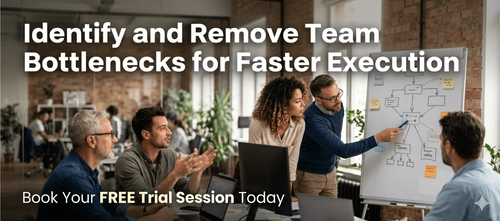

Why Smart Managers Identify Team Bottlenecks Early to Improve Productivity and Performance
Every team experiences slowdowns. A project that seemed perfectly on track suddenly stalls. Tasks remain “almost complete” for days. One employee becomes overwhelmed while others wait for approvals, updates, or clarity before moving forward. Meetings increase, deadlines begin slipping quietly, and frustration spreads across the team without anyone fully understanding the real cause.
Most organisations assume these problems come from poor performance or lack of motivation. In reality, they are often caused by bottlenecks hidden inside workflows, communication systems, approval structures, or overloaded roles. These bottlenecks rarely appear dramatically at first. Instead, they build gradually until productivity, morale, and execution speed start breaking down across the entire team.
The “How to Identify and Remove Team Bottlenecks Early” playbook provides a practical framework for solving this challenge before it turns into a larger operational problem. Instead of reacting after projects fail, the guide teaches managers and professionals how to proactively detect workflow constraints, diagnose their root causes, and remove them systematically. Through workflow mapping, bottleneck diagnostics, communication improvements, and process redesign strategies, teams can move faster, collaborate better, and maintain high performance consistently.
Download these resources and apply them alongside your daily work for improved clarity, productivity, and professional growth. You can also book a free trial to gain expert guidance and enhance your communication, problem-solving, and decision-making skills. The materials are designed in a clear, structured format to help professionals learn efficiently and implement insights with confidence.
Who Is This Blog For?
- Managers leading fast-moving or cross-functional teams
- Team leaders struggling with recurring delays and inefficiencies
- Consultants improving operational performance for clients
- Startup founders building scalable team systems
- Working professionals transitioning into leadership roles
- Project managers handling multiple workflows and dependencies
- Professionals aiming to improve collaboration and execution speed
Why This Topic Matters Today?
Modern workplaces operate under constant pressure for faster delivery, stronger collaboration, and higher accountability. Teams are expected to manage increasing workloads while adapting to remote collaboration, shifting priorities, and growing operational complexity.
According to the playbook, bottlenecks are not signs of weak teams. They are structural realities of collaborative work environments.
Bottlenecks typically emerge from:
- Unclear handoffs
- Misaligned priorities
- Communication gaps
- Mismatched workloads
- Overloaded approval structures
When left unresolved, these issues compound over time and begin affecting:
- Productivity
- Employee morale
- Team trust
- Project timelines
- Leadership credibility
The resource also explains that many bottlenecks remain invisible because teams normalize them as “just being busy.”
Early bottleneck detection matters today because organisations can no longer afford hidden inefficiencies. Teams that identify and resolve constraints quickly gain a major competitive advantage in speed, adaptability, and execution quality.
Core Concept or Framework Explained
The playbook introduces a complete bottleneck identification and removal system focused on proactive diagnosis rather than reactive firefighting.
The framework includes:
- Understanding bottleneck types
- Mapping workflows
- Running diagnostics
- Removing people bottlenecks
- Redesigning processes
- Improving communication systems
- Building early detection habits
The Four Bottleneck Types
The guide explains that most bottlenecks fall into four categories:
People Bottlenecks
These occur when too much work depends on one individual.
Examples include:
- One expert handling critical approvals
- A manager required in every decision
- A specialist holding undocumented knowledge
Process Bottlenecks
These emerge from inefficient workflow design.
Examples include:
- Too many approval layers
- Unnecessary process steps
- Repeated manual tasks
Communication Bottlenecks
These happen when information flow becomes fragmented or unclear.
Examples include:
- Delayed updates
- Ambiguous handoffs
- Siloed information
Tools Bottlenecks
These occur when systems or technology slow work down.
Examples include:
- Poor tool integrations
- Manual workarounds
- Missing automation
The guide emphasises that each bottleneck type requires a different solution.
The Workflow Mapping Process
One of the most important frameworks in the playbook is workflow mapping.
The process involves:
- Capturing every workflow stage
- Assigning ownership
- Identifying handoffs
- Tracking wait times
The guide explains that many teams skip workflow mapping because they assume everyone already understands the process. However, different team members often hold completely different assumptions about how work flows.
Making workflows visible helps leaders identify:
- Delayed approvals
- Ownership confusion
- Rework loops
- Communication gaps
The Bottleneck Diagnostic System
Once workflows are mapped, the playbook recommends a structured diagnostic process.
The system includes:
- Measuring queue depth
- Tracking cycle time
- Interviewing team members
- Identifying single points of failure
- Classifying bottleneck types
The resource also introduces the 5-Why Technique, which helps managers move beyond symptoms and identify root causes.
The STOP-SIMPLIFY-AUTOMATE-DELEGATE Framework
For process bottlenecks, the guide introduces a redesign framework focused on simplifying workflows.
Managers evaluate each process step by asking:
STOP
- Should this step exist at all?
SIMPLIFY
- Can the process require fewer actions or approvals?
AUTOMATE
- Can software or tools handle this task?
DELEGATE
- Can authority move closer to the actual work?
This framework helps teams eliminate unnecessary operational friction.
How This Blog and Guidebook Help You?
This blog and playbook provide professionals with a practical system for identifying and removing operational slowdowns before they become crises.
The resource helps professionals:
- Detect workflow inefficiencies early
- Improve team productivity and execution speed
- Reduce approval delays and communication gaps
- Eliminate unnecessary process complexity
- Improve accountability and ownership clarity
- Build scalable operational systems
- Create proactive team management habits
Unlike generic productivity advice, the guide focuses heavily on real-world workflow diagnostics and actionable operational improvements.
Step-by-Step Breakdown
Step 1: Understand What a Bottleneck Really Is
The playbook defines a bottleneck as any point where incoming work exceeds the system’s ability to process it effectively.
This creates:
- Queue buildup
- Delays
- Workflow paralysis
The guide also explains that bottlenecks are structural constraints rather than isolated problems.
Understanding this difference changes how managers respond to delays and inefficiencies.
Step 2: Learn the Early Warning Signs
Many bottlenecks appear subtly before becoming major issues.
The guide highlights several early warning indicators:
- Tasks staying “almost done” for too long
- One employee appearing in every meeting
- Questions piling up without answers
- Deadlines slipping routinely
- Teams relying on “hero workarounds”
The resource warns that repeatedly depending on one employee to rescue projects often hides deeper structural problems.
Step 3: Map Your Team’s Workflow
The playbook strongly recommends visualising workflows before trying to fix problems.
Managers should document:
- Every workflow stage
- Task ownership
- Handoff points
- Average wait times
- Rework loops
- Tools used at each stage
This process makes hidden inefficiencies visible.
The guide also recommends running workflow mapping sessions collaboratively because differences between team assumptions often reveal bottlenecks immediately.
Step 4: Run the Bottleneck Diagnostic
After mapping workflows, managers should diagnose the constraint systematically.
The guide recommends:
Measure Queue Depth
- Identify where work piles up most frequently
Track Cycle Time
- Measure how long tasks remain at each stage
Interview the Team
- Ask employees what slows their work down most often
Identify Single Points of Failure
- Find individuals who control too many workflow stages
Classify the Bottleneck Type
- Determine whether the issue is related to people, process, communication, or tools
This structured diagnostic process prevents managers from solving the wrong problem.
Step 5: Remove People Bottlenecks
People bottlenecks are among the most common operational constraints.
The playbook recommends several strategies:
Document Critical Knowledge
- Create SOPs, guides, or training resources
Cross-Train Employees
- Reduce dependency on one expert
Protect Focus Time
- Remove low-value tasks from overloaded employees
Delegate with Authority
- Transfer decision-making power, not just tasks
The guide also introduces the “70% Rule.”
If another employee can perform a task at least 70% as effectively as the bottleneck person, delegation is often more beneficial than waiting for perfection.
Step 6: Redesign Process Bottlenecks
Process bottlenecks often emerge from outdated operational systems.
The guide recommends reviewing workflows using the STOP-SIMPLIFY-AUTOMATE-DELEGATE framework.
Common red flags include:
- Excessive approval layers
- Manual copy-pasting between systems
- Status updates through long email chains
- Recurring meetings without ownership clarity
The resource explains that many inefficient processes survive simply because “that’s how we’ve always done it.”
Step 7: Improve Communication Systems
Communication bottlenecks are especially common in remote and hybrid teams.
The guide recommends:
Create a Single Source of Truth
- Centralise project status and decisions
Standardise Handoff Language
- Use templates for task transfers
Replace Status Meetings with Async Updates
- Reduce unnecessary meetings
Assign Clear Decision Owners
- Remove authority ambiguity
These changes reduce confusion, rework, and unnecessary delays.
Step 8: Build Early Detection Habits
The playbook emphasises that the strongest teams identify bottlenecks before they become major problems.
Recommended rhythm:
Daily
- Async blocker check-ins
Weekly
- Workflow queue scans
Monthly
- Health scorecard reviews
Quarterly
- Full workflow remapping
The guide also stresses the importance of psychological safety. Teams surface bottlenecks earlier when employees feel safe reporting blockers without fear of judgment.
Common Mistakes or Pitfalls to Avoid
The playbook highlights several common management mistakes.
Adding More People to Broken Processes
More employees increase coordination complexity if the real issue is workflow design.
Promoting the Bottleneck Person
Promoting critical experts without knowledge transfer creates even larger dependency risks.
Fixing Symptoms Instead of Systems
Adding more meetings or approvals rarely solves the root cause.
Ignoring Workflow Mapping
Trying to fix problems without visibility often leads to ineffective solutions.
Waiting Too Long to Act
Small delays become large operational problems when ignored repeatedly.
How Should You Use This Guidebook Effectively?
The playbook works best when implemented as an operational improvement system rather than passive reading material.
Recommended workflow:
- Read the guide fully once
- Map one critical workflow immediately
- Run the Bottleneck Diagnostic Worksheet
- Identify the primary bottleneck type
- Apply the relevant removal strategy
- Measure improvements after implementation
- Repeat quarterly as workflows evolve
The guide also includes a structured 30-day implementation plan:
Week 1
- Map workflows and diagnose constraints
Week 2
- Design the bottleneck removal strategy
Week 3
- Implement changes and communicate clearly
Week 4
- Measure results and refine the process
This phased approach makes operational improvement manageable and sustainable.
Key Takeaways
- Bottlenecks are structural constraints, not personal failures
- Workflow mapping is essential before solving operational problems
- People, process, communication, and tools bottlenecks require different solutions
- Early warning signs often appear before major delays occur
- The 5-Why Technique helps identify root causes instead of symptoms
- The STOP-SIMPLIFY-AUTOMATE-DELEGATE framework improves process design
- Communication clarity reduces rework and delays
- Psychological safety improves early bottleneck detection
- Regular workflow reviews prevent recurring operational friction
- High-performing teams remove constraints faster than others
Your Next Step: Accelerate Your Career with PlanetSpark
Creating an impact-driven resume is not just about landing your next job—it’s about owning your professional story and presenting it with clarity, confidence, and credibility. When your resume clearly communicates value, results, and impact, opportunities follow naturally.
At PlanetSpark, we are committed to empowering working professionals with practical, outcome-focused resources that drive real career growth. From resume building and workplace communication to leadership presence and professional writing, our programs are designed to help you succeed in today’s fast-evolving job market.
Visit https://www.planetspark.in/resources to explore:
- Career and resume-building guides
- Workplace communication and professional writing resources
- Skill-development tools curated for working professionals
Want a deeper, hands-on experience?
You can also book a free trial session to learn more about PlanetSpark’s Working Professional Courses, designed to accelerate your career through personalised coaching, real-world practice, and expert guidance.
Your career deserves more than generic advice.
It deserves clarity, confidence, and measurable impact.
Personalized Communication Roadmaps
Record a video to get a AI generated personalized communication reports