
Identify Hidden Assumptions in Decisions: Practical Guide
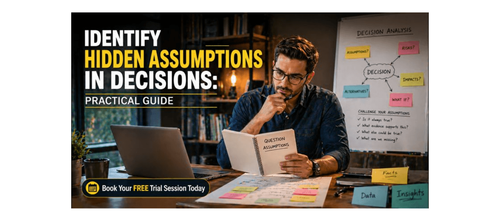

How to Identify Hidden Assumptions in Your Decision-Making: A Practical Framework for Clearer, More Confident Choices
Most professionals believe they are making decisions based on facts, data, and logical reasoning. But in reality, a large part of every decision is built on something far less visible—assumptions.
These assumptions feel like facts. They feel obvious. They feel unquestionable.
And that is exactly why they are dangerous.
You may assume a client values speed over quality, a team has enough bandwidth, or a market is growing. But if even one of these assumptions is wrong, your entire decision can collapse.
As highlighted in the guide, professionals across all levels consistently make high-stakes decisions based on assumptions they never consciously examined—leading to misalignment, costly errors, and missed opportunities.
The real issue is not that assumptions exist. It is that they remain hidden.
This blog is based on a structured worksheet framework that helps you surface, test, and refine your assumptions—so your decisions are built on reality, not invisible beliefs.

Download these resources and apply them alongside your daily work for improved clarity, productivity, and professional growth. You can also book a free trial to gain expert guidance and enhance your communication, problem-solving, and decision-making skills. The materials are designed in a clear, structured format to help professionals learn efficiently and implement insights with confidence.
Who Is This Blog For?
- Working professionals making complex or high-stakes decisions
- Managers responsible for hiring, strategy, or execution
- Consultants evaluating ambiguous business scenarios
- Entrepreneurs navigating uncertain environments
- Individuals struggling with unclear or inconsistent decision outcomes
Why This Topic Matters Today?
In modern professional environments, decisions are increasingly complex, fast-paced, and high-impact.
As explained in the guide (page 2), hidden assumptions often lead to:
- Strategic misalignment
- Incorrect problem framing
- Poor hiring or investment decisions
- Ineffective project planning
- Faulty negotiations
The challenge is subtle:
Assumptions do not feel like guesses—they feel like truth.
This creates a false sense of certainty, making it harder to question your own thinking.
The key insight:
Better decisions do not come from more data alone—they come from better examination of what you already believe.
Core Concept or Framework Explained
The framework is built around a four-step assumption audit process:
- Define the decision clearly
- Surface hidden assumptions
- Stress-test assumptions
- Challenge cognitive biases
As shown across the worksheet modules (pages 3–7), this structured approach transforms invisible thinking into visible, testable inputs.
The core idea:
You are not eliminating assumptions—you are making them deliberate.
How This Blog and Guidebook Help You?
By applying this framework, you can:
- Identify hidden risks before they impact outcomes
- Improve clarity in complex decisions
- Reduce reliance on guesswork
- Strengthen decision confidence
- Build more defensible and robust choices
You move from unconscious thinking to structured reasoning.
Step-by-Step Breakdown
Step 1: Define the Decision Clearly
The guide (page 4) emphasises that poor decisions often begin with poor problem definition.
Key actions:
- Write the decision in one clear sentence
- Define what success looks like
- Identify the decision owner
Example:
- Weak: Should we hire a consultant?
- Strong: How should we address the capability gap in our team within 60 days?
Key insight:
A vague decision creates vague assumptions.
Step 2: Surface Your Assumptions Systematically
The guide (page 5) introduces a structured “Assumption Dump” across four domains:
- People: What do others believe, want, or expect?
- Data: What information are you trusting?
- Environment: What external conditions are assumed?
- Yourself: What are your own biases or limitations?
As shown in the visual worksheet (page 5), this step requires deliberate effort—most professionals miss assumptions simply because they never look for them.
Key insight:
If you finish this step quickly, you have not gone deep enough.
Step 3: Categorise Types of Assumptions
The guide (page 3) defines four types:
- Factual: What you believe is true
- Causal: What you believe will happen
- Value: What you think matters most
- Scope: What constraints or boundaries exist
Example:
- “The market is growing” → Factual
- “This strategy will increase revenue” → Causal
Understanding types improves clarity and analysis.
Step 4: Stress-Test Your Assumptions
The guide (page 6) introduces a powerful prioritisation model:
Evaluate each assumption on:
- Criticality: How important is it?
- Certainty: How confident are you?
Focus on:
- High critical + low certainty → Validate immediately
- High critical + high certainty → Monitor
- Low critical → Accept and move
Key insight:
Not all assumptions deserve equal attention.
Step 5: Challenge Cognitive Biases
The guide (page 7) highlights three major biases:
Anchoring Bias:
- Over-reliance on initial information
Confirmation Bias:
- Seeking only supporting evidence
Social Proof Bias:
- Assuming consensus equals truth
Key insight:
The assumptions you feel most confident about are often the most dangerous.
Step 6: Apply the Assumption Audit Checklist
The guide (page 9) provides a structured checklist:
Before decision:
- Define the decision clearly
- Identify success criteria
- Check for pre-selected options
During audit:
- List assumptions across all domains
- Seek external perspectives
During validation:
- Prioritise critical assumptions
- Gather evidence
Before finalising:
- Reframe the decision if needed
- Document remaining assumptions
- Set review triggers
This ensures consistency and completeness.
Step 7: Learn from Real-World Application
The case study (page 8) shows a product manager who assumed:
- Her team had capacity
- Customers wanted customisation
- Vendor pricing was too high
After testing these assumptions:
- All three were incorrect
- The decision changed completely
- The outcome improved significantly
Key insight:
Assumptions shape decisions more than data.
Common Mistakes or Pitfalls to Avoid
The guide highlights frequent errors (page 10):
- Skipping assumption audits under time pressure
- Listing only “safe” assumptions
- Treating assumption-testing as a solo activity
- Validating assumptions after deciding
- Confusing consensus with truth
Better practices include:
- Time-boxing the audit
- Seeking external input
- Testing assumptions before deciding
- Focusing on high-impact assumptions
How Should You Use This Guidebook Effectively?
To maximise results:
- Use the framework for real decisions
- Spend 20–45 minutes per major decision
- Apply a quick version for smaller decisions
- Revisit assumptions periodically
Suggested workflow:
- Define → Surface → Test → Decide
Consistency builds clarity and confidence.
Key Takeaways
- Every decision is built on assumptions—whether visible or not
- Hidden assumptions are the biggest source of decision errors
- Clear problem definition reduces faulty assumptions
- Systematic assumption mapping improves awareness
- Prioritising critical assumptions improves efficiency
- Cognitive biases protect unexamined beliefs
- External perspectives reveal blind spots
- Better decisions come from better thinking—not just more data
Your Next Step: Accelerate Your Career with PlanetSpark
Creating an impact-driven resume is not just about landing your next job—it’s about owning your professional story and presenting it with clarity, confidence, and credibility. When your resume clearly communicates value, results, and impact, opportunities follow naturally.
At PlanetSpark, we are committed to empowering working professionals with practical, outcome-focused resources that drive real career growth. From resume building and workplace communication to leadership presence and professional writing, our programs are designed to help you succeed in today’s fast-evolving job market.
Visit https://www.planetspark.in/resources to explore:
- Career and resume-building guides
- Workplace communication and professional writing resources
- Skill-development tools curated for working professionals
Want a deeper, hands-on experience?
You can also book a free trial session to learn more about PlanetSpark’s Working Professional Courses, designed to accelerate your career through personalised coaching, real-world practice, and expert guidance.
Your career deserves more than generic advice.
It deserves clarity, confidence, and measurable impact.
Start building that advantage today—with PlanetSpark.
Personalized Communication Roadmaps
Record a video to get a AI generated personalized communication reports