
Identifying AI Skill Gaps and Strengths for Career Success
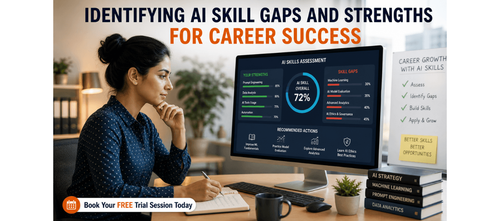

Map Your AI Growth: Mapping Strengths & Gaps in Your AI Skillset for Professional Success
AI is rapidly becoming a baseline skill across industries—from marketing and operations to finance, HR, and consulting. But despite AI’s growing importance, most professionals are unsure where they stand in their AI journey, leaving them feeling uncertain and overwhelmed. This blog will help you map out your AI strengths and identify key areas for growth, giving you the clarity and direction needed to stay ahead in your career.
In this post, we will guide you through a structured process to assess your current AI skillset, prioritize growth areas, and build a targeted action plan to level up your capabilities—whether you’re switching careers, advancing in your current role, or leading AI initiatives.
Download these resources and apply them alongside your daily work for improved clarity, productivity, and professional growth. You can also book a free trial to gain expert guidance and enhance your communication, problem-solving, and decision-making skills. The materials are designed in a clear, structured format to help professionals learn efficiently and implement insights with confidence.
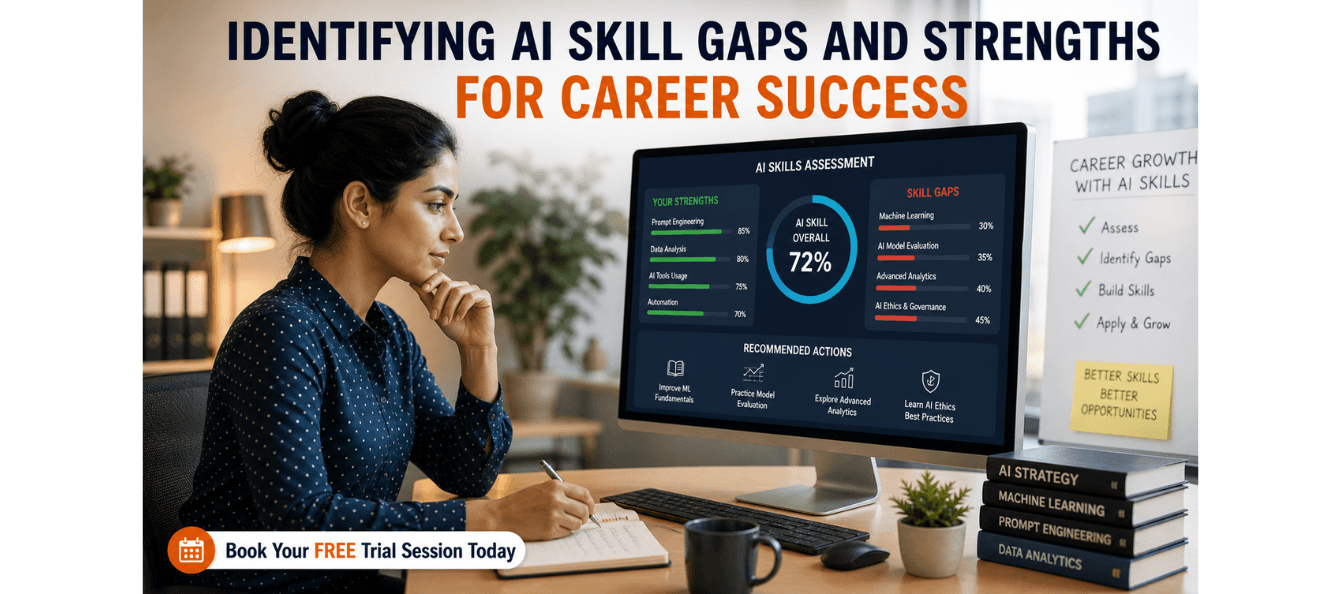
Who Is This Blog For?
- Career switchers entering AI-adjacent roles
- Early–mid career professionals (0–15 years)
- Consultants advising on digital transformation
- Managers leading AI-enabled teams
- Job seekers differentiating themselves
Why This Topic Matters Today?
AI has become a baseline skill expected in nearly every profession, but without a structured approach, professionals often struggle to assess their AI skills. Some may feel overwhelmed by the speed of AI advancements or unclear about what to prioritize in their learning. This blog helps you address this gap by providing a personalized approach to evaluating your current AI skillset and planning actionable next steps.
By mapping out your AI strengths and gaps, you’ll be able to tackle your growth strategically, rather than feeling buried under a constant stream of new tools and techniques. A clear roadmap is essential for transforming AI anxiety into confidence and measurable progress.
Core Concept or Framework Explained
The foundation of this process is the AI Skills Scorecard—a practical tool to help you assess where you stand with AI and identify areas for growth. The scorecard breaks down AI skills into three levels:
1. Awareness: Understanding AI concepts, types, and ethical implications.
2. Application: Actively using AI tools to automate, analyze, or generate content.
3. Mastery: Designing AI-enabled workflows, advising others, and evaluating AI tools critically.
These three levels form the core framework for the scorecard and help you determine where your role demands expertise and where you need to improve.
How This Blog and Guidebook Help You?
By following this blog and the accompanying AI Skills Scorecard, you will:
- Gain a clear, honest picture of your current AI skillset
- Identify gaps in key AI capabilities that need to be addressed
- Build a personalized 30-day action plan to focus your efforts
- Develop a sustainable plan for continuous learning and growth
Step-by-Step Breakdown
Step 1: Understand the AI Skills Landscape
The first step in your journey is understanding the AI skills landscape. AI is broader than many realize and can be broken down into three key layers:
1. Awareness: You know what AI is, its ethical considerations, and its potential in your industry.
2. Application: You use AI tools in your day-to-day work, adapting them to your specific tasks.
3. Mastery: You can design AI workflows, guide others, and critically assess AI tools.
Understanding which layer you're currently operating in—and which layer your role demands—is the foundation of the scorecard.
Reflection Questions:
- What is your current understanding of AI?
- How often do you use AI tools in your role?
- What level of AI expertise does your role demand now and in the future?
Step 2: Score Your Current AI Capabilities
Now that you understand the AI skills landscape, rate yourself across six core skill domains using a simple 1–4 scale (1 = No exposure, 2 = Basic awareness, 3 = Active use, 4 = Confident and consistent). These six domains will give you a snapshot of where you stand:
1. AI Literacy: Understanding AI concepts, types, and limitations
2. Prompt Engineering: Writing effective prompts for LLMs (e.g., ChatGPT, Gemini, Claude)
3. Data Interpretation: Reading AI outputs, dashboards, and analytics
4. Workflow Automation: Using tools like Zapier, Make, or Copilot to automate tasks
5. AI Ethics & Risk: Understanding bias, privacy, responsible use, and governance
6. Strategic AI Thinking: Identifying where AI creates value in your role or business
For each domain, score your current abilities and the requirements for your role. Subtract your self-score from the role requirement score for each domain to identify priority gaps.
Step 3: Identify Your Strengths to Build On
While identifying gaps is important, don’t overlook your existing strengths. Your strengths are your foundation for growth. Recognize which areas you excel in and use them to accelerate learning in areas where you’re less confident.
Reflection Questions:
- Which AI skill domain did you score highest in? What experiences helped you build that capability?
- Where have you already used AI—even informally—and what did you learn?
- Which of your existing professional skills (e.g., analysis, communication, project management) transfer directly into AI contexts?
- Who in your network is further along in AI, and what can you learn from them?
Step 4: Map Your Priority Gaps
After identifying your strengths, it’s time to focus on your gaps. Not all gaps are equal—some are urgent, while others are strategic or developmental. Use the following categories to prioritize your growth areas:
1. Urgent Gaps: Skills your current role requires that you’re not using confidently. These need to be addressed within 30 days.
2. Strategic Gaps: Skills that will be needed in your next role or in 12–18 months. Address these within 90 days.
3. Developmental Gaps: Skills that are valuable long-term but not immediately critical. These can be addressed within 6–12 months.
Map your gaps to these categories, creating a focused action plan that prioritizes urgent gaps first.
Step 5: Build Your 30-Day AI Growth Plan
A scorecard without an action plan is just a snapshot. This step helps you transform your self-assessment into a concrete, time-bound commitment. Focus exclusively on your top-performing Urgent Gap during this period. Follow a 4-week plan:
- Week 1: Learn: Consume one focused resource on your Urgent Gap.
- Week 2: Apply: Use the skill in a real task related to your role.
- Week 3: Reflect: Review what worked and make adjustments.
- Week 4: Share: Teach or document your learning for accountability.
Your 30-day commitment should align directly with your real tasks and goals, ensuring that the learning sticks and adds visible value.
Step 6: Self-Evaluation and Progress Tracking
At the end of each month, use the self-evaluation checklist to track your progress. This regular reflection will help you stay on course and adjust your learning priorities as the AI landscape evolves.
Key Takeaways
- AI skills exist on a spectrum—move from Awareness to Application and then Mastery.
- Leverage your existing professional skills to accelerate AI learning.
- Prioritize gaps by urgency and impact on your role.
- Consistently apply new AI skills to real work tasks to ensure they stick.
- Revisit your AI skill map regularly to stay relevant in a fast-evolving industry.
Your Next Step: Accelerate Your Career with PlanetSpark
Creating an impact-driven resume is not just about landing your next job—it’s about owning your professional story and presenting it with clarity, confidence, and credibility. When your resume clearly communicates value, results, and impact, opportunities follow naturally.
At PlanetSpark, we are committed to empowering working professionals with practical, outcome-focused resources that drive real career growth. From resume building and workplace communication to leadership presence and professional writing, our programs are designed to help you succeed in today’s fast-evolving job market.
Visit https://www.planetspark.in/resources to explore:
- Career and resume-building guides
- Workplace communication and professional writing resources
- Skill-development tools curated for working professionals
Want a deeper, hands-on experience?
You can also book a free trial session to learn more about PlanetSpark’s Working Professional Courses, designed to accelerate your career through personalised coaching, real-world practice, and expert guidance.
Your career deserves more than generic advice.
It deserves clarity, confidence, and measurable impact.
Personalized Communication Roadmaps
Record a video to get a AI generated personalized communication reports