
Improve Financial Judgment: Practical Guide for Complex Decisions


How to Strengthen Financial Judgment in Complex Situations: A Practical Framework for Smarter, Faster, and More Confident Decisions
Every working professional eventually reaches a point where decisions are no longer straightforward.
You are no longer just executing tasks—you are evaluating trade-offs, interpreting numbers, and making calls that impact budgets, projects, and outcomes. And in these moments, technical knowledge alone is not enough.
You may have the data. You may have the reports. But the real question is:
Can you interpret them correctly, ask the right questions, and make a decision that stands up under pressure?
This is where most professionals struggle—not because they lack intelligence, but because they lack structured financial judgment.
As highlighted in the guide, financial judgment is one of the most underrated career skills, directly influencing credibility, decision quality, and professional growth.
This blog is based on a practical playbook designed to help you build this capability—so you can move from reading numbers to shaping decisions.
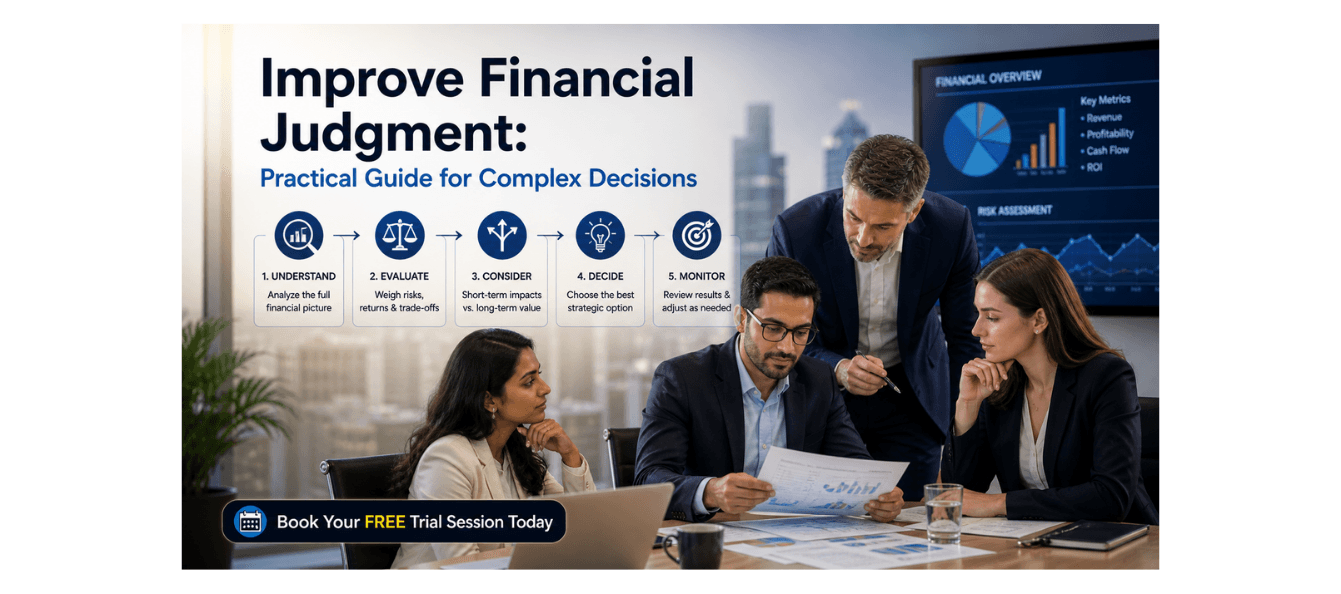
Download these resources and apply them alongside your daily work for improved clarity, productivity, and professional growth. You can also book a free trial to gain expert guidance and enhance your communication, problem-solving, and decision-making skills. The materials are designed in a clear, structured format to help professionals learn efficiently and implement insights with confidence.
Who Is This Blog For?
- Working professionals involved in financial or strategic decisions
- Managers handling budgets, projects, or investments
- Consultants and analysts evaluating business scenarios
- Mid-career professionals aiming to improve decision credibility
- Individuals who want to build confidence in financial discussions
Why This Topic Matters Today?
Modern professional roles increasingly require financial decision-making—even outside finance functions.
As explained in the guide (page 2), common challenges include:
- Lack of formal training in financial decision-making
- Over-reliance on finance teams
- Misinterpretation of financial data
- Low confidence in high-stakes decisions
This creates a hidden gap:
Professionals can read numbers—but struggle to act on them.
The key insight:
Financial judgment—not financial knowledge—is what differentiates high-impact professionals.
Core Concept or Framework Explained
Financial judgment operates at three levels (page 4):
- Financial Literacy: Understanding numbers
- Financial Analysis: Evaluating numbers
- Financial Judgment: Making decisions using numbers
As illustrated in the layered model on page 4, judgment sits at the top—it integrates data, context, risk, and strategy into actionable decisions.
The guide also introduces five core pillars (page 5):
- Contextual Clarity
- Risk Sensitivity
- Trade-off Thinking
- Time Horizon Awareness
- Communication Precision
These pillars work together to create strong, reliable decision-making capability.
The key idea:
Great decisions are not driven by data alone—they are driven by structured thinking.
How This Blog and Guidebook Help You?
By applying this framework, you can:
- Interpret financial information with confidence
- Make better decisions under uncertainty
- Identify risks before they become problems
- Communicate financial insights effectively
- Build credibility with stakeholders and leadership
You move from analysing numbers to influencing outcomes.
Step-by-Step Breakdown
Step 1: Build Context Before Analysing Numbers
The guide (page 6) emphasises a critical mistake:
Most professionals jump directly into numbers.
Instead, start with context:
- What decision needs to be made?
- What is the business objective?
- Who prepared the data and why?
- What assumptions are being made?
Use the Context-First Checklist (page 6):
- What is not shown in the data?
- What external factors matter?
Key insight:
Numbers without context lead to wrong conclusions.
Step 2: Focus on the Financial Metrics That Matter
You do not need to master every metric.
The guide (page 7) highlights key ones:
- Revenue vs Profit
- Cash Flow vs Profit
- Fixed vs Variable Costs
- Return on Investment (ROI)
- Burn Rate and Runway
Each metric answers a different question.
For example:
- Profit shows sustainability
- Cash flow shows survival
Key insight:
Understanding the right metrics improves decision clarity.
Step 3: Develop Risk Sensitivity
Strong professionals ask:
“What could go wrong?”
As explained on page 8:
- Identify key assumptions
- Stress-test them
- Analyse downside scenarios
A powerful question from the guide:
“What would have to be true for this to fail?”
This reveals hidden risks and weak assumptions.
Key insight:
Risk awareness strengthens—not slows—decision-making.
Step 4: Think in Trade-Offs, Not Isolated Options
Every decision involves alternatives.
The guide (page 9) emphasises:
- Always compare options
- Consider opportunity cost
- Evaluate risk vs return
Example:
- A 20% ROI may seem strong
- But compared to a 30% alternative, it is weaker
Key insight:
Better decisions come from comparison, not isolation.
Step 5: Understand Time Horizon Impact
Financial decisions operate across timeframes (page 10):
- Immediate (0–3 months)
- Near-term (3–12 months)
- Medium-term (1–3 years)
- Long-term (3+ years)
Short-term cost vs long-term value is a common conflict.
The guide introduces a key idea:
Value today is different from value tomorrow.
Key insight:
Time perspective changes decision quality.
Step 6: Communicate Financial Insights Effectively
Even strong analysis fails without clear communication.
The guide introduces the RNAS framework (page 11):
- Recommendation: State your position clearly
- Numbers: Share key supporting data
- Assumptions & Risk: Highlight uncertainties
- So What: Define the next action
Key insight:
Clarity drives influence.
Step 7: Use Structured Decision Frameworks
The guide provides a Decision Matrix (page 12):
Evaluate options based on:
- Financial return
- Risk level
- Strategic fit
- Time to value
This ensures balanced decision-making.
Key insight:
Structure improves objectivity.
Step 8: Apply Learning Through Real Scenarios
The case study (page 14) shows:
A manager evaluating market expansion options.
Key outcomes:
- Identified risk differences
- Compared ROI correctly
- Considered strategic priorities
- Recommended phased expansion
The result:
A better decision aligned with business goals.
Key insight:
Frameworks improve real-world outcomes.
Common Mistakes or Pitfalls to Avoid
The guide highlights common errors (page 15):
- Anchoring on the first number
- Confusing precision with accuracy
- Ignoring non-financial costs
- Presenting analysis without recommendations
- Focusing on activity instead of value
Better practices include:
- Questioning assumptions
- Comparing alternatives
- Including qualitative factors
- Always providing a recommendation
How Should You Use This Guidebook Effectively?
To maximise results:
- Apply one concept in your next financial discussion
- Use the checklist before analysing data
- Practise the RNAS framework in communication
- Use decision matrices for comparisons
Suggested workflow:
- 10–15 minutes preparation
- Structured analysis
- Clear communication
Consistency builds capability.
Key Takeaways
- Financial judgment is a critical professional skill
- Context matters more than raw numbers
- Understanding key metrics improves clarity
- Risk sensitivity strengthens decisions
- Trade-off thinking improves evaluation
- Time horizon awareness changes perspective
- Communication determines impact
- Structured frameworks improve decision quality
Your Next Step: Accelerate Your Career with PlanetSpark
Creating an impact-driven resume is not just about landing your next job—it’s about owning your professional story and presenting it with clarity, confidence, and credibility. When your resume clearly communicates value, results, and impact, opportunities follow naturally.
At PlanetSpark, we are committed to empowering working professionals with practical, outcome-focused resources that drive real career growth. From resume building and workplace communication to leadership presence and professional writing, our programs are designed to help you succeed in today’s fast-evolving job market.
Visit https://www.planetspark.in/resources to explore:
- Career and resume-building guides
- Workplace communication and professional writing resources
- Skill-development tools curated for working professionals
Want a deeper, hands-on experience?
You can also book a free trial session to learn more about PlanetSpark’s Working Professional Courses, designed to accelerate your career through personalised coaching, real-world practice, and expert guidance.
Your career deserves more than generic advice.
It deserves clarity, confidence, and measurable impact.
Start building that advantage today—with PlanetSpark.
Personalized Communication Roadmaps
Record a video to get a AI generated personalized communication reports