
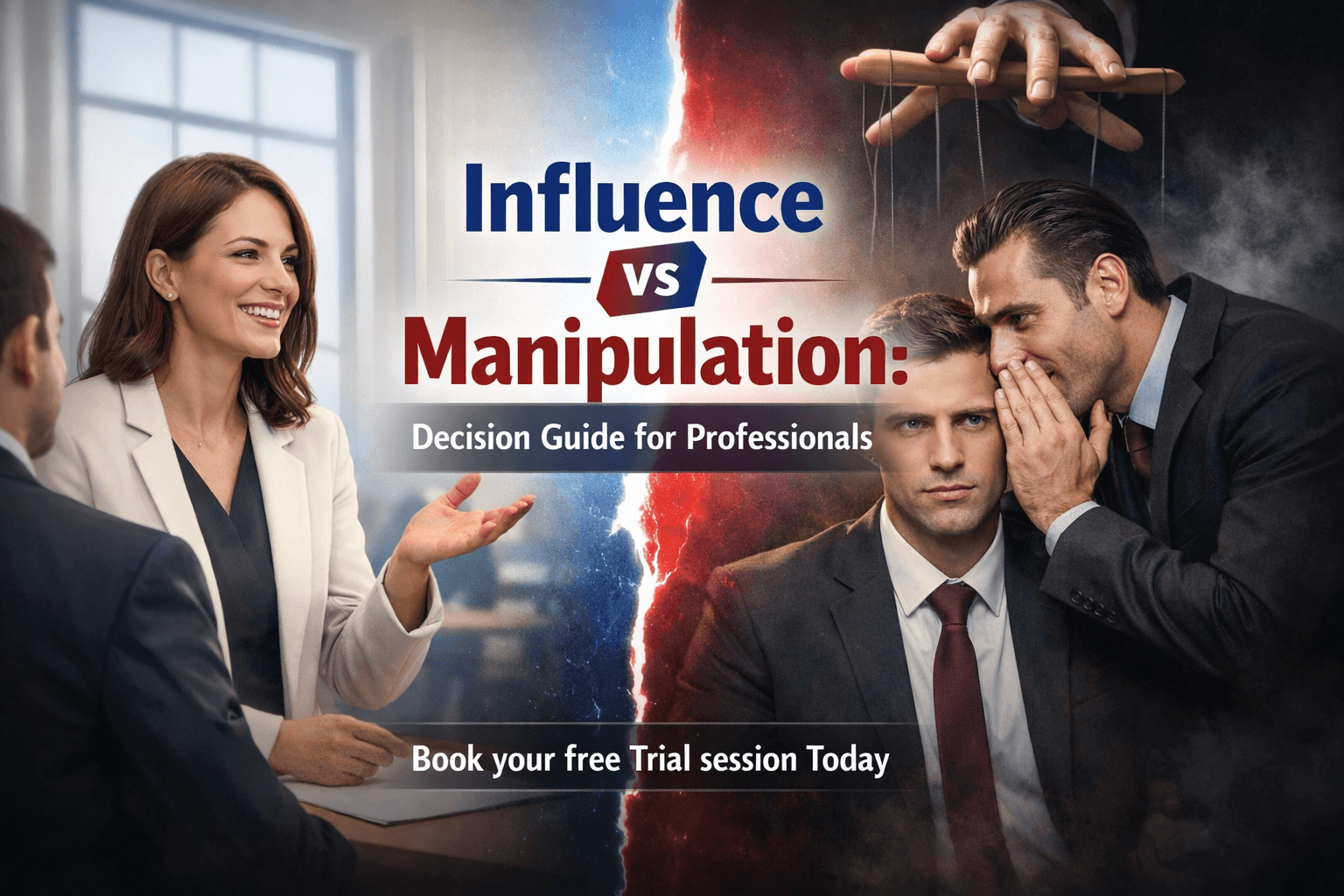
Influence vs Manipulation: Decision Guide for Professionals
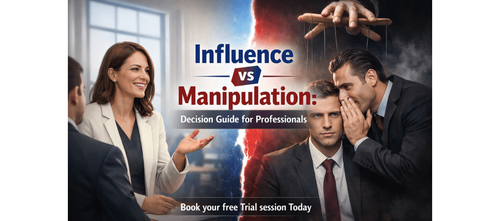

Communicating with Integrity at Work: A Practical Framework to Build Trust Without Crossing Ethical Boundaries
You’re in a meeting, presenting an idea you strongly believe in. You frame your argument, highlight benefits, and push for a decision. But later, a thought lingers—did you influence the outcome fairly, or did you unintentionally push too hard?
This is a dilemma most working professionals face daily but rarely articulate. In today’s fast-paced, performance-driven workplace, the pressure to persuade, close, convince, and deliver results can blur the line between ethical influence and manipulation.
The guidebook “Influence vs Manipulation: The Decision Framework for Working Professionals” addresses this exact challenge by offering a clear, actionable framework to help professionals communicate with integrity, build trust, and influence outcomes without compromising ethics.
What makes this framework particularly valuable is its practicality. It doesn’t rely on abstract theories or idealistic advice—instead, it breaks down real workplace scenarios into simple decision checkpoints. It helps professionals pause and evaluate intent, transparency, and impact before communicating, ensuring that influence remains constructive rather than coercive.
The guide also highlights subtle but critical differences—such as the role of consent, clarity of information, and respect for the other person’s autonomy. These distinctions often go unnoticed in everyday interactions but have a lasting impact on professional relationships, team culture, and personal credibility.
By applying this framework consistently, professionals can move beyond short-term wins driven by pressure or persuasion tactics, and instead build long-term trust, stronger collaboration, and a reputation for ethical leadership. Over time, this not only improves decision-making outcomes but also creates a more respectful and psychologically safe work environment.
In a world where communication defines success, the ability to influence ethically is no longer optional—it is a core professional skill.
Book your free trial session today with Planetspark.
Download for more details or PDF file.
Who Is This Blog For?
- Working professionals navigating stakeholder conversations,
negotiations, and decision-making
- Managers and team leaders responsible for guiding teams and influencing outcomes
- Consultants and client-facing professionals handling high-stakes persuasion
- Career switchers and early to mid-career professionals building communication credibility
- Anyone who wants to influence effectively without damaging trust or relationships
Why This Topic Matters Today?
Modern workplaces demand strong communication and persuasion skills. Whether you are pitching ideas, managing clients, or leading teams, your ability to influence decisions directly impacts your career growth.
However, as highlighted in the guidebook, the real risk lies in the “grey zone”—where actions are not clearly unethical but still cross subtle boundaries. This includes:
- Cherry-picking data to strengthen your case
- Creating artificial urgency to drive faster decisions
- Using selective information to guide outcomes
These practices may deliver short-term wins but often lead to long-term consequences such as loss of trust, damaged relationships, and reduced credibility.
In a professional world where trust is a key currency, ethical influence is no longer optional—it is essential.
Core Concept or Framework Explained
At the heart of the guidebook is a powerful shift: influence is not about outcomes, but about process.
The guide defines the difference clearly:
- Influence is transparent, respects autonomy, and allows the other person to make an informed decision
- Manipulation bypasses rational thinking, exploits biases, and limits awareness to engineer a specific outcome
A key insight from the guide is that both influence and manipulation can lead to the same result. What differentiates them is how that result was achieved.
To operationalise this distinction, the guide introduces a practical 5-question decision framework that professionals can apply before any important conversation.
This framework moves ethical decision-making from vague intuition to structured thinking.
How This Blog and Guidebook Help You?
This blog, based on the guidebook, helps you:
- Recognise the difference between ethical persuasion and manipulation in real situations
- Identify grey-zone behaviours before they damage trust
- Apply a clear decision-making framework in real time
- Improve communication clarity, transparency, and credibility
- Build long-term influence that strengthens professional relationships
The outcome is not just better communication—it is sustainable career growth built on trust and integrity.
Step-by-Step Breakdown
Step 1: Intention Audit – Why Are You Doing This?
Every act of influence starts with intention. The guide emphasises that professionals must examine their real motives—not the socially acceptable ones, but the actual drivers behind their actions.
Ask yourself:
- Whose interest am I serving?
- Would I be comfortable if they knew my full reasoning?
- Am I okay if they say no?
If your intention serves only your own outcome and ignores the other person’s interests, it signals a potential ethical risk.
This step creates self-awareness before action, which is critical in high-stakes situations.
Step 2: Information Integrity – What Are You Sharing and Hiding?
Manipulation often hides in what is not said.
The guidebook introduces an “Information Integrity Test” that focuses on four key areas:
- Completeness: Are you sharing the full picture?
- Accuracy: Is your data truthful and not misleading?
- Relevance: Are you providing what they need to decide?
- Context: Are you presenting information fairly?
Common pitfalls include:
- Cherry-picked statistics
- Omitting risks or downsides
- Presenting opinions as facts
The guiding principle is simple: if a reasonable person would feel misled after knowing everything, the approach is unethical.
Step 3: Method Check – How Are You Doing It?
Even with good intentions and accurate information, your method can still cross into manipulation.
The guide categorises methods into three zones:
- Ethical methods
- Evidence-based arguments
- Honest storytelling
- Transparent communication
- Grey zone methods
- Social proof pressure
- Manufactured urgency
- Selective framing
- Manipulative methods
- Fear-based pressure
- Guilt-tripping
- False scarcity
A key insight is that many grey-zone tactics become ethical when made transparent. For example, openly stating your negotiation strategy removes the manipulative element.
Step 4: Impact Assessment – What Happens After?
Ethical influence is not just about immediate results—it considers long-term consequences.
Evaluate impact across three dimensions:
- Immediate: Does the person feel informed and respected?
- Relational: Does this strengthen or damage trust?
- Systemic: Would this behaviour be acceptable if widely adopted?
The guide highlights that tactics that achieve results but erode trust are ultimately ineffective.
Step 5: Reversibility Test – Could You Come Clean?
This is the most powerful and practical test in the framework.
Ask yourself:
- If I fully explained my intentions, methods, and information, would the relationship survive?
If the answer is no, the approach is likely manipulative.
This test cuts through rationalisation and forces honest self-assessment before action.
Common Mistakes or Pitfalls to Avoid
The guidebook outlines common manipulation traps professionals fall into:
- The convenient omission of important information
- Creating artificial deadlines to pressure decisions
- Exaggerating social proof such as “everyone thinks this”
- Amplifying risks to create fear-based urgency
- Framing choices to make only one option seem viable
- Using relationships to bypass critical thinking
- Justifying unethical behaviour as a one-time exception
Each of these may seem minor in isolation but collectively erode trust and credibility over time.
How Should You Use This Guidebook Effectively?
To get maximum value from the framework, follow a structured approach:
- Read the guide once to understand the overall concept
- Apply the 5-question framework before important conversations
- Use the intention audit worksheet for high-stakes decisions
- Reflect after conversations to identify patterns
- Commit to a 30-day practice cycle to build habits
The guide suggests a simple yet powerful routine:
- Daily: Run a quick ethical check before key conversations
- Weekly: Reflect on one interaction
- Monthly: Identify behavioural patterns and triggers
This approach transforms ethical communication from theory into practice.
Key Takeaways
- Influence and manipulation differ in process, not outcome
- The grey zone is where most ethical mistakes occur
- The 5-question framework provides a clear decision-making tool
- Transparency reduces manipulation and builds trust
- Ethical influence leads to stronger, long-term professional relationships
- Consistent practice is essential to mastering communication integrity
---
Your Next Step: Accelerate Your Career with PlanetSpark
Creating an impact-driven resume is not just about landing your next job—it’s about owning your professional story and presenting it with clarity, confidence, and credibility. When your resume clearly communicates value, results, and impact, opportunities follow naturally.
At PlanetSpark, we are committed to empowering working professionals with practical, outcome-focused resources that drive real career growth. From resume building and workplace communication to leadership presence and professional writing, our programs are designed to help you succeed in today’s fast-evolving job market.
Visit https://www.planetspark.in/resources to explore:
- Career and resume-building guides
- Workplace communication and professional writing resources
- Skill-development tools curated for working professionals
Want a deeper, hands-on experience?
You can also book a free trial session to learn more about PlanetSpark’s Working Professional Courses, designed to accelerate your career through personalised coaching, real-world practice, and expert guidance.
Your career deserves more than generic advice.
It deserves clarity, confidence, and measurable impact.
Start building that advantage today—with PlanetSpark.
---
Personalized Communication Roadmaps
Record a video to get a AI generated personalized communication reports