
Interview Answer Quality Checklist for Job Seekers (2026)
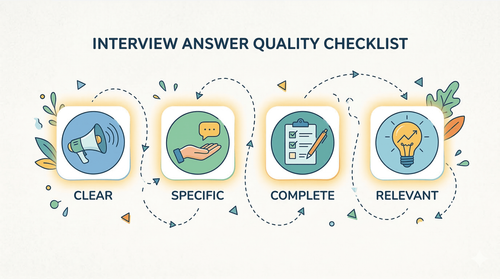

How to Perfect Your Interview Answers: A Step-by-Step Guide for Professionals
When preparing for interviews, most candidates focus on what to say. However, what truly differentiates successful candidates is not just the content of their answers, but how effectively they deliver them. The gap between landing the job and missing out often comes down to the quality of answers: their structure, relevance, clarity, and delivery.
Interviewers are not just assessing your experience, they are evaluating how you think, communicate, and perform under pressure. This means your ability to craft clear, structured, and impactful answers is as important as the stories you choose to tell.
In this guide, we’ll walk you through how to prepare, evaluate, and refine your interview answers so that you leave a lasting, positive impression. Whether you’re switching careers, seeking a promotion, or entering the job market, mastering these techniques will set you up for success.
Who Is This Blog For?
This blog is for professionals in the early to mid-career stages, including:
- Career changers preparing for high-stakes interviews
- Managers and consultants looking to demonstrate leadership and adaptability
- Job seekers aiming to improve their interview performance
- Anyone who wants to level up their interview game and stand out in the competitive job market
If you’ve ever struggled to craft concise, impactful answers in interviews or feel your performance isn’t reflecting your potential, this guide is for you.
Why Answer Quality Matters
In today’s competitive job market, interviewers are looking for more than just qualifications—they want to see how candidates perform under pressure and whether they can effectively communicate their value. Many candidates fail to convey their experience in a way that resonates with the interviewer, even though their technical knowledge may be solid.
The key is to go beyond simply providing the right answer. High-quality answers are structured, relevant, specific, and delivered with confidence. Here’s why answer quality is crucial:
- Structure: A well-structured answer is easy for interviewers to follow and demonstrates clarity in thinking.
- Specificity: Vague answers fail to create a strong impact. Specific examples with measurable outcomes are memorable.
- Relevance: Your answers should directly address the job’s requirements, showing you understand the role’s challenges.
- Delivery: Confident delivery shows composure and ensures your answers come across as credible and professional.
By mastering these areas, you’ll stand out as someone who not only understands the technical requirements but also has the communication skills to succeed in the role.
How to Prepare for Success
Preparation is your unfair advantage in any interview. High-quality answers are built before you even step into the room. Here’s how to set yourself up for success:
1. Research the Role Deeply
To tailor your answers effectively, begin by understanding the role and the company’s specific needs. Study the job description, identify core competencies the role demands, and research the company’s culture and challenges. The better you align your answers with what the company values, the more relevant your responses will feel.
2. Build a Story Bank
Prepare a collection of stories from your career that highlight the competencies required for the role. Aim for 8–10 distinct stories, each focusing on different situations such as leadership, conflict resolution, failure, and results. These stories should be specific, focused, and tied to measurable outcomes.
3. Apply a Structure Framework
Choose a structure framework like STAR (Situation, Task, Action, Result) or CAR (Context, Action, Result) to organize your answers. This ensures clarity and prevents rambling. Structuring your answers in this way helps you deliver them with confidence, making it easier for interviewers to understand your contributions.
4. Anticipate the Hard Questions
There are certain questions every candidate dreads, such as discussing weaknesses, gaps in experience, or why you left previous roles. By anticipating these questions and preparing thoughtful, honest answers, you ensure you don’t freeze when faced with them. Practicing your answers to these tough questions first will help you feel more confident during the interview.
Quick Win: Print the job description and highlight action verbs (e.g., "lead," "collaborate," "manage"). These verbs can guide you in selecting stories that match the role’s key competencies.
Delivering High-Quality Answers
Preparation is just the first step. Once you have your stories and structure in place, it’s time to focus on how you deliver them. The way you present your answers is just as important as the content.
Here’s how to make sure your answers are impactful:
1. Clarity and Structure
Every answer should have a clear beginning, middle, and end. Stick to 1–2 sentences for context, describe your role and actions in 2–3 concrete steps, and finish with a clear, quantifiable result. Keep your answers under 2.5 minutes to avoid overwhelming the interviewer.
2. Specificity and Impact
Use real numbers, percentages, or timeframes wherever possible. This adds credibility and shows the tangible impact of your actions. Avoid vague words like "helped" or "contributed," and instead focus on what you specifically did and the outcome it achieved.
3. Own Your Contribution
Always use "I" to describe your role in the project. For example, instead of saying “we worked together,” say “I led the team” or “I initiated the solution.” This ensures the interviewer understands your individual contribution.
4. Relevance
Make sure each story directly ties to the job you are applying for. If the interviewer is looking for leadership, focus on examples where you led teams or projects. If they value adaptability, demonstrate how you managed change or worked under pressure.
5. Reflection and Learning
At the end of each story, include a reflection or learning moment. This shows self-awareness and a growth mindset. For instance, after discussing a challenge you overcame, you could say, “This experience taught me how to manage competing priorities effectively.”
Post-Answer Reflection: How to Improve
After answering each question, take a moment to reflect on your response. This self-evaluation will help you identify areas for improvement, ensuring that you continuously refine your interview technique.
1. The Clarity Test
If someone unfamiliar with your industry heard your answer, would they understand what you did and why it mattered? If not, refine your answer to make it clearer and more focused.
2. The Ownership Test
Check your use of "I" versus "we." Did you take clear ownership of your contributions, or did you blend into the team? Personal ownership signals leadership and maturity.
3. The Relevance Test
Does your answer directly address the specific needs of the employer? Re-read the job description and ensure your response aligns with their priorities.
4. The Impact Test
What changed because of what you did? Make sure every answer has a concrete outcome that highlights your value. If the result wasn’t immediate, focus on what you learned and how you would approach the situation differently in the future.
Common Mistakes to Avoid
Many candidates make similar mistakes that undermine their answers. Here’s how to avoid them:
- The "We" Trap: Avoid giving group answers that don’t highlight your individual role. Always ensure the interviewer knows what you personally contributed.
- The Vague Achievement: Avoid general statements like "I improved performance." Use specific metrics to show the tangible impact of your work.
- The Endless Context: Keep context brief—don’t spend too long explaining the situation. Focus on what you did and the outcome.
- The Non-Failure Failure: Be honest about failures. Don’t spin them into success stories; instead, focus on the learning and growth that followed.
- The Dead-Air Ending: Always finish your answers with a strong outcome or learning. A story without a conclusion is incomplete.
Final Pre-Interview Checklist
As your interview approaches, use this checklist to make sure you are fully prepared:
- Have you prepared at least 8–10 distinct stories that cover core competencies?
- Does each story include a measurable outcome or verifiable result?
- Can you deliver your answers in 90 seconds or less?
- Have you tailored your stories to match the job description and company needs?
- Have you practiced aloud and refined your answers based on feedback?
Key Takeaways
- Quality interview answers are the result of strong preparation, structure, and delivery.
- Use frameworks like STAR or SOAR to ensure clarity and impact in your responses.
- Be specific and focus on your personal contribution.
- Always reflect on your answers to identify areas for improvement.
Your Next Step: Accelerate Your Career with PlanetSpark
Creating an impact-driven resume is not just about landing your next job—it’s about owning your professional story and presenting it with clarity, confidence, and credibility. When your resume clearly communicates value, results, and impact, opportunities follow naturally.
At PlanetSpark, we are committed to empowering working professionals with practical, outcome-focused resources that drive real career growth. From resume building and workplace communication to leadership presence and professional writing, our programs are designed to help you succeed in today’s fast-evolving job market.
Visit https://www.planetspark.in/resources to explore:
- Career and resume-building guides
- Workplace communication and professional writing resources
- Skill-development tools curated for working professionals
Want a deeper, hands-on experience?
You can also book a free trial session to learn more about PlanetSpark’s Working Professional Courses, designed to accelerate your career through personalised coaching, real-world practice, and expert guidance.
Your career deserves more than generic advice.
It deserves clarity, confidence, and measurable impact.
Personalized Communication Roadmaps
Record a video to get a AI generated personalized communication reports