
Interview Readiness Self-Assessment Guide for Professionals
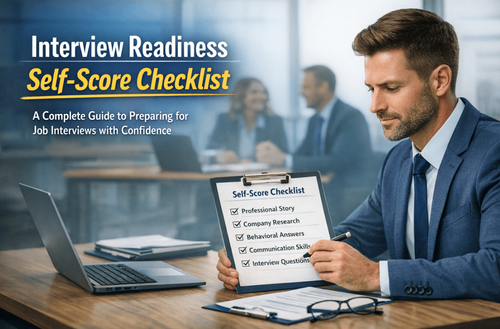

Interview Readiness Self-Score Checklist: A Complete Guide to Preparing for Job Interviews with Confidence
Many professionals assume that interview preparation simply means rehearsing answers to common questions. They spend time practising responses to prompts like “Tell me about yourself” or revisiting their most impressive achievements. Yet when the real interview begins, they often find themselves struggling to articulate their value, losing confidence under pressure, or leaving the conversation feeling they did not represent their experience effectively.
The reality is that interview success is rarely determined by a single answer. It depends on several interconnected dimensions such as your professional narrative, your understanding of the company and role, your ability to tell structured career stories, your communication presence, and even the questions you ask during the conversation.
Missing just one of these areas can weaken an otherwise strong candidacy.
That is exactly why the Interview Readiness Self-Score Checklist from PlanetSpark was created. This resource provides a structured way for professionals to assess their interview preparation across multiple dimensions, identify gaps in readiness, and build a targeted preparation plan before their next interview.
Instead of guessing whether you are ready for your next interview, this checklist helps you evaluate your readiness objectively and prepare with clarity and confidence.
Who Is This Blog For?
This guide and checklist are designed for professionals who want to improve their interview performance and secure better career opportunities.
- Early-career professionals preparing for their first major interviews
- Mid-career professionals exploring new roles, promotions, or industry shifts
- Professionals re-entering the job market after several years in the same role
- Career switchers transitioning to a new industry or function
- Consultants and specialists moving into corporate roles
- Job seekers who have strong experience but struggle to communicate it effectively in interviews
Why This Topic Matters Today?
The hiring landscape has changed significantly in recent years. Employers are no longer evaluating candidates based solely on experience or qualifications. Instead, they assess how clearly candidates communicate their value, how well they understand the organisation, and how effectively they demonstrate real-world impact.
Interview readiness is therefore a multi-dimensional capability.
According to the PlanetSpark checklist, interview success depends on your ability to articulate your professional story, demonstrate behavioural competencies, communicate with confidence, and engage thoughtfully with interviewers.
Without preparation across these dimensions, even highly qualified professionals can struggle during interviews.
Some of the most common challenges candidates face include:
- Rambling or unclear explanations of their career journey
- Weak examples when answering behavioural questions
- Limited research about the company or industry
- Nervous communication or lack of presence
- Asking generic questions that fail to demonstrate real interest
These issues often prevent strong candidates from converting interviews into job offers.
A structured preparation framework helps professionals avoid these pitfalls and approach interviews strategically.
Core Concept or Framework Explained
The Interview Readiness Self-Score Checklist is built around six critical dimensions of interview performance. Together, these dimensions form a comprehensive framework that helps professionals evaluate their readiness before stepping into an interview.
Each dimension represents a specific capability that influences hiring decisions.
The six dimensions include:
Professional Story
Your ability to clearly explain your career journey, motivations, and value.
Company and Role Research
Your understanding of the organisation, its challenges, and the specific role you are applying for.
Behavioural and Competency Answers
Your ability to provide structured, evidence-based examples from your past experience.
Communication Presence
Your verbal delivery, body language, pacing, and overall professional presence.
Questions You Ask
Your ability to ask thoughtful, insightful questions that demonstrate preparation and strategic thinking.
Logistics and Mindset
Your practical preparation and mental readiness before the interview begins.
The checklist uses a scoring system that allows professionals to rate themselves on a scale of 1 to 5 across each dimension, helping them identify the areas that require the most improvement.
How This Blog and Guidebook Help You?
This blog and the accompanying checklist help professionals prepare for interviews in a structured and practical way.
Instead of approaching interviews with vague preparation, you can:
- Diagnose your current interview readiness
- Identify the specific areas that require improvement
- Develop targeted preparation strategies
- Practise with clear frameworks and examples
- Walk into interviews with greater confidence
The checklist can also be used in different preparation scenarios.
Professionals can conduct a detailed self-assessment, quickly scan the sections to identify weak areas, or review the summary checklist the day before an important interview.
This flexibility makes it a practical tool for professionals at every stage of their career.
Step-by-Step Breakdown
Your Professional Story: Can You Explain Your Career Clearly?
Before any interview technique can work, you need a clear professional narrative.
This narrative should explain your career journey in a logical and compelling way. Interviewers often form their first impression within the first few minutes of the conversation, and your story helps them understand how your experience connects to the role you are applying for.
A strong professional narrative includes three key elements.
The Core Narrative
You should be able to summarise your career journey in about 90 seconds. This explanation should connect your past roles, skills, and experiences to the opportunity you are pursuing.
The Pivot Explanation
If you are changing industries, functions, or seniority levels, you must clearly explain why. A credible pivot story helps interviewers understand the logic behind your career move.
The Value Proposition
You should be able to explain what makes you different from other candidates. This could include a specialised skill set, unique experience, or a specific professional strength.
Recording yourself answering questions such as “Walk me through your background” can be a powerful exercise for improving this narrative.
Company and Role Research: Do You Understand Your Audience?
Many candidates underestimate the importance of researching the company and the role.
Walking into an interview without a strong understanding of the organisation signals low preparation and weak interest.
Strong candidates research multiple aspects of the company before the interview.
Company Intelligence
Understand the company’s business model, revenue streams, mission, and recent developments.
Role Alignment
Map the responsibilities listed in the job description to specific examples from your past experience.
People Research
Learn about the interviewers, their professional backgrounds, and any shared interests or connections.
Competitive Context
Understand the industry landscape and the challenges the company is currently facing.
This level of preparation allows candidates to speak the organisation’s language and demonstrate genuine interest.
Behavioural and Competency Answers: Are Your Stories Ready?
Behavioural interview questions are widely used by hiring managers to evaluate real-world skills.
Questions such as:
- Tell me about a time you handled conflict
- Describe a project that failed
- Explain a situation where you led without authority
These questions require structured examples from your professional experience.
The checklist recommends using the STAR-Q framework.
Situation
Explain the context.
Task
Describe your responsibility.
Action
Explain what you did.
Result
Share the measurable outcome.
So What?
Connect the result to broader impact or lessons learned.
Quantifying results is especially important. Numbers make your achievements credible and memorable.
Communication Presence: How Do You Actually Come Across?
Even strong answers can lose impact if they are delivered poorly.
Communication presence includes both verbal and non-verbal communication.
Strong verbal communication involves:
- Speaking at a clear and measured pace
- Using specific language rather than vague descriptions
- Structuring answers with a clear beginning, middle, and end
- Adjusting language for technical or non-technical audiences
Non-verbal communication is equally important.
This includes posture, eye contact, facial expressions, and body language.
Recording yourself answering interview questions can reveal communication habits that you might not notice during live conversations.
Questions You Ask: The Other Half of the Interview
Many candidates treat the “Do you have any questions for us?” moment as a formality.
In reality, the questions you ask often reveal your curiosity, preparation, and strategic thinking.
Strong questions might explore topics such as:
- The priorities for the role in the first 90 days
- Strategic initiatives the company is currently pursuing
- The qualities that help employees succeed in the organisation
Generic questions about company culture or daily routines may show curiosity but do not demonstrate deeper preparation.
Candidates should ideally prepare five to seven thoughtful questions before each interview.
Logistics and Mindset: The Details That Derail Candidates
Even well-prepared candidates can underperform due to small logistical mistakes.
Arriving late, technical issues during virtual interviews, or poor mental preparation can negatively affect interview performance.
The checklist highlights several areas to prepare in advance.
Before the interview:
- Confirm the interview format and time
- Test technology for virtual interviews
- Review notes about the company and role
- Prepare professional attire
- Conduct a mock interview
On the day of the interview:
- Eat a proper meal
- Arrive early
- Review your key stories and professional narrative
- Practise breathing exercises to manage nerves
Mental preparation is also essential. Approaching the interview as a two-way conversation helps candidates remain calm and confident.
Common Mistakes or Pitfalls to Avoid
Many interview failures are caused by a few common mistakes.
Telling Instead of Selling
Candidates often describe responsibilities rather than explaining measurable impact.
Generic Questions
Asking broad questions that every candidate asks reduces your ability to stand out.
Weak Pivot Explanations
Career transitions require a clear and confident narrative.
Lack of Preparation
Candidates who fail to research the company or role struggle to demonstrate relevance.
Poor Communication Delivery
Nervous pacing, filler words, or weak body language can reduce the effectiveness of strong answers.
Avoiding these mistakes significantly improves interview performance.
How Should You Use This Guidebook Effectively?
The Interview Readiness Self-Score Checklist can be used in several ways depending on your preparation timeline.
Deep Preparation
Read every module carefully and score yourself honestly across each dimension.
Gap Identification
Focus on the sections where your scores are lowest and prioritise improving those areas.
Day-Before Review
Use the summary checklist as a final preparation tool before the interview.
The scoring system helps professionals understand their overall readiness level.
Lower scores indicate areas that require focused preparation, while higher scores suggest strong readiness with minor improvements needed.
Using the checklist regularly can turn interview preparation into a repeatable professional skill.
Key Takeaways
- Interview readiness is a multi-dimensional capability, not just rehearsed answers
- A clear professional narrative is the foundation of strong interview performance
- Deep company research signals genuine interest and preparation
- Behavioural answers must include structured stories and measurable results
- Communication presence significantly influences how interviewers perceive your answers
- Thoughtful questions can leave a lasting impression on hiring managers
- Logistics and mindset preparation ensure that practical issues do not undermine your performance
- Honest self-assessment helps professionals identify and close preparation gaps
Your Next Step: Accelerate Your Career with PlanetSpark
Creating an impact-driven resume is not just about landing your next job—it’s about owning your professional story and presenting it with clarity, confidence, and credibility. When your resume clearly communicates value, results, and impact, opportunities follow naturally.
At PlanetSpark, we are committed to empowering working professionals with practical, outcome-focused resources that drive real career growth. From resume building and workplace communication to leadership presence and professional writing, our programs are designed to help you succeed in today’s fast-evolving job market.
Visit https://www.planetspark.in/resources to explore:
- Career and resume-building guides
- Workplace communication and professional writing resources
- Skill-development tools curated for working professionals
Want a deeper, hands-on experience?
You can also book a free trial session to learn more about PlanetSpark’s Working Professional Courses, designed to accelerate your career through personalised coaching, real-world practice, and expert guidance.
Your career deserves more than generic advice.
It deserves clarity, confidence, and measurable impact.