
Interview Storytelling Guide for Professionals to Deliver Impactful Answers
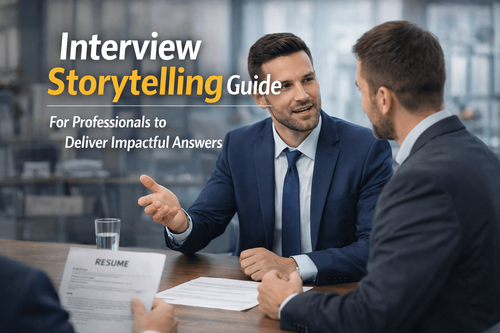

Use Interview Storytelling to Turn Your Professional Experiences Into Job-Winning Answers
Many working professionals walk into interviews
with strong resumes, impressive achievements, and years of valuable experience. Yet the moment an interviewer asks a behavioural question such as “Tell me about a time when you handled a difficult situation,” something unexpected happens. The answer becomes unfocused, overly long, or incomplete.
The issue rarely lies in the experience itself. Most professionals have powerful stories. The problem is that those stories are not structured in a way that clearly communicates impact, judgment, and value.
Interviewers are not only evaluating what happened in your past roles. They are evaluating how you think, how you solve problems, how you communicate under pressure, and whether your experience aligns with the challenges their team currently faces. Without a structured storytelling framework, even impressive achievements can sound ordinary or forgettable.
The Interview Storytelling Framework for Impactful Answers guidebook introduces a structured system designed to help professionals transform their experiences into concise, memorable interview answers that demonstrate leadership, problem solving, and real results.
Who Is This Blog For?
This blog and the accompanying guidebook are designed for professionals who want to communicate their experiences more clearly and persuasively during interviews.
- Working professionals with 0–15 years of experience preparing for competitive job interviews
- Career switchers translating experience into a new role or industry
- Managers and team leads aiming for leadership opportunities
- Consultants and specialists preparing for competency-based interviews
- Job seekers who struggle with rambling or unfocused answers
If you have ever walked out of an interview thinking, “I should have explained that better,” this storytelling system provides the structure you need.
Why This Topic Matters Today?
Modern interviews increasingly rely on behavioural and competency-based questions. Instead of simply asking about skills, interviewers ask candidates to demonstrate those skills through real examples.
These questions are designed to reveal how you think, how you make decisions, and how you respond to complexity. Interviewers typically evaluate answers across three layers.
The factual layer focuses on what happened and the context of the situation.
The behavioural layer reveals your decision making, leadership approach, and judgment.
The strategic layer shows how your experience connects to the company’s current challenges.
Candidates who answer questions without a clear structure often communicate only the factual layer. However, strong storytelling frameworks allow professionals to address all three layers simultaneously, creating answers that are far more persuasive and memorable.
Core Concept or Framework Explained
At the centre of the guidebook is the SPARK Method, a storytelling framework designed specifically for professional interviews.
SPARK stands for five structured elements that turn experiences into compelling narratives.
Situation and Stakes establish the context of the story and explain why the situation mattered.
Problem or Pivot Point identifies the specific challenge or decision that needed to be addressed.
Action You Took describes the deliberate steps you personally took and the reasoning behind those decisions.
Results and Real Impact present both measurable outcomes and qualitative impact.
Key Takeaway explains what you learned and how the experience changed the way you approach similar situations today.
Together, these five components give every interview answer a clear architecture that is easy for interviewers to follow and evaluate.
How This Blog and Guidebook Help You?
This blog explains the storytelling framework introduced in the guidebook and demonstrates how professionals can apply it to their own experiences.
By combining structured storytelling with deliberate preparation, professionals can
- Convert everyday work experiences into powerful interview stories
- Demonstrate leadership, resilience, and problem solving clearly
- Highlight measurable impact and real business value
- Adapt stories to different interview questions with confidence
- Communicate complex situations in a concise and engaging way
The result is an interview style that feels natural, authentic, and memorable.
Step-by-Step Breakdown
Step 1: Understand What Interviewers Are Listening For
Before preparing interview stories, professionals must understand how interviewers evaluate responses.
Interviewers are typically assessing three things simultaneously.
First, the factual dimension of the story, including context and outcomes.
Second, the behavioural dimension, which reveals how you think and act in challenging situations.
Third, the strategic dimension, which shows how your experience relates to the organisation’s current priorities.
Strong interview stories address all three dimensions clearly.
Step 2: Structure Every Story Using the SPARK Framework
The SPARK Method provides a clear sequence for structuring answers.
Start with Situation and Stakes by briefly explaining the context and why the situation mattered.
Next describe the Problem or Pivot Point, identifying the specific challenge or tension you faced.
Then explain the Action you took. This is the most important part of the answer because it reveals your thinking and decision making.
After that, present the Results and Real Impact, including measurable outcomes such as improved efficiency, revenue growth, or customer satisfaction.
Finally share the Key Takeaway, explaining what you learned and how it changed your approach going forward.
Step 3: Focus on Your Individual Contribution
One of the most common storytelling mistakes is overusing the word “we.” While teamwork is important, interviewers need to understand your individual contribution.
Strong interview answers use clear “I” statements that show the decisions you made and the actions you personally took.
Explaining your reasoning is just as important as explaining the action itself. When interviewers understand why you made a decision, they gain insight into your judgment and strategic thinking.
Step 4: Combine Numbers With Narrative
Results become far more compelling when they include measurable outcomes.
Quantitative results might include revenue growth, cost reduction, improved efficiency, or increased customer satisfaction scores.
However, qualitative results can also demonstrate impact. Examples include improved team collaboration, stronger client relationships, or the adoption of a new process across the organisation.
The most persuasive interview stories combine both quantitative evidence and narrative explanation.
Step 5: Build a Personal Story Bank
The most confident interview candidates rarely improvise their stories. Instead, they prepare a story bank of six to eight versatile experiences from their careers.
These stories should represent different competencies, such as
- Leadership and influence
- Problem solving and analytical thinking
- Collaboration and conflict resolution
- Resilience and overcoming adversity
- Professional growth and development
By preparing these stories in advance using the SPARK structure, professionals can adapt them quickly to different interview questions.
Step 6: Adapt Stories to Different Questions
One of the most powerful aspects of structured storytelling is flexibility.
A single experience can be told in multiple ways depending on the competency being evaluated.
For leadership questions, the emphasis should be placed on how you influenced and aligned others.
For analytical questions, focus on how you diagnosed the problem and structured the solution.
For resilience questions, emphasise how you responded when things did not go according to plan.
Practising these variations allows professionals to respond confidently even when questions are phrased in unexpected ways.
Step 7: Highlight Learning Through the Key Takeaway
Many candidates end their stories immediately after presenting results. However, the Key Takeaway step often creates the strongest impression.
A powerful takeaway demonstrates self awareness and growth.
Instead of sharing a generic lesson, explain how the experience changed your behaviour or decision making process.
For example, a candidate might explain how a challenging project taught them to incorporate structured stakeholder communication into every future project plan.
This level of reflection signals maturity and continuous learning.
Common Mistakes or Pitfalls to Avoid
Several storytelling habits weaken otherwise strong interview answers.
Using “we” language instead of clearly describing your individual actions can obscure your contribution.
Spending too much time on background context can cause interviewers to lose interest before reaching the core of the story.
Failing to explain the reasoning behind decisions can make actions appear mechanical rather than strategic.
Ending stories without measurable results reduces credibility and impact.
Providing generic lessons rather than specific behavioural insights weakens the Key Takeaway step.
Avoiding these mistakes significantly improves the clarity and effectiveness of interview storytelling.
How Should You Use This Guidebook Effectively?
The guidebook is designed as a practical preparation tool rather than a passive reading resource.
Start by reading the full guide once to understand the SPARK storytelling framework.
Next, create your personal story bank by identifying six to eight professional experiences that demonstrate different competencies.
Use the Story Bank worksheet to document each story using the SPARK structure.
Practise telling these stories aloud and record your responses to evaluate clarity, pacing, and impact.
Before each interview, review the job description and identify the competencies most relevant to the role. Then select the stories from your bank that best demonstrate those competencies.
This structured preparation ensures you walk into the interview with confidence and clarity.
Key Takeaways
- Interview storytelling transforms professional experiences into persuasive answers
- The SPARK Method provides a structured framework for behavioural interview questions
- Strong stories combine context, action, measurable results, and personal insight
- Building a story bank of six to eight experiences improves confidence and adaptability
- Using clear “I” statements highlights your personal contribution
- Quantified results strengthen credibility and impact
- Practising stories aloud helps refine clarity and pacing
Your Next Step: Accelerate Your Career with PlanetSpark
Creating an impact-driven resume is not just about landing your next job—it’s about owning your professional story and presenting it with clarity, confidence, and credibility. When your resume clearly communicates value, results, and impact, opportunities follow naturally.
At PlanetSpark, we are committed to empowering working professionals with practical, outcome-focused resources that drive real career growth. From resume building and workplace communication to leadership presence and professional writing, our programs are designed to help you succeed in today’s fast-evolving job market.
Visit https://www.planetspark.in/resources to explore:
- Career and resume-building guides
- Workplace communication and professional writing resources
- Skill-development tools curated for working professionals
Want a deeper, hands-on experience?
You can also book a free trial session to learn more about PlanetSpark’s Working Professional Courses, designed to accelerate your career through personalised coaching, real-world practice, and expert guidance. Your career deserves more than generic advice.
It deserves clarity, confidence, and measurable impact.
Start building that advantage today—with PlanetSpark.
Personalized Communication Roadmaps
Record a video to get a AI generated personalized communication reports