
Interview Storytelling Guide for Working Professionals in 2026
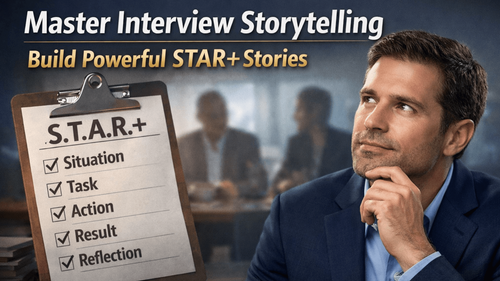

Master Interview Storytelling: Build Powerful STAR+ Stories That Impress Hiring Managers
You’ve done the work. You’ve led projects, handled difficult stakeholders, solved real problems, and delivered measurable results. But when an interviewer asks, “Tell me about a time you handled a challenge,” something strange happens — your mind either goes blank or you start rambling.
This isn’t a confidence issue. It’s a structure problem.
Most professionals are never taught how to convert their experiences into compelling, structured stories. As a result, even strong candidates struggle to communicate their value effectively in interviews.
The Interview Storytelling Storyboard solves this problem by giving you a repeatable system to craft, structure, and deliver stories that actually land. Instead of hoping you’ll “remember something in the moment,” you walk in prepared with a story bank that showcases your skills, thinking, and impact clearly.
Who Is This Blog For?
- Job seekers preparing for behavioural interviews
- Career changers looking to reposition their experience
- Managers stepping into leadership roles
- Professionals re-entering the workforce
- Anyone who struggles to answer “Tell me about a time…” questions
Why This Topic Matters Today?
Interviews today are not just about what you know — they’re about how you communicate what you’ve done.
Hiring managers are evaluating:
- How you think under pressure
- How you solve problems
- Whether they can imagine you on their team
Stories are the vehicle for this evaluation.
As highlighted in the guide, interviewers are not just listening to your answers — they are deciding whether they trust you and see you performing in their environment.
Without structured storytelling, even highly capable professionals risk sounding unclear, unfocused, or forgettable.
Core Concept or Framework Explained
The foundation of effective interview storytelling is the STAR+ framework.
Most people are familiar with STAR (Situation, Task, Action, Result), but they apply it poorly — often over-explaining context and under-explaining their actions.
The upgraded STAR+ framework adds a critical fifth element:
- Situation: What was happening? Keep it concise
- Task: What was your responsibility?
- Action: What did YOU do? This is the core
- Result: What outcome did you achieve?
- Reflection: What did you learn or change?
This final Reflection layer is what separates average candidates from high-impact, self-aware professionals.
A strong story should be delivered within 90 seconds to 2.5 minutes, ensuring clarity without losing attention.
How This Blog and Guidebook Help You?
This blog and the storyboard resource help you:
- Turn real experiences into structured, interview-ready stories
- Build a reusable story bank for multiple interview scenarios
- Communicate impact clearly and confidently
- Avoid rambling or under-explaining your contribution
- Prepare strategically instead of reacting on the spot
By following this system, you move from “hoping you answer well” to “knowing exactly what to say.”
Step-by-Step Breakdown
Step 1: Understand Story Architecture
Every great interview story follows a clear structure.
The mistake most professionals make is spending too much time explaining the Situation and not enough on Action.
To fix this:
- Keep Situation to 1–2 sentences
- Clearly define your Task
- Focus heavily on your Actions
- End with measurable Results
- Add Reflection to show growth
This ensures your story is structured, impactful, and memorable.
Step 2: Mine Your Career for Stories
You already have powerful stories — you just haven’t organised them yet.
Look for three types of experiences:
- Wins: Achievements and successes
- Struggles: Challenges, failures, or setbacks
- Pivots: Situations where you adapted or changed direction
Use a simple process:
- List your past roles
- Identify high-pressure or high-impact moments
- Map them to key competencies like leadership or problem-solving
- Select stories that create emotional impact
Aim to build at least 5–7 strong stories before any interview.
Step 3: Build Your Storyboard
The storyboard is your visual planning tool.
For each story, define:
- Story title for quick recall
- Competency tags (skills demonstrated)
- Situation in 15 seconds
- Task in 10 seconds
- Action in 60–80 seconds
- Result in 15–20 seconds
- Reflection in 10–15 seconds
- Hook line to grab attention
This structure ensures your story is concise, clear, and impactful.
Step 4: Map Stories to Interview Questions
Not all interview questions are the same.
Your stories should cover key categories:
- Achievement stories for success-based questions
- Challenge stories for failure or conflict questions
- Leadership stories for team and influence questions
- Adaptability stories for change-related questions
The goal is flexibility. One strong story should answer multiple question types.
Step 5: Create a Story Bank
Build a structured repository of your best stories.
Your story bank should include:
- 5–7 fully developed stories
- Coverage across different competencies
- Clear mapping to interview question types
- A mix of wins, failures, and learning experiences
This ensures you’re never caught off guard in an interview.
Step 6: Learn from Real Examples
The guide includes real-world storyboard examples that show how to combine:
- Strong hook lines
- Clear structure
- Specific actions
- Quantified results
- Insightful reflections
For instance, a simple campaign story becomes powerful when it demonstrates initiative, stakeholder influence, and measurable revenue impact.
Step 7: Rehearse for Natural Delivery
Preparation doesn’t mean memorising scripts.
Instead:
- Memorise the structure, not the exact words
- Practise telling stories out loud
- Time your delivery
- Refine based on clarity and flow
This ensures your delivery feels natural, not robotic.
Common Mistakes or Pitfalls to Avoid
- Spending too long on context before getting to action
- Using “we” instead of clearly showing your contribution
- Giving vague results without numbers or specifics
- Skipping reflection and missing the learning angle
- Preparing only success stories and ignoring failures
- Memorising scripts word-for-word
- Starting stories without a strong hook
Each of these reduces clarity, credibility, and impact.
How Should You Use This Guidebook Effectively?
To maximise results from this resource:
- Spend around 20 minutes understanding the system
- Build your story bank using the worksheet
- Create 5–7 storyboard cards for your strongest stories
- Rehearse stories out loud before interviews
- Use the 48-hour checklist to refine preparation
- Update your story bank after every interview
Treat your stories as a living system that evolves with your experience.
Key Takeaways
- Interview success depends on structured storytelling, not just experience
- The STAR+ framework ensures clarity, depth, and impact
- Strong stories balance brevity with meaningful detail
- A story bank prepares you for multiple interview scenarios
- Reflection is critical for demonstrating growth and self-awareness
- Rehearsing structure leads to confident, natural delivery
- Continuous refinement improves performance over time
Your Next Step: Accelerate Your Career with PlanetSpark
Creating an impact-driven resume is not just about landing your next job—it’s about owning your professional story and presenting it with clarity, confidence, and credibility. When your resume clearly communicates value, results, and impact, opportunities follow naturally.
At PlanetSpark, we are committed to empowering working professionals with practical, outcome-focused resources that drive real career growth. From resume building and workplace communication to leadership presence and professional writing, our programs are designed to help you succeed in today’s fast-evolving job market.
Visit https://www.planetspark.in/resources to explore:
- Career and resume-building guides
- Workplace communication and professional writing resources
- Skill-development tools curated for working professionals
Want a deeper, hands-on experience?
You can also book a free trial session to learn more about PlanetSpark’s Working Professional Courses, designed to accelerate your career through personalised coaching, real-world practice, and expert guidance.
Your career deserves more than generic advice.
It deserves clarity, confidence, and measurable impact.
Personalized Communication Roadmaps
Record a video to get a AI generated personalized communication reports