
Interview Tracking Dashboard Guide for Career Growth
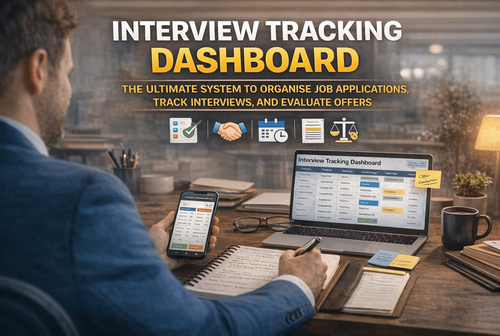

Interview Tracking Dashboard: The Ultimate System to Organise Job Applications, Track Interviews, and Evaluate Offers
Most professionals approach job searching with enthusiasm but without a system. They apply to dozens of roles, receive interview invitations, and try to keep everything organised through memory, email searches, and scattered notes.
Then reality strikes.
An interviewer asks about a role you applied to three weeks ago, and you scramble to remember the details. You cannot recall the salary range you mentioned. You struggle to remember the recruiter’s name. The conversation begins with uncertainty rather than confidence.
This is the hidden cost of a disorganised job search.
A job search is not just a series of applications. It is a complex project that involves multiple conversations, deadlines, follow-ups, and decisions. Without a clear system, opportunities slip through the cracks.
The Interview Tracking Dashboard solves this problem by giving professionals a structured way to manage every application, interview stage, conversation, and offer decision in one organised workflow.
Instead of reacting to events as they happen, you gain clarity, control, and strategy in your job search.
Who Is This Blog For?
This guide is especially valuable for professionals who want a structured and strategic job search process.
- Early and mid-career professionals looking to move into their next role
- Career switchers transitioning into new industries or functions
- Job seekers managing multiple applications simultaneously
- Consultants and managers evaluating competing opportunities
- Professionals with 0–15 years of experience who want a systematic job search process
If you want to avoid losing track of opportunities and approach your career transition with clarity and confidence, this system is designed for you.
Why This Topic Matters Today?
Modern job searches are far more complex than they were a decade ago.
Professionals now apply across multiple platforms, including LinkedIn, referrals, and job boards. Recruiters conduct multiple interview rounds, hiring managers request case studies, and companies expect candidates to maintain consistent follow-up communication.
Without organisation, even highly qualified professionals lose opportunities simply because they cannot manage the process effectively.
Common job search challenges include:
- Losing track of which companies you applied to and when
- Forgetting what was discussed during early screening calls
- Missing follow-up windows due to poor tracking
- Evaluating job offers emotionally rather than strategically
- Failing to identify patterns in interview feedback or rejections
The Interview Tracking Dashboard exists to eliminate these problems by giving job seekers a clear operational system for managing their entire pipeline.
Core Concept or Framework Explained
At its core, the Interview Tracking Dashboard treats your job search like a professional project.
Instead of relying on memory, scattered notes, or inbox searches, the system centralises every piece of information into one structured dashboard.
The framework consists of several modules that guide professionals through the entire hiring journey.
The key principles behind the system include:
One Source of Truth
All applications, interview stages, contacts, and follow-up actions are captured in a single master tracker.
Preparation Before Conversations
Structured research ensures every interview begins with clarity and insight about the company and role.
Continuous Improvement
Interview conversations are logged and analysed to improve performance across multiple rounds.
Pipeline Thinking
Your job search is treated like a professional pipeline where opportunities move through stages such as applied, interview, and offer.
Strategic Offer Decisions
Offers are evaluated across multiple criteria instead of relying only on salary.
When these components work together, the job search becomes organised, measurable, and far more effective.
How This Blog and Guidebook Help You?
This system helps professionals move from a reactive job search to a strategic one.
Instead of guessing what to do next, you gain clarity about:
- Which applications are active
- Which interviews require preparation
- Which contacts require follow-up
- Which opportunities deserve priority
The benefits are significant.
You reduce anxiety because everything is visible in one place.
You improve interview performance because you prepare systematically.
You maintain stronger relationships with recruiters and hiring managers.
You make smarter decisions when evaluating job offers.
Most importantly, you stop losing opportunities due to simple organisational mistakes.
Step-by-Step Breakdown
Master Application Tracker: Your Job Search Command Centre
Every effective tracking system begins with a master application tracker.
This tracker acts as the central command centre for your entire job search.
Each row represents a job application, while columns capture key data points such as:
- Company name
- Job title
- Application source
- Date applied
- Current stage in the hiring process
- Next action required
- Priority level
For example, a professional might log:
Company: Example Co.
Role: Senior Marketing Manager
Source: LinkedIn
Stage: Round 2 Interview
Next Action: Send thank-you note within two days
Maintaining this tracker ensures that at any moment you can see the status of every opportunity in your pipeline.
Company and Role Research Card: Preparing for Interviews Strategically
Many candidates prepare for interviews casually by reading a company website for a few minutes.
High-performing candidates prepare strategically.
The Company and Role Research Card ensures every interview begins with structured research.
This template helps you gather insights such as:
- Company industry, size, and growth stage
- Core products or services
- Key competitors
- Recent company news
- Cultural values
- Hiring manager details
You also define your tailored value proposition for the role.
This forces you to answer a powerful question:
What does this company most urgently need from someone in this role, and how does my experience solve that problem?
This level of preparation significantly increases the chances of progressing to the next round.
Interview Conversation Log: Capturing What Actually Happened
Interviews are high-pressure situations, and memory fades quickly.
That is why the Interview Conversation Log should be completed within 30 minutes after every interview.
The log captures critical information including:
Interview metadata
- Company and role
- Interview round
- Format such as phone, video, or in-person
- Interviewer names and titles
Questions asked during the interview
- Key questions
- Summary of your responses
- Unexpected or difficult questions
Observations from the interaction
- Interviewer engagement level
- Topics explored in depth
- Positive signals from the interviewer
- Potential concerns raised
Post-interview reflection
- Overall performance rating
- Strongest moment
- Weakest answer and how to improve
- Next steps communicated
Over time, this log becomes a personal coaching tool that helps you refine your interview strategy.
Stage-by-Stage Pipeline Tracker: Visualising Your Job Search Funnel
Successful job seekers treat their job search like a professional pipeline.
Opportunities move through stages such as:
Applied
Screening
Interview rounds
Offer and decision
A healthy pipeline should include opportunities at multiple stages simultaneously.
The dashboard also highlights several strategic benchmarks:
- Maintain at least 15 active applications at any time
- Send follow-up messages within 48 hours after interviews
- Referred candidates are significantly more likely to receive interviews
- Send a professional check-in if there is no response after a final round within 72 hours
These metrics keep your pipeline active and prevent stalled opportunities.
Recruiter and Stakeholder Contact Log: Managing Relationships
Your job search is not only about applications. It is about relationships.
Recruiters, hiring managers, and referral contacts all play important roles in your career progression.
The Contact Log ensures you maintain a structured record of these relationships.
For each contact, you track:
- Name and title
- Company
- Relationship type such as recruiter or hiring manager
- Summary of the last conversation
- Date of last interaction
- Next follow-up action
Professionals who maintain strong relationships often discover future opportunities even when an initial application does not convert.
Offer Comparison Framework: Evaluating Opportunities Objectively
Receiving an offer can be exciting and stressful at the same time.
Many professionals make the mistake of evaluating offers based only on base salary.
The Offer Comparison Framework prevents this by scoring each offer across several dimensions.
Key evaluation criteria include:
- Base salary compared with market rate
- Career growth potential
- Work-life balance and flexibility
- Role clarity and scope
- Quality of the direct manager
- Company stability and culture
- Benefits, equity, and additional perks
Each factor receives a weight, allowing professionals to calculate a final weighted score.
This structured approach ensures that the final decision aligns with long-term career goals rather than short-term emotions.
Common Mistakes or Pitfalls to Avoid
Even motivated professionals fall into common job search traps.
Understanding these pitfalls can dramatically improve outcomes.
Spray and Pray Applications
Applying to dozens of roles with minimal tailoring often leads to low response rates.
Instead, prioritise high-impact opportunities and customise your application.
No Follow-Up After Interviews
Candidates often assume the hiring team will contact them if interested.
Professional follow-up within 48 hours demonstrates initiative and professionalism.
Accepting the First Offer Out of Anxiety
Relief can lead professionals to accept the first offer they receive without evaluating alternatives.
Using a structured offer comparison framework ensures better decisions.
Neglecting Warm Contacts
Professionals often forget to update recruiters or referrals about their application status.
Maintaining communication keeps relationships strong and may lead to future opportunities.
How Should You Use This Guidebook Effectively?
The Interview Tracking Dashboard works best when used consistently.
The recommended workflow is simple.
Use the Master Tracker daily
Log every application and update the current status.
Complete research cards before interviews
Spend 30 minutes gathering insights about the company and role.
Fill conversation logs after interviews
Capture key insights immediately while the conversation is still fresh.
Conduct a weekly dashboard review
A 30-minute weekly ritual ensures the system remains accurate and effective.
During this weekly review, you should:
- Update the status of all applications
- Archive inactive opportunities
- Identify top priorities for the coming week
- Schedule interview preparation time
- Send outstanding follow-up messages
- Add new contacts to the relationship log
This consistent review turns your job search into a controlled, proactive process.
Key Takeaways
- Treat your job search like a project with structured systems and processes
- Maintain a single master tracker to manage all applications and opportunities
- Prepare structured research before every interview conversation
- Use interview logs to analyse performance and improve continuously
- Track recruiters, hiring managers, and referrals through a contact log
- Evaluate job offers using multiple criteria rather than salary alone
- Conduct a weekly dashboard review to maintain clarity and momentum
- Consistency and organisation often matter as much as qualifications in landing the right role
Your Next Step: Accelerate Your Career with PlanetSpark
Creating an impact-driven resume is not just about landing your next job—it’s about owning your professional story and presenting it with clarity, confidence, and credibility. When your resume clearly communicates value, results, and impact, opportunities follow naturally.
At PlanetSpark, we are committed to empowering working professionals with practical, outcome-focused resources that drive real career growth. From resume building and workplace communication to leadership presence and professional writing, our programs are designed to help you succeed in today’s fast-evolving job market.
Visit https://www.planetspark.in/resources to explore:
- Career and resume-building guides
- Workplace communication and professional writing resources
- Skill-development tools curated for working professionals
Want a deeper, hands-on experience?
You can also book a free trial session to learn more about PlanetSpark’s Working Professional Courses, designed to accelerate your career through personalised coaching, real-world practice, and expert guidance.
Your career deserves more than generic advice.
It deserves clarity, confidence, and measurable impact.
Personalized Communication Roadmaps
Record a video to get a AI generated personalized communication reports