
Job Fair Follow-Up Message Guide for Professionals
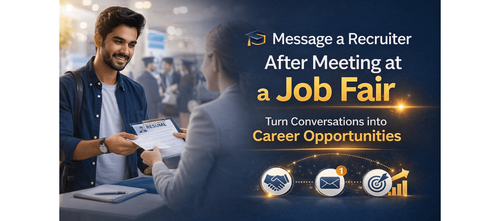

Message a Recruiter After Meeting at a Job Fair and Turn Conversations into Career Opportunities
You had a great conversation at a job fair. You exchanged a few words, maybe even shared your resume. But once the event ends, most candidates disappear—and that’s exactly where opportunities are lost.
The real impact of a job fair is not in the conversation itself, but in what you do after it.
A well-crafted follow-up message can transform a brief interaction into a meaningful professional opportunity. The PlanetSpark template pack is specifically designed to help you follow up with clarity, confidence, and professionalism—without second-guessing every word.
Download these resources and apply them alongside your daily work for improved clarity, productivity, and professional growth. You can also book a free trial to gain expert guidance and enhance your communication, problem-solving, and decision-making skills. The materials are designed in a clear, structured format to help professionals learn efficiently and implement insights with confidence.
Who Is This Blog For?
- Students and early-career professionals attending job fairs
- Job seekers looking to convert networking into real opportunities
- Career switchers building new industry connections
- Professionals attending conferences or hiring events
- Anyone who wants to stand out after initial recruiter interactions
Why This Topic Matters Today?
Job fairs are high-volume environments. Recruiters meet dozens—sometimes hundreds—of candidates in a single day. Without a follow-up, it is easy to be forgotten.
The guide clearly states that how you follow up determines whether you are remembered or overlooked.
In fact, structured follow-up messages serve multiple purposes:
- Reinforce your initial impression
- Demonstrate professionalism and intent
- Keep you top-of-mind during hiring decisions
Many professionals struggle because they:
- Don’t follow up at all
- Send generic messages without context
- Forget to personalise their communication
- Miss the optimal timing window
This is why templates built for specific scenarios are so powerful—they guide you toward effective communication.
Core Concept or Framework Explained
The core framework in this guide is structured follow-up communication based on real-world scenarios.
For job fair interactions, the follow-up message follows a simple but effective structure:
- Reconnect: Reference your conversation and context
- Reinforce: Highlight your background and fit
- Request: Suggest a clear next step
This aligns closely with the principle illustrated in the guide’s visual flow—reconnect, add value, and stay connected—which is emphasised as the foundation of effective networking communication.
This structure ensures your message is:
- Personal and memorable
- Professionally relevant
- Action-oriented without being pushy
How This Blog and Guidebook Help You?
This guidebook simplifies one of the most overlooked career skills—professional follow-up.
With these templates, you can:
- Convert brief job fair interactions into ongoing conversations
- Communicate clearly without overthinking
- Build a strong professional impression quickly
- Increase your chances of progressing in the hiring process
Most importantly, it helps you turn networking into measurable outcomes.
Step-by-Step Breakdown
Step 1: Send Your Message Within 24 Hours
Timing is critical.
The guide recommends sending your follow-up within 24 hours of meeting the recruiter to ensure the interaction is still fresh.
This increases the likelihood that:
- The recruiter remembers you
- Your message feels timely and relevant
- You stay ahead of other candidates
Step 2: Start with a Strong Contextual Opening
Your opening should immediately remind the recruiter who you are.
For example:
- Mention the event name
- Reference the date
- Highlight a specific topic you discussed
This creates instant recognition and connection.
Step 3: Reference a Specific Conversation Detail
One of the most powerful differentiators is specificity.
The guide emphasises referencing:
- A project the recruiter mentioned
- A team initiative
- Advice they shared
This signals that you were engaged and attentive.
Step 4: Reinforce Your Value Clearly
After reconnecting, briefly highlight your background.
Focus on:
- Your experience or current status
- Relevant skills or expertise
- Alignment with the role or company
Keep it concise and relevant.
Step 5: Express Genuine Interest in the Opportunity
Make it clear why you are interested in the company or role.
Examples include:
- Company mission or culture
- Role responsibilities
- Growth opportunities
This shows intentionality—not just mass outreach.
Step 6: Include a Clear Call to Action
Every effective follow-up ends with a simple, actionable next step.
For example:
- Requesting a brief call
- Offering availability options
- Asking about next steps
Clarity increases response rates.
Step 7: Keep the Message Concise and Structured
The ideal follow-up message should be:
- Under 200 words
- Structured in short paragraphs
- Easy to scan quickly
Recruiters often read messages quickly—clarity wins.
Step 8: Attach Supporting Information
The guide recommends attaching your resume or including your LinkedIn profile link.
This makes it easier for the recruiter to:
- Review your profile
- Share your details internally
- Take the next step
Step 9: Personalise Every Message
A critical insight from the guide is that generic messages are often ignored, while personalised ones get responses.
Even one personalised line can dramatically improve outcomes.
Common Mistakes or Pitfalls to Avoid
Many candidates lose opportunities due to avoidable mistakes.
Common pitfalls include:
- Sending generic, copy-paste messages
- Forgetting to reference the conversation
- Writing overly long emails
- Failing to include a clear next step
- Delaying the follow-up beyond 24–48 hours
The guide also highlights that brevity signals respect for the recruiter’s time, making concise messages more effective.
How Should You Use This Guidebook Effectively?
To maximise results, follow this workflow:
- Step 1: Choose the job fair follow-up template
- Step 2: Replace all placeholders with specific details
- Step 3: Add one personalised reference from your conversation
- Step 4: Keep the message concise and structured
- Step 5: Attach your resume or include LinkedIn
- Step 6: Send within 24 hours
Best practices include:
- Using clear subject lines with your name and role
- Proofreading before sending
- Maintaining a professional yet warm tone
Key Takeaways
- Job fair follow-up messages are critical for standing out
- Timing within 24 hours significantly improves recall
- Personalisation is the biggest differentiator
- Structured messages improve clarity and professionalism
- Concise communication increases response rates
- A clear call to action drives next steps
- Consistent follow-up builds long-term career opportunities
Your Next Step: Accelerate Your Career with PlanetSpark
Creating an impact-driven resume is not just about landing your next job—it’s about owning your professional story and presenting it with clarity, confidence, and credibility. When your resume clearly communicates value, results, and impact, opportunities follow naturally.
At PlanetSpark, we are committed to empowering working professionals with practical, outcome-focused resources that drive real career growth. From resume building and workplace communication to leadership presence and professional writing, our programs are designed to help you succeed in today’s fast-evolving job market.
Visit https://www.planetspark.in/resources to explore:
- Career and resume-building guides
- Workplace communication and professional writing resources
- Skill-development tools curated for working professionals
Want a deeper, hands-on experience?
You can also book a free trial session to learn more about PlanetSpark’s Working Professional Courses, designed to accelerate your career through personalised coaching, real-world practice, and expert guidance.
Your career deserves more than generic advice.
It deserves clarity, confidence, and measurable impact.
Personalized Communication Roadmaps
Record a video to get a AI generated personalized communication reports