
Key Skills Professionals Need for Global Careers

A Proven 6-Pillar Framework to Build Future-Ready Skills for a Global Career
Most professionals assume that strong technical skills and years of experience are enough to build a successful global career. But when they step into international opportunities—whether through remote roles, cross-border projects, or global leadership positions—they often face an unexpected reality: what worked locally doesn’t always translate globally.
You might communicate clearly in your current team, deliver strong results, and maintain solid relationships. Yet, in a global context, your ideas may not land the same way, your influence may not scale, and your skills may not be as visible as you expected. This gap is not about talent—it is about global readiness.
The workplace has already shifted. Distributed teams, cultural diversity, and rapid technological change mean that professionals need a new set of interconnected capabilities to stay competitive. Without these, even high performers risk being overlooked in global environments.
This is exactly why a structured, skills-based framework becomes essential. Instead of guessing what to improve, you can systematically assess, prioritise, and build the capabilities that global employers actually value.
Download these resources and apply them alongside your daily work for improved clarity, productivity, and professional growth. You can also book a free trial to gain expert guidance and enhance your communication, problem-solving, and decision-making skills. The materials are designed in a clear, structured format to help professionals learn efficiently and implement insights with confidence.
Who Is This Blog For?
- Working professionals aiming to transition into global roles
- Early and mid-career individuals preparing for international opportunities
- Managers seeking to lead cross-border teams effectively
- Freelancers and consultants targeting global clients
- Professionals who feel their skills are not translating into global impact
Why This Topic Matters Today?
Global employers are no longer hiring based on isolated skills—they evaluate professionals based on how effectively their capabilities translate across contexts.
Research and industry insights show that hiring decisions are shaped by multiple skill categories working together, not individually. Communication consistently ranks as the highest priority because it determines whether all other skills are visible and usable.
At the same time, digital fluency is rapidly shifting from a differentiator to a baseline expectation. Professionals who fail to build this capability will feel the impact within the next few years.
The implication is clear: success in global careers requires a balanced, structured skill system—not isolated improvement.
Core Concept or Framework Explained
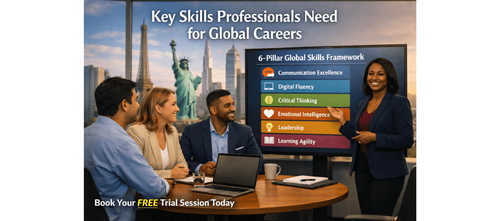
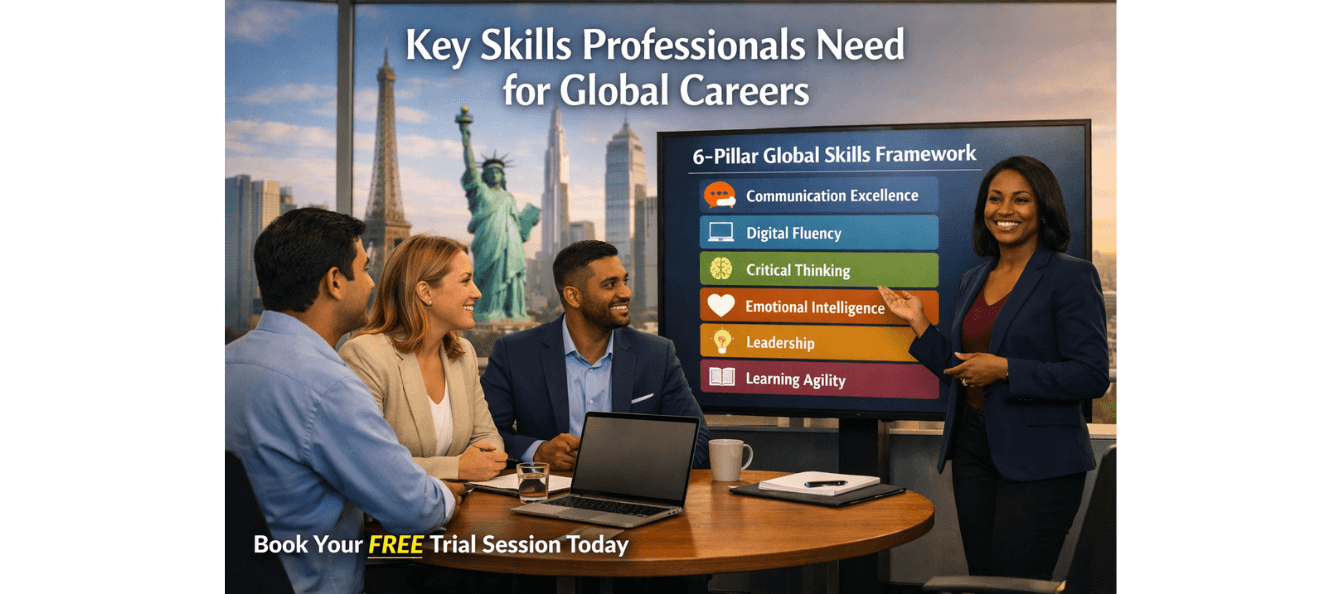
At the heart of this guide is a 6-Pillar Global Skills Framework that defines what it takes to become globally competitive.
These six pillars are:
- Communication Excellence: Clear writing, structured thinking, persuasive delivery, and cross-cultural tone
- Digital and Tech Fluency: AI usage, data literacy, remote collaboration, and cybersecurity awareness
- Critical Thinking: Structured problem-solving and logical reasoning
- Emotional Intelligence and Cultural Agility: Self-awareness, empathy, and cross-cultural adaptability
- Leadership and Influence: Building credibility and influencing without authority
- Learning Agility: Continuous learning, reflection, and adaptability
These pillars are interconnected. Weakness in one reduces the impact of others. For example, strong critical thinking without communication clarity remains invisible in global settings.
How This Blog and Guidebook Help You?
This framework gives you a clear roadmap for building globally relevant skills.
By applying it, you will be able to:
- Assess your current readiness across key global competencies
- Identify high-impact skill gaps
- Build a focused development plan
- Apply skills in real-world scenarios
- Track measurable progress over time
Instead of working harder without direction, you begin working smarter with clarity and structure.
Step-by-Step Breakdown
Step 1: Evaluate Yourself Using the Global Skills Checklist
Start with honest self-assessment across all six pillars.
The checklist helps you evaluate behaviours such as:
- Writing clearly for international audiences
- Using AI tools in your daily work
- Structuring problem-solving approaches
- Adapting communication across cultures
- Leading without formal authority
- Maintaining a consistent learning practice
Rate yourself as Strong, Developing, or Gap. The goal is not perfection—it is awareness.
Step 2: Define Your 3-Year Career Vision
Clarity drives effective skill development.
Ask yourself:
- What role do you want in 3 years?
- What type of organisation will you work in?
- What will your geographic scope look like?
Then identify the top 5 skills required for that role by analysing job descriptions or professional profiles.
This ensures your development is aligned with real-world expectations.
Step 3: Identify Your Biggest Skill Gap
Not all gaps are equal.
Compare your current level with required skills and identify:
- The largest gap
- The highest-impact gap
This becomes your Priority 1 focus for the next 90 days.
Focusing on one key area prevents scattered effort and accelerates progress.
Step 4: Build a 90-Day Skill Development Plan
A 90-day window creates urgency and measurable results.
For each pillar, define:
- A specific goal
- Actions and resources
- Evidence of progress
For example:
- Goal: Deliver a structured presentation to a global audience
- Action: Practice weekly presentations and seek feedback
- Evidence: Positive feedback from international stakeholders
Schedule a 30-day review to track progress and adjust your approach.
Step 5: Apply Skills in Real Work Environments
Learning without application does not translate into results.
Every skill must be linked to a real scenario:
- Present to a global team
- Write reports for international stakeholders
- Lead cross-border projects
- Use AI tools in daily workflows
Application builds credibility and confidence simultaneously.
Step 6: Learn from Real-World Success
Consider the case of Priya, an operations manager who was initially rejected for a global role despite strong performance.
Her gap was not technical—it was in globally portable skills like communication, cultural agility, and influence. By addressing these gaps systematically over 12–18 months, she transitioned into a global leadership role with significant career growth.
The lesson is clear: targeted skill development creates transformational outcomes.
Step 7: Track Your Global Readiness Score
Use a structured self-evaluation to measure progress.
Rate yourself across key behaviours such as:
- Communicating with global stakeholders
- Using digital tools effectively
- Adapting across cultures
- Maintaining a learning routine
Your total score places you in stages like Foundation, Building, Advancing, or Global Ready.
This helps you understand where you stand and what to focus on next.
Common Mistakes or Pitfalls to Avoid
- Optimising only for local recognition instead of global visibility
- Assuming fluency equals effective communication
- Waiting for employers to provide training
- Ignoring cultural differences in professional settings
- Learning without applying skills in real scenarios
Avoiding these mistakes accelerates your progress significantly.
How Should You Use This Guidebook Effectively?
To maximise results, follow a structured workflow:
- Spend 20–30 minutes completing the reflection worksheet
- Identify one Priority 1 skill gap
- Build a 90-day development plan
- Apply skills weekly in real work scenarios
- Review progress at 30-day intervals
Consistency is the key driver of transformation.
Key Takeaways
- Global careers require a new set of interconnected skills
- Communication is the most critical and highest-impact capability
- Self-awareness is the starting point for growth
- A 90-day plan creates measurable progress
- Skills must be applied in real contexts to build credibility
- Learning agility determines long-term success
- Consistent action matters more than perfect planning
Your Next Step: Accelerate Your Career with PlanetSpark
Creating an impact-driven resume is not just about landing your next job—it’s about owning your professional story and presenting it with clarity, confidence, and credibility. When your resume clearly communicates value, results, and impact, opportunities follow naturally.
At PlanetSpark, we are committed to empowering working professionals with practical, outcome-focused resources that drive real career growth. From resume building and workplace communication to leadership presence and professional writing, our programs are designed to help you succeed in today’s fast-evolving job market.
Visit https://www.planetspark.in/resources to explore:
- Career and resume-building guides
- Workplace communication and professional writing resources
- Skill-development tools curated for working professionals
Want a deeper, hands-on experience?
You can also book a free trial session to learn more about PlanetSpark’s Working Professional Courses, designed to accelerate your career through personalised coaching, real-world practice, and expert guidance.
Your career deserves more than generic advice.
It deserves clarity, confidence, and measurable impact.
Personalized Communication Roadmaps
Record a video to get a AI generated personalized communication reports