
Leadership Checklists: Essential Systems for Managers 2026


Designing Personal Leadership Checklists: A Practical System to Improve Accountability, Productivity, and Impact
In most workplaces, leadership failure rarely comes from lack of intelligence or effort—it comes from inconsistency. Meetings get missed, feedback is delayed, strategic priorities lose momentum, and important conversations happen too late. Even highly capable professionals struggle to manage leadership responsibilities effectively because they rely on memory instead of systems.
If you’ve ever felt overwhelmed juggling team management, performance tracking, stakeholder alignment, and your own growth, you’re not alone. Leadership today demands structured execution—not just vision.
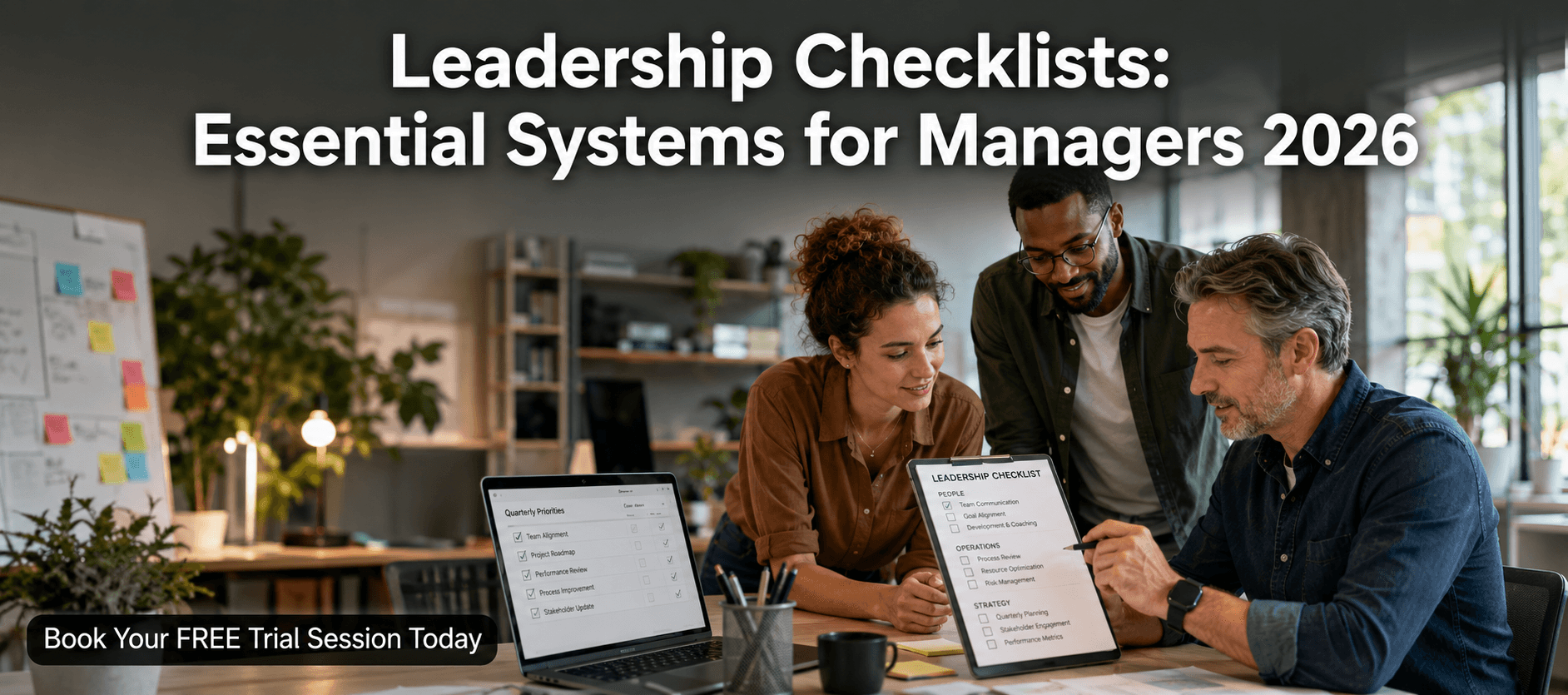
The guidebook “Designing Personal Checklists for Key Leadership Responsibilities” offers a powerful solution: turning leadership into a repeatable, system-driven process using scenario-based checklists. These tools act as your personal operating system, ensuring nothing critical slips through the cracks while helping you lead with clarity and measurable impact.
Download these resources and apply them alongside your daily work for improved clarity, productivity, and professional growth. You can also book a free trial to gain expert guidance and enhance your communication, problem-solving, and decision-making skills. The materials are designed in a clear, structured format to help professionals learn efficiently and implement insights with confidence.
Who Is This Blog For?
- First-time managers transitioning into leadership roles
- Team leads managing recurring responsibilities and team performance
- Senior professionals handling cross-functional projects
- Consultants and freelancers managing multiple stakeholders
- Professionals aiming to improve productivity, accountability, and execution
Why This Topic Matters Today?
Leadership today is less about authority and more about execution consistency. Yet, many professionals struggle due to lack of structure.
According to the guide, common leadership challenges include:
- Relying on memory instead of structured systems
- Confusing busyness with productivity
- Skipping preparation before key meetings
- Ignoring team development due to delivery pressure
- Failing to conduct regular self-assessments
As shown in the framework on page 2, leadership requires disciplined execution across people, processes, and performance—not just decision-making. Without systems like checklists, even experienced leaders lose effectiveness over time.
Core Concept or Framework Explained
The core idea behind this guide is simple but powerful: leadership can be systematised.
Instead of reacting to situations, effective leaders prepare for them using structured checklists. Each checklist is designed for a specific, repeatable scenario—such as onboarding, performance reviews, or team meetings—ensuring consistent execution.
The framework is built on three key principles:
- Repeatability: Leadership tasks happen regularly and should follow a consistent process
- Accountability: Clear checklists ensure ownership and follow-through
- Clarity: Defined steps eliminate confusion and reduce decision fatigue
As highlighted in the template directory on page 3, the guide provides 10 scenario-specific checklists covering critical leadership moments—from transition planning to delegation tracking.
How This Blog and Guidebook Help You?
This guide helps you shift from reactive leadership to proactive execution by:
- Providing ready-to-use checklists for real-world leadership situations
- Improving time management and meeting effectiveness
- Ensuring consistent team communication and feedback
- Strengthening accountability across tasks and projects
- Helping you track both team performance and personal growth
By using these templates, you build a leadership system that scales with your responsibilities.
Step-by-Step Breakdown
New Team Lead Transition Checklist: Start Strong in Your First 90 Days
When stepping into a leadership role, your first 90 days define your long-term impact.
This checklist ensures you:
- Spend the first 30 days listening and understanding team dynamics
- Align goals and processes in days 31–60
- Deliver visible impact in days 61–90
As outlined on page 4, this phased approach prevents rushed decisions and builds trust systematically.
Weekly 1:1 Meeting Preparation Checklist: Make Conversations Count
Unstructured one-on-one meetings often waste time.
This checklist helps you:
- Review past action items
- Identify development opportunities
- Address blockers and progress
- Document outcomes and next steps
It ensures every meeting drives clarity and results, not just updates.
Quarterly Team Performance Review Checklist: Drive Accountability
Performance reviews become effective when they are structured and evidence-based.
This checklist focuses on:
- Goal tracking and outcome evaluation
- Behavioural assessment
- Development planning for the next cycle
As shown on page 5, it ensures fairness, consistency, and actionable insights.
Cross-Functional Project Kickoff Checklist: Align Before Execution
Many projects fail due to poor alignment at the start.
This checklist ensures:
- Clear project objectives and scope boundaries
- Defined roles and decision authority
- Alignment across departments before execution
It eliminates confusion and reduces mid-project conflicts.
Team Conflict Resolution Checklist: Handle Disputes Professionally
Conflict is inevitable—but unmanaged conflict damages performance.
This checklist helps you:
- Identify the type and impact of conflict
- Conduct structured conversations
- Create behavioural agreements
- Track resolution progress
The structured approach ensures fairness and long-term resolution.
Strategic Planning Session Checklist: Lead with Direction
Strategy without structure leads to confusion.
This checklist ensures:
- Pre-session preparation with data and inputs
- Clear priorities and measurable goals
- Defined ownership and follow-ups
As detailed on page 6, it transforms planning into actionable execution.
New Direct Report Onboarding Checklist: Set Up Early Success
First impressions shape long-term performance.
This checklist ensures:
- Strong first-week integration
- Clear expectations and role clarity
- Early contribution opportunities
- Continuous feedback loops
It creates a structured, relationship-driven onboarding experience.
Leader’s Personal Self-Assessment Checklist: Reflect and Improve
Leadership growth requires honest reflection.
This checklist helps you evaluate:
- Alignment between intention and action
- Team development efforts
- Strategic focus
- Personal growth commitments
It ensures continuous improvement, not stagnation.
Team Meeting Facilitation Checklist: Run Effective Meetings
Meetings should produce outcomes, not just discussions.
This checklist ensures:
- Clear agenda and purpose
- Structured discussion flow
- Defined actions and ownership
- Post-meeting follow-ups
As shown on page 7, it improves meeting efficiency and engagement.
Delegation and Accountability Tracking Checklist: Scale Your Leadership
Effective delegation is critical for leadership scalability.
This checklist ensures:
- Clear task definitions and expectations
- Appropriate ownership assignment
- Defined check-in cadence
- Performance tracking and feedback
It helps you delegate without losing control of outcomes.
Common Mistakes or Pitfalls to Avoid
- Managing tasks mentally instead of using structured systems
- Skipping preparation for recurring leadership activities
- Focusing only on execution, ignoring development
- Failing to document decisions and follow-ups
- Not reviewing performance regularly
These mistakes reduce effectiveness and create unnecessary stress.
How Should You Use This Guidebook Effectively?
To get the most value:
- Start with the checklist that matches your immediate challenge
- Customise templates with real context and details
- Use them consistently across cycles, not just once
- Review and refine after each use
As suggested on page 2, following a simple workflow—select, customise, use, and review—ensures long-term impact.
Key Takeaways
- Leadership success depends on consistent execution, not just ideas
- Checklists convert complex responsibilities into manageable systems
- Structured preparation improves productivity and outcomes
- Regular reviews strengthen accountability and growth
- Effective delegation and communication require clarity
- Self-assessment is essential for long-term leadership development
Your Next Step: Accelerate Your Career with PlanetSpark
Creating an impact-driven resume is not just about landing your next job—it’s about owning your professional story and presenting it with clarity, confidence, and credibility. When your resume clearly communicates value, results, and impact, opportunities follow naturally.
At PlanetSpark, we are committed to empowering working professionals with practical, outcome-focused resources that drive real career growth. From resume building and workplace communication to leadership presence and professional writing, our programs are designed to help you succeed in today’s fast-evolving job market.
Visit https://www.planetspark.in/resources to explore:
- Career and resume-building guides
- Workplace communication and professional writing resources
- Skill-development tools curated for working professionals
Want a deeper, hands-on experience?
You can also book a free trial session to learn more about PlanetSpark’s Working Professional Courses, designed to accelerate your career through personalised coaching, real-world practice, and expert guidance.
Your career deserves more than generic advice.
It deserves clarity, confidence, and measurable impact.
Personalized Communication Roadmaps
Record a video to get a AI generated personalized communication reports