
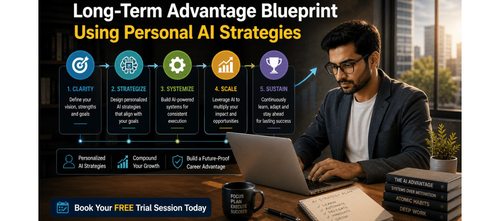
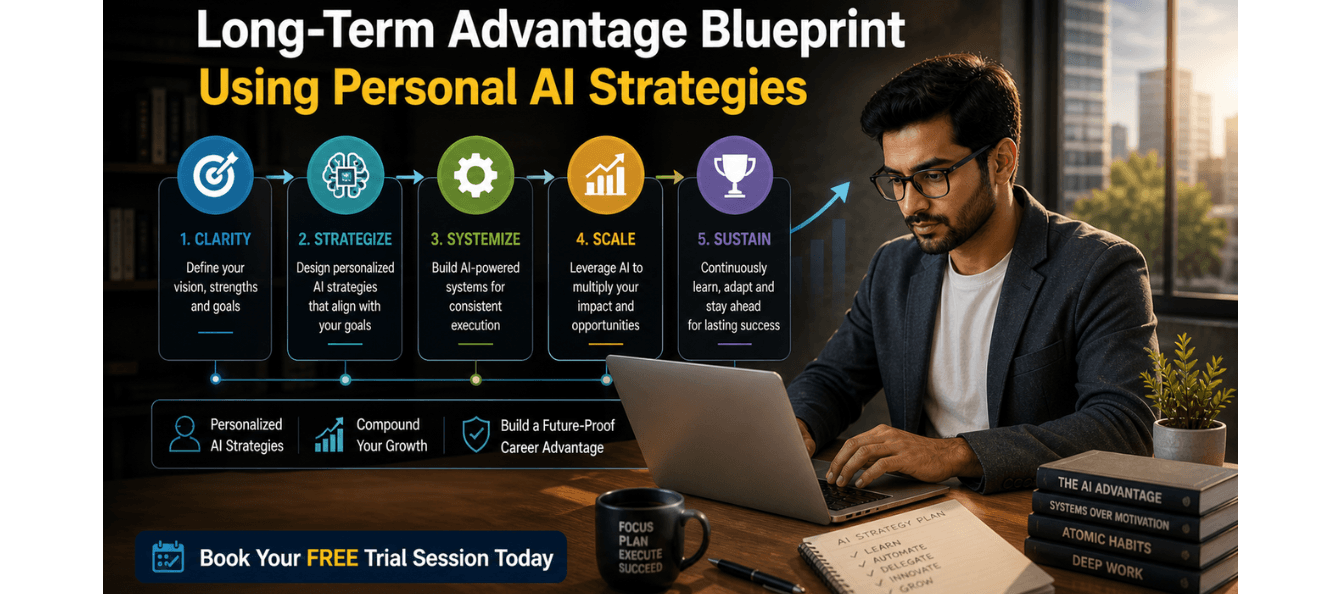
Long-Term Advantage Blueprint Using Personal AI Strategies

How to Create a Personal AI Strategy for Long-Term Career Advantage: A Step-by-Step Guide
AI is no longer a distant future concern — it’s reshaping industries and roles right now. However, most professionals are reacting to AI, rather than strategically positioning themselves within it. This blog will help you build a proactive, personalized AI strategy that will not only help you stay ahead but also provide you with a long-term career advantage.
The framework in this guide is designed to empower professionals at every stage of their careers, whether you're a career switcher, early-career professional, consultant, or manager. The steps are practical, actionable, and aimed at building lasting AI fluency for meaningful career advancement.
Download these resources and apply them alongside your daily work for improved clarity, productivity, and professional growth. You can also book a free trial to gain expert guidance and enhance your communication, problem-solving, and decision-making skills. The materials are designed in a clear, structured format to help professionals learn efficiently and implement insights with confidence.
Who Is This Blog For?
- Career switchers who want to proactively integrate AI into their new role
- Professionals looking to leverage AI for improved efficiency and higher-quality work
- Consultants aiming to stand out in a competitive landscape with AI expertise
- Managers and team leads who want to drive AI adoption within their teams
- Early-career professionals eager to position themselves as AI-savvy leaders
Why This Guide Matters?
The challenge many professionals face is that they know AI is important but don’t have a personal plan for it. Generic advice like “learn AI tools” only scratches the surface. This guide goes deeper — helping you build a strategy that’s tailored to your career goals, industry, and unique strengths. Think of this as your personal AI playbook — a strategy that evolves with both you and the AI landscape.
AI is a career strategy issue, not just a tech issue. It will shape your professional trajectory for the next decade. However, most professionals fail to think about how they will integrate AI into their work for long-term advantage.
How to Use This Guide?
- Read Through: Absorb the full framework in one sitting
- Reference: Return to specific steps as your career evolves
- Worksheet Mode: Complete the action elements to build your strategy
Step-by-Step Breakdown
Step 1 — Awareness: Know Where You Stand
Before you can build a strategy, you need an honest picture of your current relationship with AI. Most professionals either overestimate their AI fluency or underestimate how much AI is already embedded in their workflows. Neither position serves you well.
Start by auditing your current role. Which tasks are repetitive, data-heavy, or pattern-based? These are the areas most susceptible to AI augmentation. Equally important: identify the tasks that require human judgment, empathy, creativity, or stakeholder relationships. These are your durable strengths.
List your top 10 weekly tasks and mark each as "AI-augmentable" or "human-essential."
Rate yourself honestly: Beginner / Developing / Proficient across awareness, tool use, and strategic thinking.
Research 3 ways AI is currently being used in your sector. Note what skills are being valued or replaced.
If AI could handle 30% of your current role tomorrow, what would you want to be doing with that time? Your answer reveals your strategic direction.
Step 2 — Application: Build Your AI Toolkit
Awareness without action is just anxiety. This step is about deliberately selecting and practicing the AI tools that are most relevant to your career goals. Instead of chasing every new release, build genuine fluency in a focused set of capabilities.
Select tools tied to career goals.
Use skills on real tasks.
Understand relevant AI trends.
Review progress and refine.
Set focused practice routines.
Tools like ChatGPT, Claude, and Gemini can dramatically accelerate drafting, editing, and summarizing. Build a personal prompt library for your most common tasks.
Tools like Copilot in Excel, Julius AI, and Perplexity help professionals extract insights faster. You don’t need to be a data scientist — you need to ask better questions.
Midjourney, Canva AI, and Adobe Firefly are reshaping creative workflows. Even non-designers can now produce professional-grade visuals with the right prompting skills.
Notion AI, Otter.ai, and Zapier integrations can automate administrative overhead. Reclaim hours each week by systematically identifying and eliminating low-value manual tasks.
Pick ONE tool from each category above. Spend one week genuinely using it in your real work. Document what changed. This is how fluency is built — through deliberate, contextual practice.
Step 3 — Mastery: Position AI as Your Career Differentiator
The Mastery Mindset Shift
Most professionals ask: "How do I use AI?"
Masters ask: "How do I use AI to produce outcomes no one else in my field can match?"
This is the difference between being an AI user and being an AI-powered professional. Mastery is about combining your domain expertise with AI capability to create a unique professional value proposition.
At the mastery level, your personal AI strategy becomes a competitive advantage. You're not just saving time — you're producing higher-quality work, making better decisions, and demonstrating capabilities that set you apart in hiring, promotion, and client conversations.
Mastery requires three things: a consistent practice of experimentation, a habit of documenting what works, and the confidence to share your AI-augmented work publicly — in portfolios, case studies, and professional conversations.
- Build a personal "AI wins" log — document time saved and quality improvements
- Create at least one AI-augmented work sample per quarter for your portfolio
- Develop a signature workflow that combines your expertise with AI tools
- Teach others — explaining your approach deepens your own mastery
Real-World Application — Case Example
Meet Priya — Senior Marketing Manager, 7 Years' Experience. Priya was concerned that AI tools would make her team redundant and undermine her value as a manager. Rather than waiting to see what happened, she decided to build a proactive AI strategy.
What Priya Did
- Audited her team's workflows and identified 4 tasks consuming 40% of their time
- Introduced AI tools for first-draft copywriting, social scheduling, and performance reporting
- Repositioned herself as the team's "AI integration lead" — a role she created
- Documented the efficiency gains and presented them to senior leadership
- Built a personal prompt library and shared it with her wider department
Common Mistake: Priya's colleagues who waited for their company to "provide AI training" fell 6–12 months behind. Don't outsource your AI strategy to your employer. Own it yourself.
The Outcome
- Time Saved: Reclaimed weekly across the team
- Output Volume: Content production doubled in 3 months
- Promotion: New role created within 6 months
Common Mistakes
Even motivated professionals make predictable errors when building their AI strategy. Recognizing these patterns early saves months of wasted effort and frustration.
- Trying every new AI tool without building depth in any.
: Commit to 3–5 core tools for 90 days before expanding your stack.
Developing AI skills privately without making them visible to employers or clients.
Share your AI-augmented work publicly at least once per month.
Learning AI tools in isolation, disconnected from career goals.
Every tool you learn must connect to a specific outcome in your 12-month career plan.
Waiting to see how AI affects your role before acting.
Proactively reframe your role around AI augmentation before someone else does it for you.
Key Takeaways
Your personal AI strategy is not a one-time exercise — it is a living document that evolves with your career and the technology landscape. The professionals who thrive will be those who treat AI fluency as an ongoing practice, not a box to tick.
- AI is a career strategy issue, not just a tech issue
- Start with your strengths, not the tools
- Depth beats breadth
- Visibility is non-negotiable
- Review quarterly
Your Next Step: Accelerate Your Career with PlanetSpark
You now have everything you need to build a personal AI strategy that creates genuine, long-term career advantage. The gap between professionals who thrive in an AI-augmented world and those who struggle will not be determined by intelligence or experience — it will be determined by who acts first and acts deliberately.
Visit https://www.planetspark.in/resources to explore: -
Career and-building guides
Workplace communication and professional writing resources
Skill-development tools curated for working professionals
Want a deeper, hands-on experience?
You can also book a free trial session to learn more about PlanetSpark’s Working Professional Courses, designed to accelerate your career through personalised coaching, real-world practice, and expert guidance. Your career deserves more than generic advice. It deserves clarity, confidence, and measurable impact.
Personalized Communication Roadmaps
Record a video to get a AI generated personalized communication reports