
Long vs Short-Term Decisions: Strategic Guide for Professionals
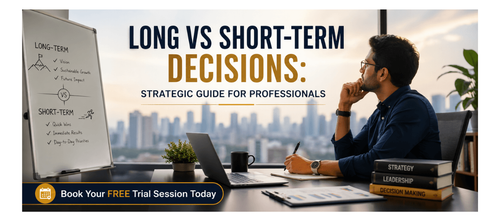

How to Evaluate Long-Term vs Short-Term Decision Impacts: A Practical Framework for Smarter Career Choices
Every professional reaches moments where a decision feels urgent, high-stakes, and uncertain at the same time. Should you accept a higher-paying job now or stay in a role that offers long-term growth? Should you prioritise quick wins or invest in something that may take years to pay off?
Most people rely on instinct, incomplete information, or external advice that does not fully reflect their situation. The result is often a pattern of decisions that either optimise for immediate rewards but create long-term regret, or overanalyse the future and miss critical opportunities today.
The reality is simple: career growth is not defined by a single decision, but by the consistency and quality of your decision-making process over time. This is where a structured framework becomes essential. Instead of reacting to pressure, you begin to evaluate choices with clarity, balance, and confidence.
This blog is based on a practical guidebook designed specifically to help working professionals evaluate decisions across both short-term and long-term horizons using proven frameworks from decision science and real-world applications.
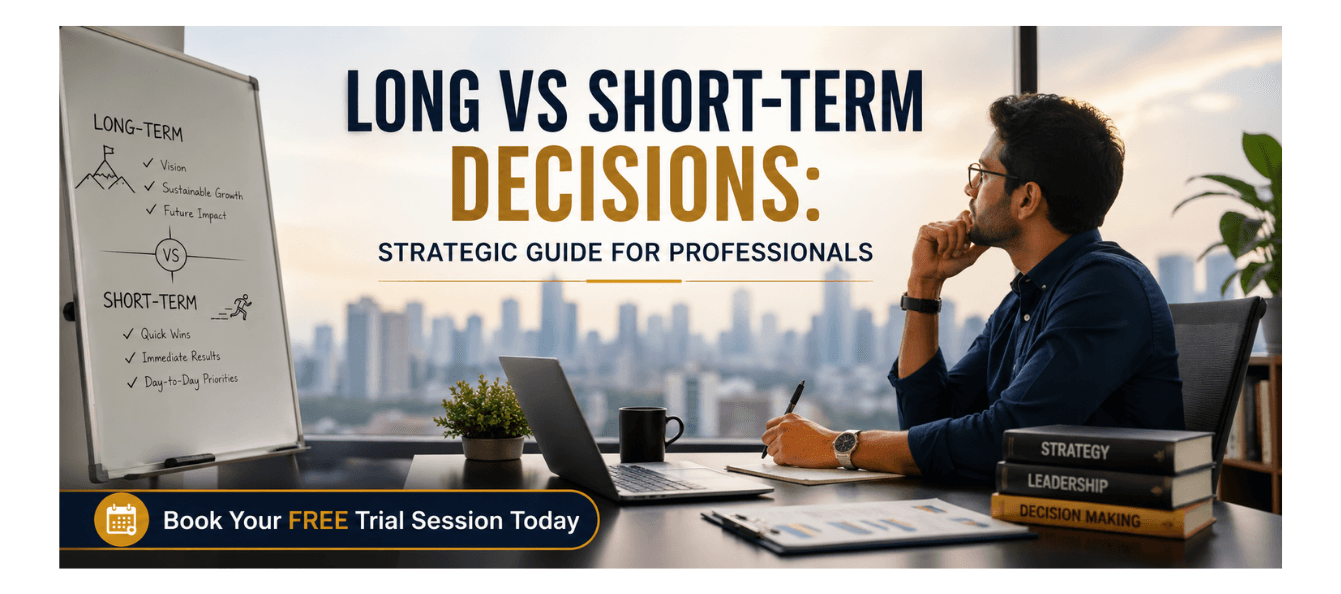
Download these resources and apply them alongside your daily work for improved clarity, productivity, and professional growth. You can also book a free trial to gain expert guidance and enhance your communication, problem-solving, and decision-making skills. The materials are designed in a clear, structured format to help professionals learn efficiently and implement insights with confidence.
Who Is This Blog For?
- Working professionals making career or job-related decisions
- Managers and leaders balancing short-term targets with long-term strategy
- Entrepreneurs and consultants evaluating business trade-offs
- Career switchers choosing between stability and growth
- High-potential professionals aiming to build better decision-making habits
Why This Topic Matters Today?
Modern workplaces reward speed, visibility, and quick results. This creates a natural bias toward short-term thinking, often at the expense of long-term outcomes.
The guide highlights a critical insight: most professionals operate under “present bias,” a cognitive tendency to overvalue immediate rewards and undervalue future consequences.
This leads to three major risks:
- Choosing short-term gains that create long-term misalignment
- Overthinking long-term scenarios and delaying action
- Making reactive decisions without structured evaluation
In a fast-changing professional environment, the ability to balance both time horizons is no longer optional—it is a core career skill.
Core Concept or Framework Explained
At the heart of the guidebook is the Dual-Horizon Decision Framework, a powerful model that evaluates decisions across two dimensions: short-term impact and long-term value.
The framework uses a simple but highly effective 2×2 grid:
- High short-term + high long-term impact: Priority decisions worth full investment
- High short-term + low long-term impact: Quick wins, but not strategic bets
- Low short-term + high long-term impact: Strategic investments requiring patience
- Low short-term + low long-term impact: Decisions to deprioritise or delegate
This model shifts your thinking from “either short-term or long-term” to “how do I optimise both simultaneously?”
The guide also introduces the idea of dual-horizon thinking—holding both immediate and future consequences in mind while making decisions. This is a defining trait of high-performing professionals.
How This Blog and Guidebook Help You?
This blog translates the guidebook into a practical, easy-to-apply format so you can:
- Make faster decisions without compromising quality
- Avoid common cognitive traps and biases
- Evaluate trade-offs with clarity and structure
- Align decisions with your long-term career goals
- Build confidence in high-pressure situations
Instead of second-guessing your choices, you develop a repeatable system that improves over time.
Step-by-Step Breakdown
Step 1: Clarify the Decision Clearly
Most professionals skip this step and jump straight into analysis.
The guide emphasises creating a precise decision statement:- Define what you are deciding
- Set a clear timeline
- Identify constraints or context
Example:
“I am deciding whether to accept a promotion within two weeks, given increased responsibility and limited salary change.”
Also define:
- What “short-term” means (30 days, 6 months, etc.)
- What “long-term” means (2–5 years or more)
- Who is affected—stakeholders now and later
Clarity at this stage prevents flawed analysis later.
Step 2: Map the Consequences Across Time
Every decision has multiple layers of impact.
The guide introduces first, second, and third-order thinking:
- First-order: Immediate outcomes
- Second-order: Effects of those outcomes
- Third-order: Long-term consequences
Use two lenses:
Short-term:
- Immediate results
- Resource costs (time, money, energy)
- Reversibility
- Quick wins
Long-term:
- Career trajectory
- Compounding effects
- Identity and skill development
- Strategic positioning
A powerful technique here is asking: “And then what?” repeatedly to uncover deeper consequences.
Step 3: Assign Weight Based on Priorities
Not all outcomes matter equally.
The guide recommends assigning weights based on your current priorities:
- Career growth
- Financial impact
- Relationships and reputation
- Energy and wellbeing
For example:
- Career growth: 40%
- Financial impact: 25%
- Relationships: 20%
- Wellbeing: 15%
These weights change depending on your life stage, making decision-making more personalised and coherent.
Step 4: Apply the SCOPE Test
The SCOPE Test is a five-question diagnostic tool that strengthens your evaluation:
- Sustainability: Can this be maintained over time?
- Compounding: Do benefits grow or decline over time?
- Opportunity Cost: What are you giving up?
- Path Dependency: Does this limit future choices?
- Externalities: How does this affect others?
This step ensures you don’t overlook hidden risks or long-term trade-offs.
Step 5: Stress-Test Your Thinking
Even strong decisions can fail if assumptions are flawed.
The guide introduces two powerful techniques:
Pre-Mortem Analysis
- Imagine the decision failed in 2 years
- Identify what went wrong
- Trace back to incorrect assumptions
Devil’s Advocate Thinking
- Identify the strongest argument against your choice
- Challenge your own reasoning
- Seek contradictory evidence
This step improves decision quality by eliminating blind spots.
Step 6: Make the Decision with Confidence
No decision is ever made with complete certainty.
The guide recommends the “70% Rule”:
- If you have 70% of the required information
- And have followed a structured process
- It is time to act
Also define:
- Short-term success metrics (30–90 days)
- Long-term success metrics (1–3 years)
- Review checkpoints
This turns decisions into evolving strategies rather than fixed choices.
Common Mistakes or Pitfalls to Avoid
The guide identifies recurring mistakes professionals make:
- Mistaking urgency for importance
- Choosing options that “look good” instead of delivering results
- Failing to define long-term clearly
- Ignoring second- and third-order effects
- Treating decisions as permanent
Better alternatives include:
- Separating urgency from significance
- Focusing on outcomes, not perception
- Using structured frameworks consistently
- Building review checkpoints into every major decision
How Should You Use This Guidebook Effectively?
To maximise value from the framework:
- Start with one real decision you are currently facing
- Work through the 6-step framework systematically
- Write your analysis instead of thinking mentally
- Use the decision worksheet for structured evaluation
- Revisit decisions at predefined checkpoints
Suggested workflow:
- 20–30 minutes for initial evaluation
- 10 minutes for stress-testing
- 5 minutes to define metrics and next steps
Consistency matters more than perfection. The more you use the framework, the more intuitive it becomes.
Key Takeaways
- Short-term and long-term thinking must work together, not compete
- Present bias leads to poor decision-making if left unchecked
- Structured frameworks improve both speed and accuracy of decisions
- Second- and third-order thinking reveal hidden consequences
- Personal priorities must guide decision weighting
- The SCOPE Test helps identify blind spots and trade-offs
- Stress-testing strengthens confidence and clarity
- The 70% Rule encourages timely action without overthinking
- Every major decision should include review checkpoints
Your Next Step: Accelerate Your Career with PlanetSpark
Creating an impact-driven resume is not just about landing your next job—it’s about owning your professional story and presenting it with clarity, confidence, and credibility. When your resume clearly communicates value, results, and impact, opportunities follow naturally.
At PlanetSpark, we are committed to empowering working professionals with practical, outcome-focused resources that drive real career growth. From resume building and workplace communication to leadership presence and professional writing, our programs are designed to help you succeed in today’s fast-evolving job market.
Visit https://www.planetspark.in/resources to explore:
- Career and resume-building guides
- Workplace communication and professional writing resources
- Skill-development tools curated for working professionals
Want a deeper, hands-on experience?
You can also book a free trial session to learn more about PlanetSpark’s Working Professional Courses, designed to accelerate your career through personalised coaching, real-world practice, and expert guidance.
Your career deserves more than generic advice.
It deserves clarity, confidence, and measurable impact.
Start building that advantage today—with PlanetSpark.
Personalized Communication Roadmaps
Record a video to get a AI generated personalized communication reports