
Managing Confrontation Anxiety at Work: Practical Guide
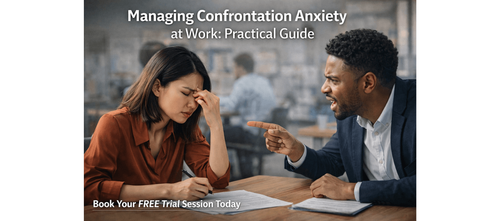

Managing Confrontation Anxiety at Work: A Practical Framework to Speak Up with Confidence and Clarity
You know the moment. You’ve rehearsed the conversation in your head multiple times—what to say, how to say it, and how the other person might respond. But when the moment actually arrives, something shifts. You hesitate. You soften your message. Or worse, you avoid the conversation entirely.
This is not a lack of skill or intelligence. It is confrontation anxiety—and it is one of the most common yet overlooked barriers to professional growth.
In today’s workplace, where collaboration, assertiveness, and clear communication define success, the inability to handle difficult conversations comes at a cost. Missed opportunities, unresolved conflicts, stalled growth, and reduced credibility all stem from the same root issue: not speaking up when it matters.
The “Managing Confrontation Anxiety” guidebook is designed to solve this exact problem. It provides a structured, repeatable system to help you understand your anxiety triggers, prepare effectively, communicate clearly under pressure, and build long-term confidence through reflection and practice.
Download these resources and apply them alongside your daily work for improved clarity, productivity, and professional growth. You can also book a free trial to gain expert guidance and enhance your communication, problem-solving, and decision-making skills. The materials are designed in a clear, structured format to help professionals learn efficiently and implement insights with confidence.
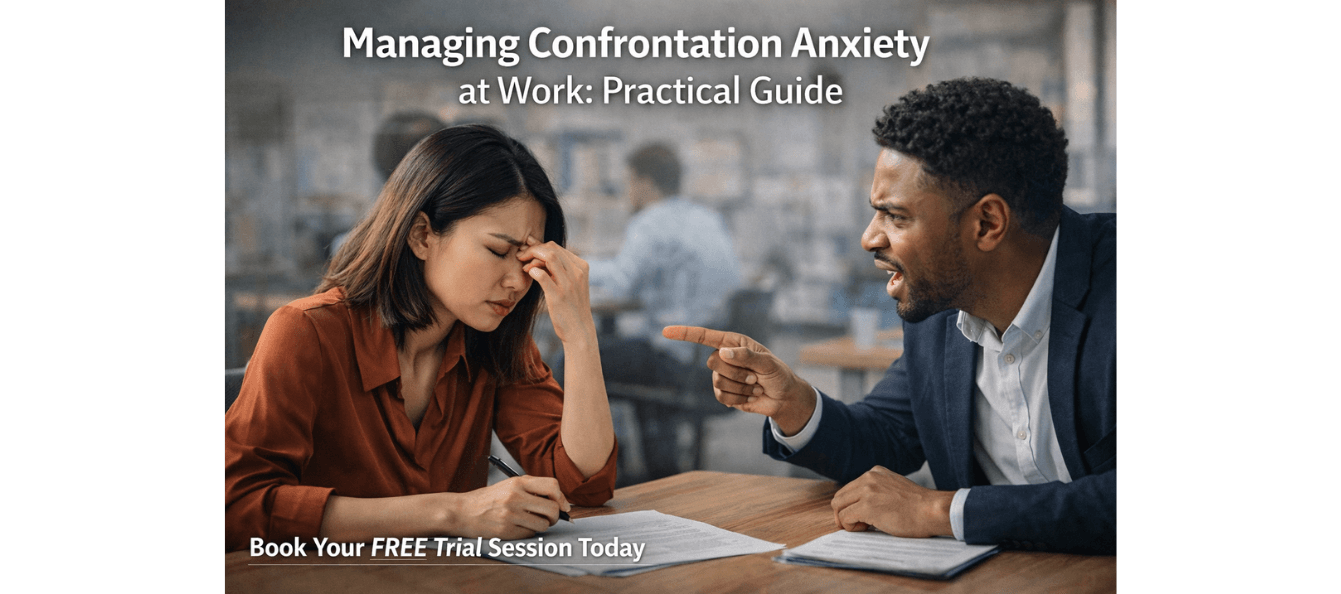
Who Is This Blog For?
- Working professionals with 0–15 years of experience navigating workplace challenges
- Managers and team leads handling difficult conversations with teams or stakeholders
- Consultants and client-facing professionals managing expectations and boundaries
- Career switchers adapting to new environments and communication dynamics
- Professionals who avoid confrontation or struggle to express disagreement clearly
- Individuals looking to build confidence in high-stakes professional conversations
Why This Topic Matters Today?
Modern workplaces demand more than technical competence. Professionals are expected to communicate clearly, manage conflict constructively, and advocate for themselves and their teams.
Yet, research shows that a majority of professionals avoid at least one important confrontation every month. This avoidance leads to real consequences—delayed decisions, unresolved issues, strained relationships, and missed career opportunities.
Confrontation anxiety is not just a personal discomfort. It is a professional risk.
When professionals consistently avoid difficult conversations, they accumulate invisible costs:
- Resentment that affects collaboration
- Missed opportunities for recognition or growth
- Reduced influence in decision-making
- A reputation for passivity or lack of assertiveness
Addressing this challenge is no longer optional. It is essential for career progression.
Core Concept
At the heart of this guidebook is a simple but powerful idea: confrontation anxiety is not a flaw—it is a signal. And like any signal, it can be understood, managed, and acted upon with the right system.
The guide introduces a four-part cycle that transforms how professionals approach difficult conversations:
Understand Triggers
Before managing anxiety, you must identify what causes it. Triggers can be situational, relational, or internal. By mapping these triggers, professionals gain clarity and reduce emotional overwhelm.
Prepare with Structure
Preparation replaces vague anxiety with clear thinking. The PREP framework—Purpose, Reality, Empathy, Path—helps professionals organise their thoughts and approach conversations with intention.
Communicate with Regulation
The goal is not to eliminate anxiety but to function effectively despite it. Techniques such as pausing, acknowledging, and returning to the core message help maintain composure in real time.
Reflect and Improve
Every conversation becomes a learning opportunity. Structured reflection transforms experience into skill, reducing anxiety over time.
A real-world example in the guide illustrates this clearly. A professional delaying a salary negotiation due to fear of judgment was able to prepare using the framework, handle resistance calmly, and achieve a measurable outcome. The shift came not from eliminating anxiety, but from managing it effectively.
How This Blog and Guidebook Help You?
This blog and the underlying guidebook provide more than just insight—they offer a practical system for change.
You will learn how to:
- Identify and understand your personal anxiety triggers
- Replace overthinking with structured preparation
- Communicate clearly even when facing resistance
- Stay composed in high-pressure conversations
- Build confidence through repeated, structured practice
- Turn every difficult conversation into a growth opportunity
The result is not just better conversations—it is stronger professional presence, improved relationships, and accelerated career growth.
Step-by-Step Breakdown
Understanding Your Anxiety: The Trigger Map
The first step is awareness. Instead of labelling yourself as “bad at confrontation,” the guide helps you identify specific triggers.
These fall into three categories:
- Situational triggers such as high-stakes meetings or unexpected confrontations
- Relational triggers involving authority figures or emotionally reactive individuals
- Internal triggers such as fear of judgment, past negative experiences, or imposter syndrome
By clearly mapping these triggers, you move from vague anxiety to specific, manageable insights.
Preparing for the Conversation: The PREP Framework
Preparation is the most powerful antidote to anxiety.
The PREP framework provides a structured approach:
- Purpose: Define the one outcome you want from the conversation
- Reality: Focus on observable facts rather than assumptions
- Empathy: Consider the other person’s perspective
- Path: Propose a clear way forward
This ensures that you enter the conversation with clarity rather than uncertainty.
Executing the Conversation: Staying Regulated
Even with preparation, anxiety may still appear. The guide focuses on managing it in real time.
A simple loop helps maintain control:
- Pause and breathe to regulate your response
- Acknowledge the other person’s perspective
- Return to your core message
- Propose the next step
This approach prevents common reactions like backing down too quickly or becoming overly aggressive.
Post-Conversation Reflection: Building Confidence
Growth happens after the conversation.
The structured debrief focuses on:
- What actually happened
- What worked well
- What can be improved next time
- What you learned about the other person
- What the next steps are
This reflection turns each experience into a building block for future confidence.
Long-Term Development: The 30-Day Plan
The guide includes a structured plan to build confrontation confidence over time.
It encourages:
- Starting with low-stakes conversations
- Gradually increasing difficulty
- Tracking anxiety levels
- Practising consistently across different scenarios
This systematic approach ensures sustainable improvement rather than temporary fixes.
Common Mistakes
Even experienced professionals fall into predictable patterns when dealing with confrontation anxiety.
Common mistakes include:
- Apologising before starting the conversation, which reduces credibility
- Over-explaining points due to fear of rejection
- Giving in at the first sign of resistance
- Avoiding eye contact or rushing through communication
- Bringing up multiple issues at once instead of focusing on one
- Ending conversations without a clear next step
- Replaying conversations excessively instead of reflecting constructively
The guide not only highlights these mistakes but also provides clear, actionable alternatives for each.
How Should You Use This Guidebook Effectively?
To get maximum value, treat this guidebook as a working tool rather than a one-time read.
Recommended approach:
- First, read the entire guide to understand the overall framework
- Next, identify one real conversation you are currently avoiding
- Complete the Trigger Map to build awareness
- Use the PREP worksheet to prepare your conversation
- Apply the communication techniques during the discussion
- Complete the debrief within 24 hours
- Repeat the process consistently over a 30-day period
Time investment:
- Initial read-through: 30–45 minutes
- Preparation per conversation: 20–30 minutes
- Post-conversation reflection: 10–15 minutes
This small, focused investment can create significant long-term impact.
Key Takeaways
- Confrontation anxiety is a signal, not a weakness
- Avoiding difficult conversations creates long-term professional costs
- Structured preparation reduces anxiety significantly
- The PREP framework provides clarity and direction
- Real-time regulation is more important than eliminating anxiety
- Reflection is essential for building long-term confidence
- Small, consistent practice leads to measurable improvement
- Every conversation is an opportunity to grow your professional capability
Your Next Step: Accelerate Your Career with PlanetSpark
Creating an impact-driven resume is not just about landing your next job—it’s about owning your professional story and presenting it with clarity, confidence, and credibility. When your resume clearly communicates value, results, and impact, opportunities follow naturally.
At PlanetSpark, we are committed to empowering working professionals with practical, outcome-focused resources that drive real career growth. From resume building and workplace communication to leadership presence and professional writing, our programs are designed to help you succeed in today’s fast-evolving job market.
Visit https://www.planetspark.in/resources to explore:
- Career and resume-building guides
- Workplace communication and professional writing resources
- Skill-development tools curated for working professionals
Want a deeper, hands-on experience?
You can also book a free trial session to learn more about PlanetSpark’s Working Professional Courses, designed to accelerate your career through personalised coaching, real-world practice, and expert guidance.
Your career deserves more than generic advice.
It deserves clarity, confidence, and measurable impact.
Personalized Communication Roadmaps
Record a video to get a AI generated personalized communication reports