
Map Decision Complexity Levels for Better Handling in Your Role
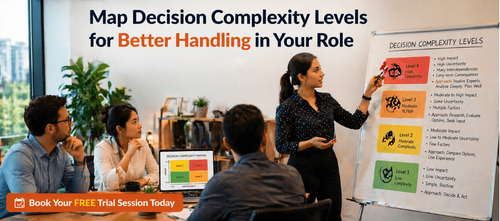

Master Decision-Making with a Proven Framework: A Practical Guide to Handling Complexity
In today's fast-paced professional environment, making high-stakes decisions can often feel like navigating a maze. Many professionals make decisions without fully understanding their complexity, leading to unnecessary mistakes or indecision. Whether you're a manager, consultant, or career switcher, being able to assess and navigate complex decisions effectively is a vital skill.
Most decision-making processes are rushed, with the focus on urgency rather than complexity. This can lead to over-deliberation of simple choices or under-preparation for truly complex ones. Without a reliable framework, professionals often struggle to decide with clarity and confidence. That’s where a structured decision complexity framework comes into play, helping you break down your choices and handle them systematically.
Download these resources and apply them alongside your daily work for improved clarity, productivity, and professional growth. You can also book a free trial to gain expert guidance and enhance your communication, problem-solving, and decision-making skills. The materials are designed in a clear, structured format to help professionals learn efficiently and implement insights with confidence.
Who Is This Blog For?
- Managers overseeing team and project decisions
- Consultants facing layered, high-stakes business decisions
- Career switchers who need to make strategic career choices
- Professionals with 0-15 years of experience
- Individuals aiming to make better, more informed decisions in high-stakes environments
Why This Topic Matters Today?
The ability to make clear, confident decisions is a skill that sets professionals apart. In today’s world, where ambiguity and uncertainty are common in every business decision, understanding the true complexity of a choice is more important than ever. According to the resource, a misclassified decision or applying the wrong decision-making strategy can lead to wasted resources, missed opportunities, and reduced trust from stakeholders.
Professional decision-making today is riddled with:
- Uncertainty and unclear outcomes
- Multiple stakeholders and conflicting interests
- Time-sensitive decisions with far-reaching impacts
- Conflicting information that requires synthesis
- The risk of making the wrong choice due to the complexity of the situation
The good news is that this guide equips you with a proven framework to manage complexity effectively.
Core Concept or Framework Explained
The central framework of this guide revolves around assessing decision complexity across five key dimensions:
1. Uncertainty: How much do you not know about the potential outcomes of the decision? High uncertainty signals a need for structured analysis and risk mitigation.
2. Stakeholder Reach: The more people or teams involved in the decision, the more complex the decision becomes. The challenge is to align these stakeholders effectively.
3. Reversibility: Can the decision be undone if it proves wrong? Irreversible decisions require more careful planning and a backup strategy.
4. Time Horizon: How far into the future does the decision’s impact extend? Longer horizons often carry more complex variables that can shift over time.
5. Information Conflict: Do you have clear, consistent data, or are there competing analyses? Complex decisions often involve conflicting data that requires careful evaluation and synthesis.
These five dimensions are the key to assessing the complexity of a decision and applying the appropriate strategy to handle it.
How This Blog and Guidebook Help You?
This blog and the corresponding guidebook will help you:
- Gain clarity about the true complexity of your decisions
- Navigate through high-stakes decisions with confidence
- Apply proven strategies to make the right choices at the right time
- Avoid common pitfalls of misclassified decisions or over-complicated processes
- Improve stakeholder management and reduce conflict in decision-making
Step-by-Step Breakdown
Step 1: Understand the Five Dimensions of Decision Complexity
Each decision has its own level of complexity, based on uncertainty, stakeholder involvement, reversibility, time horizon, and information conflict. Assess each of these dimensions individually to get an accurate sense of how complex your decision is.
Example:
If you’re deciding whether to take a job offer in a new city, your decision might have high uncertainty (what the job environment will really be like), a significant time horizon (moving and settling in), and potential stakeholder reach (family, future colleagues).
Step 2: Score Your Decision Using the Complexity Scorecard
Once you’ve assessed the five dimensions, use the decision complexity scorecard to assign scores and categorize the decision into one of four tiers: Routine, Considered, Complex, or Adaptive. This tiering system helps you decide how much energy and what strategy to apply to the decision.
Example:
A decision to accept a job offer might score high on uncertainty and time horizon, landing it in the “Complex” tier, while a decision about a short-term project assignment might be categorized as “Routine.”
Step 3: Apply the Tier-Matched Handling Strategy
Once you’ve scored your decision, the next step is to choose the appropriate handling strategy for the complexity tier:
- Tier 1 (Routine): For low-complexity decisions, use standard procedures or personal judgment to make quick decisions.
- Tier 2 (Considered): Moderate complexity calls for structured analysis and brief alignment with stakeholders.
- Tier 3 (Complex): High complexity requires collaboration, expert input, and thorough risk mapping before finalizing the decision.
- Tier 4 (Adaptive): Extreme complexity needs an emergent strategy with iterative testing and flexibility.
Step 4: Reduce Complexity Where Possible
Many decisions initially appear complex but can be simplified with the right pre-work. Use the provided checklist to reduce uncertainty, manage stakeholder reach, and improve reversibility before committing to a final decision.
Common Mistakes or Pitfalls to Avoid
1. Misclassifying Decision Complexity
Many professionals wrongly treat simple decisions as complex or vice versa. Always score your decisions first to ensure you’re applying the right strategy.
2. Rushing Complex Decisions
Tier 3 and Tier 4 decisions require careful deliberation. Rushing these decisions can lead to mistakes that could have been avoided with more structured input.
3. Ignoring the Importance of Stakeholders
Overlooking stakeholder involvement or failing to align with key decision-makers is a common mistake that can lead to delays and conflicts.
4. Underestimating the Role of Information Conflict
In complex decisions, conflicting data can paralyze decision-making. It’s critical to assess and address information conflict before making a final choice.
How Should You Use This Guidebook Effectively?
To make the most of this guidebook:
- Invest 30 minutes to an hour the first time you use it to familiarize yourself with the framework and scoring system.
- Use the scorecard for every significant decision you face. The more you practice, the more intuitive the process becomes.
- Review your decisions monthly to assess whether you’ve been applying the correct strategies and adjust as needed.
Key Takeaways
- Decision complexity is multi-dimensional—don’t rush through it
- Scoring your decisions ensures you apply the right strategy every time
- Use tier-matched strategies to maximize efficiency and outcomes
- Avoid common mistakes like misclassifying decisions or rushing through complex choices
- Reducing complexity upfront increases your decision-making effectiveness
Your Next Step: Accelerate Your Career with PlanetSpark
Creating an impact-driven resume is not just about landing your next job—it’s about owning your professional story and presenting it with clarity, confidence, and credibility. When your resume clearly communicates value, results, and impact, opportunities follow naturally.
At PlanetSpark, we are committed to empowering working professionals with practical, outcome-focused resources that drive real career growth. From resume building and workplace communication to leadership presence and professional writing, our programs are designed to help you succeed in today’s fast-evolving job market.
Visit https://www.planetspark.in/resources to explore:
- Career and resume-building guides
- Workplace communication and professional writing resources
- Skill-development tools curated for working professionals
Want a deeper, hands-on experience?
You can also book a free trial session to learn more about PlanetSpark’s Working Professional Courses, designed to accelerate your career through personalised coaching, real-world practice, and expert guidance.
Your career deserves more than generic advice.
It deserves clarity, confidence, and measurable impact.
Personalized Communication Roadmaps
Record a video to get a AI generated personalized communication reports