
Master CV Guide for Final-Year Students and Freshers
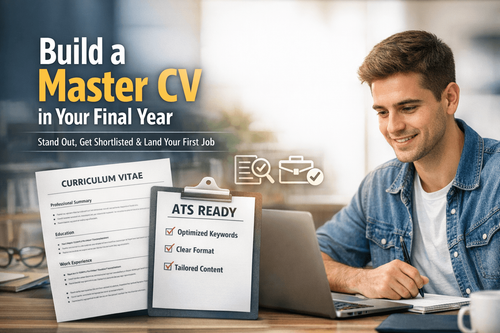

How to Build a Master CV in Your Final Year: The Complete Guide to Stand Out, Get Shortlisted, and Land Your First Job
Your final year of college or university is more than just exams, assignments, and graduation plans. It is the moment when your academic journey begins transforming into a professional career.
Yet most students make a critical mistake during this transition. They treat their CV as something to create quickly before submitting job applications. Often, it is written the night before a deadline, copied from generic templates, and filled with vague descriptions.
The result is predictable.
Recruiters spend only six to ten seconds scanning a CV before deciding whether it deserves further attention. In a job market where hundreds of candidates apply for a single role, a poorly structured CV rarely survives the first scan.
This is why building a Master CV during your final year can completely change your job search outcomes. Instead of creating a new CV for every application under pressure, you develop a comprehensive career document that stores every achievement, project, skill, and experience you have gained.
From that master document, you create focused, tailored CVs for each job application.
This guide explains how to build that powerful professional asset step by step.
Who Is This Blog For?
This guide is especially valuable for individuals preparing to enter the job market or reposition their professional profile.
- Final-year undergraduate or postgraduate students preparing for placements
- Early-career professionals applying for their first full-time role
- Students applying to graduate programmes
- Career switchers moving into a new industry
- Interns converting internships into full-time opportunities
- Young professionals building a strong professional identity
Why This Topic Matters Today?
Today's hiring landscape is extremely competitive. Recruiters often review hundreds of CVs for a single opening, and many companies use automated systems to screen applications before a human ever sees them.
Studies suggest that up to 75 percent of CVs are rejected by Applicant Tracking Systems before reaching a recruiter.
This means that a generic CV does not simply reduce your chances. It may prevent your application from being seen at all.
Another important insight from recruiter behaviour is that the first few sections of a CV determine whether the rest of the document is read. Professional summary, experience bullets, and skills often receive the most attention during the initial scan.
Students who present their experience clearly and strategically consistently outperform candidates who list responsibilities without demonstrating impact.
A well-structured master CV allows you to:
- Present your experience strategically
- Customise your application quickly
- Align your CV with job descriptions
- Avoid forgetting important achievements
- Build a professional narrative recruiters understand
Core Concept Explained
What Is a Master CV?
Most people think of a CV as a single document they send to employers.
A Master CV works differently.
A Master CV is a comprehensive document that stores every professional detail about your career journey. It includes internships, projects, awards, certifications, extracurricular leadership roles, and academic achievements.
Think of it as your personal career database.
You never send the Master CV directly to employers. Instead, you use it as the source document to create shorter, tailored CVs that match each role you apply for.
The diagram on page 3 of the guide visually explains this concept by showing how the Master CV feeds two outputs: a tailored CV customised for the job and an ATS-optimised version designed to pass automated screening systems.
This approach offers two major advantages:
- You never forget important experiences when applying for jobs
- You can quickly customise CVs without rewriting everything
How This Blog and Guidebook Help You?
The framework in this guide simplifies the process of building a powerful Master CV from scratch.
It helps you:
- Conduct a complete CV audit of your experiences
- Build a strong professional identity statement
- Transform job descriptions into achievement-driven bullets
- Highlight academic work strategically
- Present skills and certifications effectively
- Optimise your CV for ATS systems
- Tailor your CV for different industries
By following the structured steps in this guide, you create a CV system that works throughout your career, not just during your final year.
Step-by-Step Breakdown
Step 1: Conduct a CV Audit
Before writing anything, the first step is to collect every piece of evidence about your academic and professional journey.
The guide recommends spending around two hours on this process.
Start by opening a blank document and listing everything you have done, including:
- Internships and part-time jobs
- Academic projects
- Certifications and courses
- Technical skills
- Club memberships
- Competitions or hackathons
- Volunteer work
- Freelance or consulting work
- Research papers or presentations
Many students underestimate how much experience they already have. A group presentation you led, a hackathon your team won, or tutoring work that improved communication skills all contribute to your professional story.
The goal at this stage is not editing or filtering. It is simply collecting information.
Step 2: Build Your Professional Identity Statement
A powerful CV begins with a professional summary.
This is a three to five line statement that tells recruiters who you are, what you have accomplished, what skills you bring, and what type of role you are seeking.
The guide introduces a simple formula for writing this section:
Who you are
What you have done
What you are good at
What you want
For example, a strong summary for a marketing student might describe their specialisation, campaign experience, analytical skills, and target industry.
Specificity is the key difference between weak and strong summaries.
Instead of writing generic objectives, your summary should clearly communicate your value to employers.
Step 3: Structure Your Experience Using Achievement Statements
One of the most common CV mistakes is listing job descriptions instead of achievements.
For example, a weak bullet might say:
Responsible for managing social media accounts.
A stronger version would explain what you actually achieved in that role.
The guide recommends using the CAR framework to write strong bullet points:
Context
Action
Result
This framework ensures every bullet tells a meaningful story.
For instance, managing social media becomes a measurable achievement when it includes actions and outcomes such as increased engagement, audience growth, or improved performance metrics.
Step 4: Strengthen Your Education Section
For final-year students, education remains a major component of the CV.
However, listing only the degree title and graduation year wastes valuable space.
Your education section should also include:
- Relevant coursework
- Dissertation or thesis topic
- Academic awards or scholarships
- Exchange programmes
- Research contributions
The guide emphasises thinking of your degree as a long-term project. Your CV should show the outputs of that project rather than simply listing the qualification.
Step 5: Build a Strong Skills and Certifications Section
Another common mistake is listing vague skills such as communication, teamwork, or leadership without evidence.
Instead, skills should be organised into categories such as:
Technical skills
Tools and platforms
Domain knowledge
Certifications
Languages
For example, instead of simply writing data analysis, a stronger skills section might list specific tools such as Python, Tableau, or Excel with proficiency levels.
Certifications should always include the issuing organisation and completion year.
This level of detail signals credibility and expertise.
Step 6: Highlight Projects and Extracurricular Achievements
Projects and extracurricular activities often become the differentiating factor for final-year students.
If two candidates have similar grades and internships, the one with stronger projects and leadership experience stands out.
Projects may include:
- Capstone or dissertation research
- Case competitions
- Personal apps or websites
- NGO initiatives
- Hackathon entries
- Freelance work
Each project entry should explain the objective, the tools used, and the outcome or impact.
Recruiters value these experiences because they demonstrate initiative, curiosity, and problem-solving ability.
Step 7: Optimise Your CV for ATS Systems
Before recruiters see your CV, it is often scanned by Applicant Tracking Systems.
These systems rank candidates based on keyword matching with the job description.
The guide recommends several strategies to improve ATS performance:
- Use standard section headings such as Work Experience and Education
- Avoid graphics, tables, or text boxes
- Mirror terminology from the job description
- Include keyword variations
- Use clean formatting with standard fonts
These adjustments significantly increase the chances that your CV passes automated screening.
Step 8: Format Your CV for Clarity and Impact
A master CV can be four to six pages long because it stores everything.
However, the CV you send to employers should usually be limited to two pages.
The guide recommends maintaining a clean layout with:
- Consistent typography
- Clear section headings
- Balanced white space
- Standard date formats
- Uniform bullet alignment
Consistency signals professionalism and attention to detail.
Step 9: Tailor Your CV for Each Application
Once your master CV is built, tailoring becomes much easier.
Instead of rewriting your CV, you simply select the most relevant content and adjust language to match the job description.
The guide suggests a five-step tailoring process:
- Read the job description and highlight key skills
- Identify relevant experiences in your master CV
- Select three or four strong bullet points per role
- Adjust your professional summary
- Check ATS readiness before submission
Even spending thirty to forty-five minutes tailoring your CV can significantly increase interview chances.
Common Mistakes or Pitfalls to Avoid
Many CVs fail not because of weak experience but because of avoidable mistakes.
Some of the most common issues include:
- Using generic objective statements
- Listing duties instead of achievements
- Sending the same CV for every job
- Ignoring the education section
- Using inconsistent formatting
- Including unprofessional email addresses
- Submitting CVs with spelling or grammar errors
- Writing more than three pages with limited experience
Avoiding these mistakes immediately improves the professionalism of your application.
How Should You Use This Guidebook Effectively?
To get the most benefit from this guide, follow a structured weekly plan.
Day 1
Conduct your CV audit and gather all relevant information.
Day 2
Write multiple versions of your professional summary and refine them with feedback.
Day 3–4
Rewrite experience bullets using the CAR framework.
Day 5
Complete education, skills, projects, and certifications sections.
Day 6–7
Review formatting, run ATS checks, and have a trusted peer review your CV.
The guide emphasises that your Master CV should remain a living document. Update it regularly whenever you gain new skills, projects, or achievements.
Key Takeaways
- Your CV is one of the most important assets for launching your career
- A Master CV stores all achievements and experiences in one place
- Tailored CVs should be created for every job application
- The CAR framework helps transform job descriptions into achievement statements
- Professional summaries should clearly communicate your value and direction
- Projects and extracurricular activities can significantly strengthen a student CV
- ATS optimisation is essential for passing automated screening systems
- A well-built Master CV saves time and improves application success
Your Next Step: Accelerate Your Career with PlanetSpark
Creating an impact-driven resume is not just about landing your next job—it’s about owning your professional story and presenting it with clarity, confidence, and credibility. When your resume clearly communicates value, results, and impact, opportunities follow naturally.
At PlanetSpark, we are committed to empowering working professionals with practical, outcome-focused resources that drive real career growth. From resume building and workplace communication to leadership presence and professional writing, our programs are designed to help you succeed in today’s fast-evolving job market.
Visit https://www.planetspark.in/resources to explore:
- Career and resume-building guides
- Workplace communication and professional writing resources
- Skill-development tools curated for working professionals
Want a deeper, hands-on experience?
You can also book a free trial session to learn more about PlanetSpark’s Working Professional Courses, designed to accelerate your career through personalised coaching, real-world practice, and expert guidance.
Your career deserves more than generic advice.
It deserves clarity, confidence, and measurable impact.
Personalized Communication Roadmaps
Record a video to get a AI generated personalized communication reports