
Measuring Business Impact of AI Across Daily Workstreams
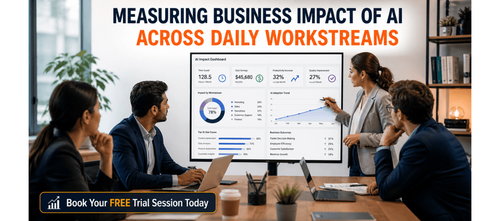

How to Track ROI of AI Adoption and Maximize Its Value Across Workstreams
As AI adoption accelerates across industries, professionals are often faced with the same tough question: "Is this actually working?" Whether you're a manager, consultant, or career switcher, measuring the ROI (Return on Investment) of AI tools in your daily work is essential to justify their use, secure buy-in, and scale their adoption effectively.
This guide provides you with a structured, practical approach to tracking AI ROI across various workstreams, ensuring that you can prove, measure, and maximize the value of AI tools without getting lost in data. By following this framework, you’ll gain clarity on how AI enhances your productivity and deliver consistent, high-quality results—every single time.
Download these resources and apply them alongside your daily work for improved clarity, productivity, and professional growth. You can also book a free trial to gain expert guidance and enhance your communication, problem-solving, and decision-making skills. The materials are designed in a clear, structured format to help professionals learn efficiently and implement insights with confidence.
Who Is This Blog For?
- Career switchers building AI credentials
- Early-to-mid career professionals adopting AI tools
- Consultants proving the value of AI tools to clients
- Managers reporting AI impact upward
- Anyone looking to measure AI effectiveness without drowning in theory
Why This Topic Matters Today?
AI tools are transforming the way professionals work, yet many still struggle to prove their impact. Without a clear framework for tracking ROI, even the best AI tools can be underutilized or misunderstood. This leads to missed opportunities, unsubstantiated claims, and an inability to scale AI usage effectively.
Tracking the ROI of AI adoption isn’t just about measuring cost savings—it's about capturing all the metrics that reflect how AI impacts your workflow. Time efficiency, quality improvements, error reduction, decision speed, and even employee satisfaction are all integral to understanding AI’s full value. But with so many potential metrics, it’s easy to become overwhelmed. The key is to focus on the right metrics for each workstream and measure them consistently.
By following this guide, you will:
- Gain clarity on what ROI means for your specific workstream
- Build a robust tracking system to measure AI performance
- Communicate AI’s value in a way that resonates with stakeholders
- Scale AI adoption by making your ROI story defensible and credible
Core Concept or Framework Explained
The first step in tracking AI’s ROI is defining what success looks like in your specific workstream. ROI from AI adoption is rarely just about saving costs. It spans across different dimensions: time saved, improved quality, faster decision-making, and even employee satisfaction.
1. Identify Your Workstream
Start by identifying the specific function or process where AI is being applied. This could be content creation, data analysis, customer communication, project management, or any other area of your work. Each workstream has its own set of ROI indicators, so being specific is key.
2. Choose Your ROI Metrics
Once you’ve identified the workstream, decide which metrics will best capture AI’s value. Typical metrics include time saved per task, output volume, error rates, and cost per unit. Avoid tracking too many metrics, as this can lead to data paralysis and reduce the focus on key outcomes.
3. Set a Baseline
To track progress, it’s essential to have a baseline. This means documenting how the workstream performed before AI adoption. Without a baseline, there’s no way to measure improvement or justify AI’s impact.
4. Define Your Time Horizon
Decide whether you're measuring ROI over a short period (30–60 days) or a longer cycle (90 days). Short cycles allow for quicker feedback and iteration, while longer cycles give you a clearer picture of cumulative gains.
How This Blog and Guidebook Help You?
This guide and the blog will help you:
- Understand the ROI measurement framework for AI adoption
- Choose the right metrics and track them consistently across different workstreams
- Use workstream-specific tracking templates for efficient data capture and reporting
- Communicate AI’s value to stakeholders with clarity and confidence
Step-by-Step Breakdown
Step 1: Define What ROI Means for Your Workstream
Before you can track ROI, you need to define what success looks like in your context. This will vary depending on the workstream, but it typically involves metrics like time saved, error reduction, and quality improvements.
- Identify the workstream: For example, blog drafting, social media scheduling, customer communication.
- Choose your ROI lens: Focus on 2–3 primary metrics such as time saved, output volume, or quality score.
- Set a baseline: Document how your workstream performed before adopting AI to provide a reference point.
- Define your time horizon: Decide whether you will measure over 30, 60, or 90 days.
Step 2: Build Your Baseline and Choose Your Metrics
You’ll need both quantitative and qualitative metrics to track AI's impact.
- Quantitative metrics: Time per task, output volume, error or revision rate, cost per output, etc.
- Qualitative metrics: Confidence level, stakeholder satisfaction, creative headroom, team adoption sentiment, etc.
Your baseline data should be gathered honestly, even if it’s just a rough estimate. Track your AI-assisted tasks daily and weekly to capture the impact over time.
Step 3: Map AI Tools to Workstreams
Not all AI tools deliver the same type of value across different workstreams. Map the tools you’re using to their corresponding workstreams, and track the ROI accordingly.
- Content & Communications: Tools like ChatGPT, Jasper—Track draft speed, tone consistency, approval rates.
- Data & Analysis: Tools like Copilot, Tableau AI—Track analysis time, insight accuracy, error rate.
- Project Management: Tools like Notion AI, ClickUp—Track planning time, task completion rate.
- Customer & Client Work: Tools like Intercom AI, HubSpot—Track response time, resolution rate.
Step 4: Track, Capture, and Review
The key to tracking ROI is consistency. The most effective professionals build micro-tracking moments into their existing workflow, such as:
- Daily micro-log: Capture key data for each task (time with AI, baseline time, quality rating).
- Weekly review: Spend 5 minutes each week checking for patterns in your AI usage and results.
- Monthly summary: Create a summary for stakeholders, outlining ROI and key insights.
Common Mistakes or Pitfalls to Avoid
Many professionals make mistakes when trying to measure AI ROI. Common errors include:
- No Baseline: Always establish a baseline before adopting AI to make the "after" results meaningful.
- Tracking Everything: Stick to 2–3 metrics per workstream. Too many metrics create noise and confusion.
- Inconsistent Logging: Attach tracking to an existing habit to ensure consistency.
- Ignoring Qualitative Wins**: Include qualitative insights such as stakeholder feedback or personal observations.
- Waiting for Perfect Data: Start sharing findings at the 30-day mark, even if the data is incomplete.
How Should You Use This Guidebook Effectively?
To get the most out of this guidebook:
- Week 1: Define your workstreams and establish your baseline metrics.
- Week 2: Map AI tools to workstreams and start tracking your data.
- Week 3: Review your tracking process weekly, and refine as necessary.
- Week 4: Prepare a monthly summary for stakeholders, highlighting key ROI insights.
Key Takeaways
- Define ROI for each workstream: Establish clear metrics before measuring.
- Set a baseline**: Document the pre-AI performance to make comparisons meaningful.
- Track in micro-moments: Daily, weekly, and monthly reviews help capture the full picture.
- Mix numbers with narrative: Quantitative data and qualitative insights together tell a compelling ROI story.
- Share early and iterate often: Don’t wait for perfect data—visibility and feedback drive continuous improvement.
Your Next Step: Accelerate Your Career with PlanetSpark
Creating an impact-driven resume is not just about landing your next job—it’s about owning your professional story and presenting it with clarity, confidence, and credibility. When your resume clearly communicates value, results, and impact, opportunities follow naturally.
At PlanetSpark, we are committed to empowering working professionals with practical, outcome-focused resources that drive real career growth. From resume building and workplace communication to leadership presence and professional writing, our programs are designed to help you succeed in today’s fast-evolving job market.
Visit https://www.planetspark.in/resources to explore:
- Career and resume-building guides
- Workplace communication and professional writing resources
- Skill-development tools curated for working professionals
Want a deeper, hands-on experience?
You can also book a free trial session to learn more about PlanetSpark’s Working Professional Courses, designed to accelerate your career through personalized coaching, real-world practice, and expert guidance.
Your career deserves more than generic advice.
It deserves clarity, confidence, and measurable impact.
Personalized Communication Roadmaps
Record a video to get a AI generated personalized communication reports