
Monitoring Growth Effectively During Career Transitions
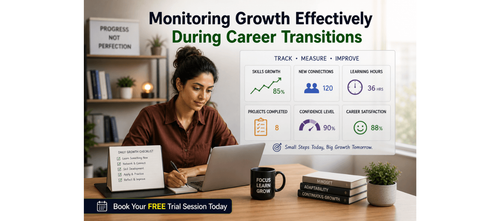

Mastering Career Transitions: How to Track Progress and Stay on Course
Career transitions can be a time of uncertainty and self-doubt, but with a structured approach, you can turn this phase into an opportunity for growth. Many professionals struggle during career transitions because they lack a system for tracking their progress. They put in the hard work—attending webinars, updating resumes, reaching out to contacts—but without a clear way to measure change, it can feel like they’re not making meaningful progress.
This blog offers a proven framework and practical tools for tracking your progress during a career transition phase, helping you stay focused, motivated, and confident as you move forward.
Download these resources and apply them alongside your daily work for improved clarity, productivity, and professional growth. You can also book a free trial to gain expert guidance and enhance your communication, problem-solving, and decision-making skills. The materials are designed in a clear, structured format to help professionals learn efficiently and implement insights with confidence.
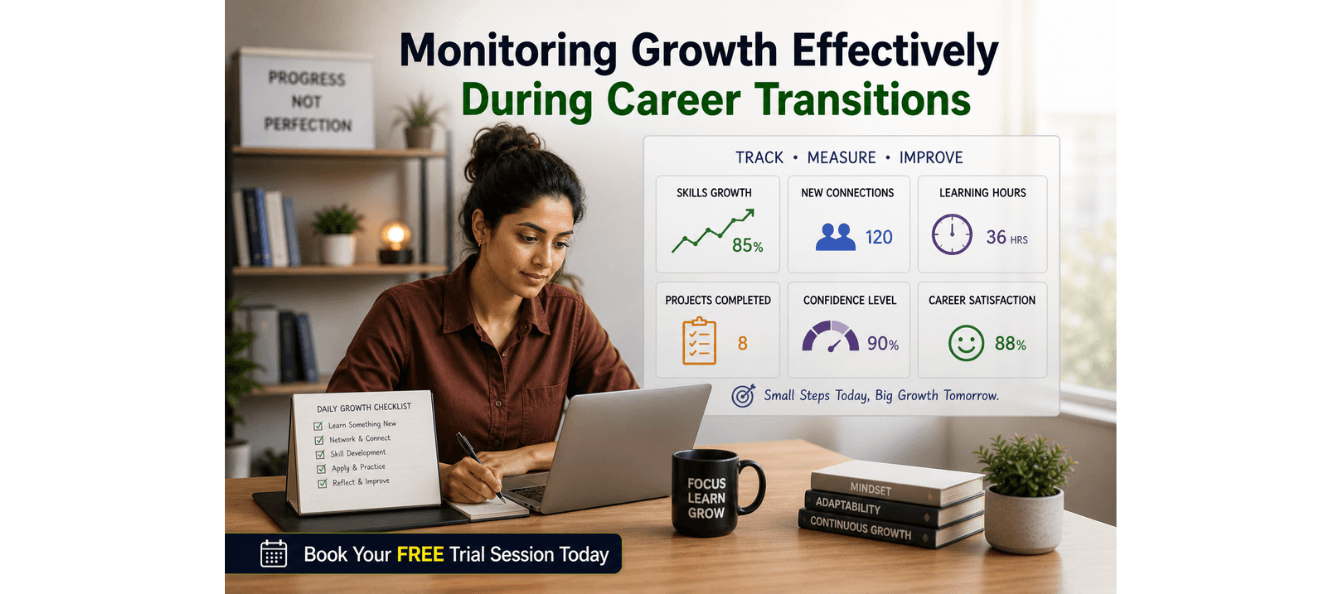
Who Is This Blog For?
- Career switchers looking to make a strategic move
- Mid-career professionals (3–15 years of experience) considering a pivot
- Consultants looking to transition their focus or client base
- Managers exploring a shift to new leadership or functional areas
- Professionals looking for a structured approach to measure progress during their transition
Why This Topic Matters Today?
In a world where professional paths are no longer linear, many people find themselves considering a career transition at some point. However, despite all the hard work, it’s easy to feel stuck without a system to track progress. Without clear indicators of success, transitions can feel slow, discouraging, or like they’re lacking direction.
This blog introduces a comprehensive tracking system to help you measure your transition, build confidence, and maintain momentum, no matter where you are in the process. Whether you’re in the early stages of your transition or already on your new path, this framework will keep you focused and moving forward.
Core Concept or Framework Explained
The key to success during any career transition is knowing where you are, where you’re going, and how to measure your progress. This framework breaks down your transition into three distinct phases:
1. Before: Clarity & Preparation
- This phase is focused on assessing where you are, defining your target role, and preparing your transition toolkit.
2. During: Action & Momentum
- In this phase, you’ll apply for jobs, network, learn new skills, and track your weekly actions to keep momentum going.
3. After: Consolidation & Growth
- After landing a new role, your focus will shift to tracking early wins, building relationships, and meeting 30/60/90-day goals.
How This Blog and Guidebook Help You?
This blog, paired with the practical worksheets and action guides, will help you:
- Define your phase in the transition process
- Conduct a skills audit to understand where you are
- Track your weekly actions and learning progress
- Measure the milestones that matter in your career transition
Step-by-Step Breakdown
Step 1: Clarity & Self-Assessment
Before you can track progress, you need a baseline. This step helps you define where you are, where you want to go, and what the gap looks like. Skipping this step is the single most common mistake professionals make in career transitions—they start applying before they’ve defined what they’re applying for.
Key Actions:
- Skills Audit Worksheet: List your top 10 transferable skills. For each, rate your current proficiency (1–5) and the level required in your target role. The gap score tells you where to focus your learning energy.
Reflection Questions:
- What does success look like in my target role in 12 months?
- What am I most afraid of losing in this transition?
- Which of my current strengths are most undervalued?
- What would I need to believe about myself to move forward confidently?
Step 2: Weekly Action Tracker
Progress in a career transition is built through consistent, intentional weekly actions. This tracker is your accountability system. Fill it in every Monday to plan, and every Friday to review. Over time, the data you collect will reveal patterns—what’s working, what isn’t, and where to double down.
Key Metrics to Track:
- Applications per week: Recommended minimum for active job seekers in transition (3 applications per week)
- Outreach messages: New networking contacts to reach out to each week (2)
- Learning time: Dedicated skill-building hours per week (at least 2 hours)
- Reflection session: Weekly review to assess what's working and adjust (at least 1)
Reflection Actions:
- Track rejections and responses, noting patterns that emerge over time.
- Review your actions to determine where to adjust focus for better results.
Step 3: Networking & Relationship Tracker
In career transitions, relationships are infrastructure. Research consistently shows that most roles are filled through networks, not job boards. Yet many professionals treat networking as an afterthought—something to do when they’re desperate, rather than as an ongoing, strategic practice. This section helps you build and track a purposeful network.
Key Networking Log:
- Name: Who are you connecting with?
- Role/Company: Their position and where they work.
- Next step: What will be the follow-up action after this interaction? (e.g., follow-up coffee chat, send CV, schedule a meeting)
Network Mapping Framework:
1. Inner Circle: 5–10 people who know your work deeply and will advocate for you.
2. Warm Connections: 20–30 people in your target industry or function. Focus on value exchange, not just asking for favors.
3. Weak Ties: Broader connections who may surface unexpected opportunities. LinkedIn engagement and community participation help build this layer.
Step 4: Learning & Skill-Building Log
A career transition is also a learning sprint. The professionals who transition most successfully treat skill-building as a structured project, not a passive activity. This section helps you track what you're learning, why it matters, and how you're applying it—turning knowledge into demonstrable capability.
Types of Learning to Track:
- Formal Learning: Courses, certifications, and structured programs.
- Self-Directed Learning: Books, podcasts, industry reports, and thought leadership.
- Applied Learning: Shadowing, freelance projects, volunteering, or side work in your target field.
Reflection Actions:
- Identify specific skills learned and how you’re applying them in real-world scenarios.
- Document key insights from each learning experience to reinforce retention.
Real-World Application: Case Example
Meet Aisha, 32—a marketing manager with seven years of experience in FMCG who decided to transition into a product management role in a SaaS company. She had strong transferable skills in customer insight and go-to-market strategy but lacked formal product credentials and technical vocabulary.
Aisha’s Transition Tracker (Weeks 1–8):
1. Skills Audit: Identified gaps in data analysis and Agile. Enrolled in a 4-week PM bootcamp.
2. Weekly Applications: Sent 4–6 targeted applications per week and tracked response rates. Noticed higher responses when leading with customer insight experience.
3. Networking: Connected with 12 product managers over 8 weeks via LinkedIn, two of whom became informal mentors.
4. Applied Learning: Took on a freelance product brief for a startup, providing real case study examples for interviews.
Common Mistakes and How Aisha Avoided Them
- Applying broadly without focus: Aisha narrowed her search to SaaS companies with fewer than 500 people, who were more open to career changers and had faster hiring cycles.
- Waiting until "ready": She started applying before completing her course, using early interviews as practice and gaining real feedback.
- Networking without purpose: Every outreach message included a specific question or value offer, not just a generic "can we connect?" request.
Career transitions are as much an emotional journey as a professional one. Tracking your mindset and energy levels alongside your actions gives you a fuller picture of your progress and helps you catch burnout or self-doubt before they derail your momentum. Use this check-in weekly or fortnightly.
Key Scores to Track:
- Clarity Score: How clear are you on your target role and value proposition? (70%)
- Momentum Score: Are your weekly actions building on each other? (60%)
- Confidence Score: How confident do you feel walking into an interview or networking conversation? (80%)
Key Takeaways
- Define your phase first: Know whether you’re in Before, During, or After to match your actions and metrics.
- Build your baseline with a skills audit: Understand where you are before tracking progress.
- Track actions, not just outcomes: Focus on weekly actions, which are more actionable than end-results.
- Treat networking as infrastructure: Consistent, purposeful networking builds over time.
- Apply learning immediately: Skills are most valuable when used in real scenarios.
- Monitor your mindset weekly: Confidence and momentum scores help you stay grounded.
- Look back to see forward: Regularly review your tracker to see how far you've come.
Your Next Step: Accelerate Your Career with PlanetSpark
Visit https://www.planetspark.in/resources to explore: -
Career and-building guides
Workplace communication and professional writing resources
Skill-development tools curated for working professionals
Want a deeper, hands-on experience?
You can also book a free trial session to learn more about PlanetSpark’s Working Professional Courses, designed to accelerate your career through personalised coaching, real-world practice, and expert guidance. Your career deserves more than generic advice. It deserves clarity, confidence, and measurable impact.
Your Next Step: Accelerate Your Career with PlanetSpark
Visit https://www.planetspark.in/resources to explore: -
Career and-building guides
Workplace communication and professional writing resources
Skill-development tools curated for working professionals
Want a deeper, hands-on experience?
You can also book a free trial session to learn more about PlanetSpark’s Working Professional Courses, designed to accelerate your career through personalised coaching, real-world practice, and expert guidance. Your career deserves more than generic advice. It deserves clarity, confidence, and measurable impact.
Personalized Communication Roadmaps
Record a video to get a AI generated personalized communication reports