
Networking Conversation Starters for Working Professionals
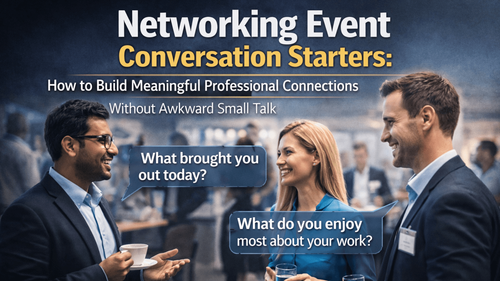

Networking Event Conversation Starters: How to Build Meaningful Professional Connections Without Awkward Small Talk
You walk into a networking event.
People are talking, exchanging ideas, and building connections that could shape their careers.
And you?
You’re stuck thinking of what to say.
Most professionals default to one question: “So, what do you do?”
And just like that, the conversation becomes predictable, shallow, and forgettable.
The truth is, networking is not about talking more—it’s about starting, shaping, and closing conversations intentionally.
The Networking Event Conversation Starters guide is designed to solve exactly this problem. It gives you ready-to-use phrases, frameworks, and strategies to walk into any event with clarity and walk out with real connections.
Who Is This Blog For?
- Job seekers attending career fairs, meetups, or industry events
- Working professionals looking to expand their network
- Career changers exploring new industries
- Consultants and freelancers seeking referrals or clients
- Managers aiming to build influence and cross-functional relationships
Why This Topic Matters Today?
Networking is no longer optional—it’s essential.
Research consistently shows that:
- Over 70% of jobs are filled through personal connections
- Promotions and opportunities often go to those with stronger networks
Yet most professionals:
- Show up unprepared
- Struggle with small talk
- Miss opportunities to build meaningful connections
The biggest gap isn’t knowledge—it’s execution.
The ability to start, deepen, and close conversations effectively is a career-defining skill—and one that can be learned.
Core Concept or Framework Explained
The Networking Conversation Lifecycle
The guide breaks networking into a structured, repeatable process:
1. Before the Event
Preparation sets the tone for confidence and clarity
2. Opening the Conversation
Use context-driven, natural openers
3. Deepening the Conversation
Move beyond surface-level small talk
4. Sharing Your Story
Introduce yourself in a way that invites engagement
5. Navigating and Closing
Use pivots and graceful exits
6. Following Up
Turn conversations into long-term relationships
This structured approach transforms networking from a stressful activity into a strategic skill.
How This Blog and Guidebook Help You?
This blog and guidebook help you:
- Eliminate small-talk anxiety
- Use ready-to-say phrases in real time
- Build confidence before entering any event
- Create meaningful, memorable conversations
- Convert interactions into real career opportunities
Instead of improvising, you operate with clarity and intention.
Step-by-Step Breakdown
Step 1: Prepare Before You Arrive
The guide emphasizes a simple 10-minute preparation ritual that changes everything.
Before attending any event:
- Set one clear goal (explore, build, or deepen connections)
- Prepare a short, conversational self-introduction
- Identify 2–3 people you want to meet
- Review 5–8 key phrases
Preparation is not about scripting—it’s about readiness.
Step 2: Start Conversations Using Context
Avoid generic openers.
Instead, use your environment as a natural entry point:
- “Which session brought you here today?”
- “Have you been to this event before?”
- “What brought you out today?”
These openers feel natural, reduce awkwardness, and invite conversation.
The guide highlights that warm, context-based openers are far more effective than direct job-related questions.
Step 3: Move Beyond Small Talk with the 1-Deep Rule
Most conversations stay surface-level.
The solution? Ask one layer deeper.
Examples:
- “What does a genuinely good day look like in your role?”
- “What’s the part of that work most people don’t see?”
This simple shift transforms conversations into meaningful exchanges.
The “1-Deep Rule” is one of the most powerful habits for building real connections.
Step 4: Introduce Yourself Without Sounding Like a Pitch
Instead of listing your job title, use structured frames:
- Outcome Frame: Focus on results you create
- Transition Frame: Explain your career shift
- Problem-Solver Frame: Share what you’re passionate about solving
- Honest Seeker Frame: Show curiosity and openness
Each introduction should:
- Be clear
- Be engaging
- End with a question (the bridge)
This turns your introduction into a conversation—not a monologue.
Step 5: Use Pivots and Graceful Exits
Networking is dynamic.
You need to:
- Shift topics when conversations stall
- Introduce people to each other
- Exit conversations smoothly
Example exit:
“I’ve really enjoyed this—I don’t want to monopolise your evening. Can we exchange details?”
A strong exit strengthens your professional impression.
Step 6: Follow Up Within 24–48 Hours
This is where most professionals fail.
A strong follow-up:
- References a specific part of your conversation
- Adds value (article, insight, or idea)
- Suggests a next step
Example:
“I’ve been thinking about what you said about [topic]—came across something relevant and thought of you.”
The guide clearly highlights that most networking value is created after the event—not during it.
Step 7: Use the Networking Prep Sheet
The worksheet (page 9) helps you structure your approach:
- Define your goal
- Prepare your opening line
- Identify key people
- Select deep-dive questions
- Track follow-ups
This simple system dramatically improves confidence and outcomes.
Step 8: Learn from Real Conversations
The guide includes a full example (page 11) showing:
- A context-based opener
- Use of the 1-Deep Rule
- A problem-solver introduction
- A graceful exit with follow-up
This demonstrates how natural and effective structured networking can be.
Common Mistakes or Pitfalls to Avoid
- Starting with “So, what do you do?”
- Talking too much about yourself (CV dump)
- Treating conversations like interviews
- Pitching too early
- Ending conversations without closure
- Not following up within 48 hours
Each of these mistakes reduces your chances of building meaningful connections.
How Should You Use This Guidebook Effectively?
To get the best results:
- Spend 10 minutes preparing before each event
- Practise key phrases out loud
- Choose 3–5 phrases to focus on per event
- Apply the 1-Deep Rule consistently
- Use structured introductions
- Follow up within 24 hours
- Reflect after each event
Consistency is what turns networking into a long-term advantage.
Key Takeaways
- Networking is a learnable, structured skill
- Preparation dramatically improves confidence and results
- Context-based openers outperform generic questions
- The 1-Deep Rule creates meaningful conversations
- Structured self-introductions make you memorable
- Graceful exits strengthen professional relationships
- Follow-ups turn conversations into opportunities
- One well-executed event can change your career trajectory
Your Next Step: Accelerate Your Career with PlanetSpark
Creating an impact-driven resume is not just about landing your next job—it’s about owning your professional story and presenting it with clarity, confidence, and credibility. When your resume clearly communicates value, results, and impact, opportunities follow naturally.
At PlanetSpark, we are committed to empowering working professionals with practical, outcome-focused resources that drive real career growth. From resume building and workplace communication to leadership presence and professional writing, our programs are designed to help you succeed in today’s fast-evolving job market.
Visit https://www.planetspark.in/resources to explore:
- Career and resume-building guides
- Workplace communication and professional writing resources
- Skill-development tools curated for working professionals
Want a deeper, hands-on experience?
You can also book a free trial session to learn more about PlanetSpark’s Working Professional Courses, designed to accelerate your career through personalised coaching, real-world practice, and expert guidance.
Your career deserves more than generic advice.
It deserves clarity, confidence, and measurable impact.
Personalized Communication Roadmaps
Record a video to get a AI generated personalized communication reports