
Networking Event Scripts for Confident Professional Introductions
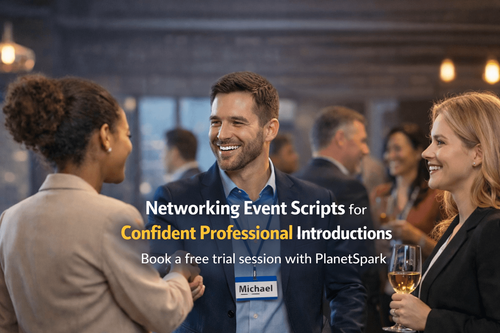

Networking Event Introduction Scripts for Working Professionals: A Practical Guide to Confident Professional Networking
Many working professionals attend networking events
with strong experience, valuable ideas, and genuine career goals—yet struggle in the first few seconds of conversation. The challenge is rarely capability. It is communication.
A conference hall, industry mixer, alumni meet, or leadership summit often creates one immediate pressure point: how to introduce yourself in a way that feels natural, memorable, and relevant. In most cases, professionals rely on job titles, company names, or vague one-line responses that fail to create curiosity.
The first few words you speak at a networking event often determine whether a conversation develops into a meaningful connection or fades within minutes. When introductions lack clarity, confidence, or intent, opportunities are lost before they begin.
This is exactly where structured networking scripts become valuable. Instead of improvising under pressure, professionals who use practical frameworks can introduce themselves with clarity, show professional relevance, and open genuine dialogue.
This guide transforms the Networking Event Introduction Scripts playbook into a practical blog for working professionals who want stronger networking outcomes, better conversations, and more purposeful professional relationships.
Book your free trial session today with Planetspark !
Download for more details or PDF file
Who Is This Blog For?
- Working professionals attending conferences, mixers, seminars, and industry events
- Mid-career professionals building stronger visibility in their sector
- Career changers introducing themselves in a new professional space
- Consultants and freelancers looking to build trust without sounding sales-driven
- Managers and senior professionals expanding strategic networks
- Job seekers who want to create stronger first impressions at professional events
Why This Topic Matters Today?
Professional networking has changed significantly. Earlier, attending an event and exchanging business cards often felt sufficient. Today, professional value is judged much faster, and conversations must create relevance almost immediately.
Research highlighted in the guidebook shows that people form impressions of competence, trust, and warmth within seconds of hearing someone speak. That means a weak introduction can quietly reduce opportunity before the actual conversation even begins.
Modern networking environments are also more competitive because:
- Events now bring professionals from multiple industries into one room
- Attention spans are shorter in fast-moving professional settings
- Senior decision-makers often meet dozens of people in one session
- Follow-up success depends heavily on whether the first interaction was memorable
A generic introduction such as "I work in marketing" rarely creates enough interest to continue a conversation. By contrast, an introduction that communicates impact, context, and purpose gives the listener a reason to engage further.
That difference matters for career growth, business opportunities, mentorship access, and professional visibility.
Core Concept or Framework Explained
The guidebook introduces one central framework that simplifies professional introductions: the BUILD Framework.
This framework gives professionals a repeatable structure that works across industries and networking situations.
The five parts of BUILD are:
- Begin with your name and a warm opener
- Unveil your role using outcome language
- Identify your context or audience
- Link to why you are at the event
- Drop a question that opens conversation
This framework solves a major networking mistake: professionals often stop after naming their title.
A title alone rarely communicates professional value.
For example:
"Hi, I'm Arjun. I'm a product manager at a software company."
This statement shares identity but offers no reason for the other person to respond meaningfully.
A stronger version becomes:
"Hi, I'm Arjun. I help SaaS teams cut onboarding time significantly through product improvements, and I'm here because I'm curious how other teams approach user activation. What brings you here today?"
The second version works because it:
- Shows impact
- Signals purpose
- Creates curiosity
- Invites dialogue
This is why the BUILD structure is powerful—it turns introductions into conversation starters instead of static statements.
How This Blog and Guidebook Help You?
The framework and scripts in this guidebook help professionals improve networking outcomes in practical ways.
You learn how to:
- Replace job-title introductions with memorable impact language
- Speak confidently even when entering unfamiliar professional rooms
- Introduce career transitions without apology
- Ask better follow-up questions that sustain dialogue
- Prepare for events instead of relying on spontaneous improvisation
This matters because strong introductions improve more than just conversation quality.
They influence:
- Whether someone remembers you after the event
- Whether LinkedIn requests are accepted later
- Whether senior professionals offer guidance
- Whether recruiters and hiring managers continue the discussion
- Whether business relationships move forward
A good introduction does not guarantee opportunity, but it dramatically improves access to meaningful conversations.
Step-by-Step Breakdown
Step 1: Understand the Anatomy of a Strong Introduction
A professional introduction is not simply your designation spoken aloud.
It works best when it follows a deliberate structure:
- Who you are
- What you do with impact
- Why you are here
The guidebook emphasises that the third element is often ignored but creates the strongest professional signal.
When you explain why you attended an event, you immediately show intent.
For example:
- Exploring sustainable logistics opportunities
- Learning how fintech companies build customer success teams
- Understanding leadership challenges in growth-stage organisations
This instantly gives direction to the conversation.
Step 2: Apply the BUILD Framework in Real Situations
The BUILD framework becomes practical when converted into natural speech.
Begin
Start with your name and a human opener.
Examples:
- Hi, I'm Priya—great energy in the room today
- Hello, I'm Rahul, this panel discussion was genuinely interesting
Warm openers reduce stiffness and make introductions sound natural.
Unveil
Describe your work through outcomes.
Instead of:
- I work in HR
Use:
- I help growing companies improve hiring speed and candidate quality
Outcome language communicates value immediately.
Identify
Add context so people understand where your work applies.
Examples:
- Mostly early-stage startups
- Primarily enterprise healthcare teams
- Mid-market manufacturing companies
This helps listeners quickly locate relevance.
Link
State why you attended the event.
Examples:
- I'm here because I'm exploring how leadership teams are solving retention challenges
- I wanted to understand how consulting firms approach digital transformation today
Purpose makes you memorable.
Drop
End with a genuine question.
Examples:
- What kind of work are you focused on right now?
- What brought you to this event today?
This turns introduction into dialogue.
Step 3: Use Situation-Based Scripts
The guidebook provides scripts for different professional scenarios.
Career Changer
A transition must sound intentional, not uncertain.
A strong script acknowledges past experience while confidently naming future direction.
This works because it shows clarity instead of hesitation.
Job Seeker
A job seeker should not sound desperate.
The guidebook suggests framing the transition as intentional exploration.
This creates stronger professional positioning.
Consultant or Freelancer
Independent professionals should focus on client outcomes rather than service labels.
Mentioning current market challenges also signals thought leadership.
Senior Professional
Leaders benefit from mentioning strategic priorities rather than operational detail.
This shows scale and intellectual depth.
Step 4: Prepare Before the Event
Strong networking begins before entering the venue.
The guidebook recommends:
- Practising one main introduction aloud
- Preparing two variations
- Setting one networking goal
- Identifying three good questions
Preparation reduces anxiety and improves natural delivery.
Silent preparation is not enough.
Speaking aloud reveals awkward wording quickly.
Step 5: Improve During the Event
Execution matters as much as preparation.
During the event:
- Use your opening within the first minute
- Listen actively
- Focus on quality conversations
- Avoid forcing contact exchange too early
Three meaningful conversations create more value than many superficial introductions.
Step 6: Follow Up Properly After the Event
A strong introduction loses value without follow-up.
The guidebook recommends following up within 24–48 hours.
A strong follow-up includes:
- Mention of where you met
- Specific reference to the conversation
- A useful article, idea, or connection if relevant
- A simple next-step suggestion
This converts one conversation into a continuing professional relationship.
Common Mistakes or Pitfalls to Avoid
Several mistakes repeatedly weaken professional networking introductions.
Leading only with a job title
This gives no hook and no differentiation.
Speaking for too long
Anything beyond 45 seconds risks losing attention.
Failing to ask a question
Without a question, conversation often stalls.
Apologising for transitions
Career shifts should sound deliberate, not defensive.
Using heavy jargon
Plain language improves connection across industries.
Pitching too quickly
Networking works better when curiosity comes before selling.
The guidebook also shows that professionals often underestimate how strongly these small habits affect first impressions.
How Should You Use This Guidebook Effectively?
The guidebook works best when used actively rather than passively read once.
Recommended process:
- Read the full framework first
- Fill in your personal BUILD worksheet
- Draft your own 45-second introduction
- Practise aloud three times
- Use one version at your next event
- Reflect immediately afterward
The worksheet encourages professionals to define:
- Their impact statement
- Their audience context
- Their reason for attending
- Their opening question
A realistic time investment is around 1–2 focused hours for full preparation before an important networking event.
Repeating this process before multiple events gradually improves confidence and flexibility.
Key Takeaways
- Strong networking introductions follow structure, not improvisation
- The BUILD framework creates clarity in under 45 seconds
- Outcome language is more powerful than job titles
- Stating why you are at an event creates immediate relevance
- Asking thoughtful questions improves conversation quality
- Preparation before events increases confidence significantly
- Follow-up within 48 hours strengthens long-term professional value
Your Next Step: Accelerate Your Career with PlanetSpark
Creating an impact-driven resume is not just about landing your next job—it’s about owning your professional story and presenting it with clarity, confidence, and credibility. When your resume clearly communicates value, results, and impact, opportunities follow naturally.
At PlanetSpark, we are committed to empowering working professionals with practical, outcome-focused resources that drive real career growth. From resume building and workplace communication to leadership presence and professional writing, our programs are designed to help you succeed in today’s fast-evolving job market.
Visit https://www.planetspark.in/resources to explore:
- Career and resume-building guides
- Workplace communication and professional writing resources
- Skill-development tools curated for working professionals
Want a deeper, hands-on experience?
You can also book a free trial session to learn more about PlanetSpark’s Working Professional Courses, designed to accelerate your career through personalised coaching, real-world practice, and expert guidance.
Your career deserves more than generic advice.
It deserves clarity, confidence, and measurable impact.
Start building that advantage today—with PlanetSpark.
Personalized Communication Roadmaps
Record a video to get a AI generated personalized communication reports