
Offer Comparison Guide to Maximize Your Career Move
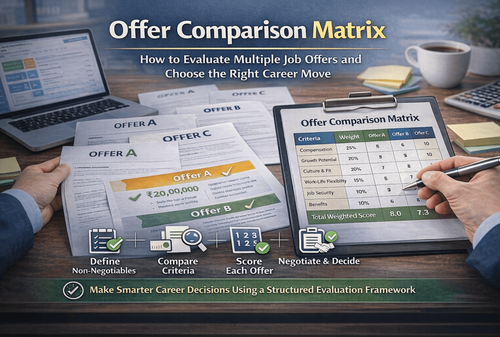

Offer Comparison Matrix: How to Evaluate Multiple Job Offers and Choose the Right Career Move
Receiving a job offer is exciting. Receiving two or three offers at the same time can feel like a dream scenario.
But for many professionals, this moment quickly turns into confusion.
You open multiple offer letters and try to compare them. One company offers a higher salary. Another promises faster growth. A third has a stronger brand name. Suddenly, what should be a clear win becomes a stressful decision.
Most professionals evaluate offers the way they scan a restaurant menu. They focus on the most visible number, usually the salary, make a quick decision, and rationalise it afterward.
This approach often leads to regret.
Many professionals who leave jobs within the first year report misalignment around growth, culture, or role expectations, factors that were visible during the offer stage but never properly evaluated.
The Offer Comparison Matrix solves this problem by providing a structured, objective framework to evaluate multiple offers across the factors that truly shape your career trajectory.
Instead of relying on gut instinct alone, you gain clarity, structure, and confidence when making one of the most important professional decisions of your life.
Who Is This Blog For?
This guide is designed for professionals who want to make smarter, more strategic career decisions.
- Early and mid-career professionals comparing multiple job offers
- Career switchers evaluating opportunities across industries
- Consultants and managers negotiating new roles
- Professionals who want to avoid accepting the wrong offer due to pressure or confusion
- Anyone who wants a structured framework for evaluating compensation, growth, and long-term career fit
If you want to move beyond emotional decision-making and approach your next role with clarity and confidence, this framework will help.
Why This Topic Matters Today?
The modern job market offers more options than ever before.
Professionals frequently receive multiple opportunities across startups, multinational companies, remote-first organisations, and hybrid workplaces. Each opportunity presents different trade-offs involving salary, growth potential, culture, flexibility, and long-term career impact.
Yet many professionals still evaluate offers using incomplete or inconsistent information.
Common decision-making mistakes include:
- Comparing offers purely based on salary
- Ignoring role scope and growth trajectory
- Making decisions under artificial recruiter deadlines
- Accepting the first offer due to anxiety or pressure
- Failing to assess long-term career positioning
These mistakes often lead to job dissatisfaction and career stagnation.
The Offer Comparison Matrix eliminates these risks by turning a complex decision into a structured evaluation process where every important factor is considered systematically.
Core Concept or Framework Explained
The Offer Comparison Matrix is a weighted decision framework designed to evaluate job offers objectively.
Instead of relying on instinct alone, the matrix breaks down each offer across several evaluation criteria and assigns importance to each one.
The framework works in three stages.
Assign weights to evaluation criteria
Each factor such as compensation, growth potential, or culture receives a percentage weight based on its importance to you.
Score each offer against those criteria
Each offer receives a score between 1 and 10 for every criterion.
Calculate the weighted totals
Scores are multiplied by the assigned weights to produce a final score for each offer.
The matrix typically evaluates criteria such as:
- Total compensation including salary and bonuses
- Role scope and ownership
- Career growth potential
- Culture and team fit
- Work-life flexibility
- Brand and market visibility
- Benefits and perks
By combining weighting and scoring, professionals avoid emotional bias and arrive at a clear comparison between opportunities.
How This Blog and Guidebook Help You?
The Offer Comparison Matrix helps professionals make confident career decisions through structured analysis.
Instead of reacting to offers emotionally, you learn how to:
- Define what truly matters in your career
- Compare offers using consistent criteria
- Identify hidden trade-offs between opportunities
- Negotiate more effectively with employers
- Align your job choice with long-term career goals
The framework also forces you to clarify your personal priorities before comparing offers.
This step alone prevents one of the most common decision-making mistakes: comparing offers against each other instead of comparing them against your own career goals.
Step-by-Step Breakdown
Step 1: Define Your Non-Negotiables Before Comparing Offers
Before analysing any offer, you must define your personal dealbreakers.
These are the conditions that an offer must satisfy in order to remain under consideration.
Common non-negotiables include:
- Minimum salary requirement
- Work arrangement such as remote, hybrid, or onsite
- Location or commute limits
- Role title or seniority level
- Industry preference
- Start date flexibility
If an offer fails to meet any of these criteria, it should be removed from consideration immediately.
This step prevents professionals from rationalising offers that do not truly fit their needs.
In addition to non-negotiables, you should also identify "nice-to-have" factors such as:
- Learning and development opportunities
- Manager leadership style
- Company growth trajectory
- Team structure
- Culture alignment
These factors will later be weighted in the scoring matrix.
Step 2: Gather Complete and Comparable Information
One of the most common mistakes professionals make is comparing offers with incomplete information.
For example, you may know the exact salary for one offer but only have a vague estimate for another.
Before scoring offers, gather detailed information across four key categories.
Compensation package
- Base salary
- Performance bonus structure
- Equity or ESOPs
- Joining bonuses
- Retirement and statutory benefits
Role and scope
- Exact job title and reporting structure
- Team size and responsibilities
- Deliverables expected within the first 90 days
- Budget or P&L ownership
- Cross-functional collaboration expectations
Growth and development
- Promotion cycle
- Training and development budgets
- Mentorship opportunities
- Leadership pipeline visibility
Culture and flexibility
- Remote or hybrid work policy
- Expected working hours
- Leave policies
- Team culture and diversity
- Manager communication style
If any information is missing, request clarification from the recruiter before making comparisons.
Step 3: Build the Weighted Scoring Matrix
The weighted scoring matrix is the core analytical tool in the framework.
Each evaluation criterion receives a percentage weight representing its importance in your career decision.
A typical weight distribution might look like this:
- Compensation: 25 percent
- Role scope and ownership: 20 percent
- Career growth potential: 20 percent
- Culture and team fit: 15 percent
- Work-life flexibility: 10 percent
- Brand and market visibility: 5 percent
- Benefits and perks: 5 percent
Once weights are assigned, each offer is scored from 1 to 10 for every criterion.
These scores are multiplied by their weights to produce weighted values.
The total weighted score reveals which offer best aligns with your priorities.
Step 4: Score Each Criterion Honestly
Scoring requires objectivity and discipline.
Professionals often unconsciously manipulate scores to justify the offer they already prefer.
To avoid this bias, use clear scoring anchors.
Scores between 1 and 3 indicate the offer does not meet expectations.
Scores between 4 and 6 represent baseline performance.
Scores between 7 and 8 indicate the offer exceeds expectations.
Scores between 9 and 10 should be reserved for exceptional situations where the offer significantly exceeds market standards.
For example:
A compensation score of 10 might represent a package more than 20 percent above your target salary.
A culture score of 10 might indicate strong alignment after meeting multiple team members and observing clear company values.
Anchoring scores to real data rather than impressions keeps the comparison objective.
Step 5: Run the Gut-Check Tests
Numbers provide structure, but intuition still matters.
After calculating the matrix totals, the framework recommends four additional decision tests.
The Cover Test
Imagine the offers have identical salaries. Which company would you choose?
The Sunday Evening Test
Picture the Sunday evening before your first day. Which job excites you more?
The Advisor Test
Discuss the offers with a trusted mentor or former manager to identify blind spots.
The Three-Year Projection Test
Consider where each role will place you three years from now in terms of skills, responsibilities, and professional network.
If these tests align with the matrix results, the decision is usually clear.
If they conflict, revisit the weights assigned to each criterion.
Common Mistakes or Pitfalls to Avoid
Even experienced professionals make avoidable mistakes when evaluating offers.
Comparing headline CTC numbers
Many offers include variable compensation that may not fully pay out.
Always calculate expected compensation rather than comparing headline numbers.
Ignoring the manager factor
Your direct manager influences daily work satisfaction more than any other factor.
Request a conversation with your future manager before accepting an offer.
Assuming the offer cannot be negotiated
Many professionals accept the initial offer without negotiation.
However, most employers expect some negotiation and have flexibility built into their budget.
Deciding under artificial time pressure
Recruiters may impose short deadlines to accelerate decisions.
Professionals should request reasonable evaluation time before accepting an offer.
How Should You Use This Guidebook Effectively?
To get maximum value from the Offer Comparison Matrix, follow a structured workflow.
First, define your non-negotiables and eliminate unsuitable offers.
Second, collect detailed information about every offer.
Third, assign weights to evaluation criteria before scoring.
Fourth, score each offer objectively using data rather than impressions.
Fifth, perform the gut-check tests to ensure emotional alignment.
Finally, use the matrix results as a foundation for negotiation.
The matrix also doubles as a negotiation tool.
By identifying the lowest scoring criteria in an offer, you can negotiate improvements such as:
- Higher base salary
- Signing bonuses
- Additional remote work days
- Faster performance review cycles
This approach allows you to negotiate with confidence and clarity.
Key Takeaways
- Job offer decisions should be structured rather than emotional
- Define your non-negotiables before comparing offers
- Gather complete information about compensation, role scope, growth, and culture
- Use a weighted scoring matrix to evaluate offers objectively
- Score each criterion using data-based anchors rather than impressions
- Perform gut-check tests to confirm emotional alignment with the decision
- Use the matrix as a negotiation tool to improve offer conditions
- Evaluate opportunities based on long-term career trajectory, not just short-term salary
Your Next Step: Accelerate Your Career with PlanetSpark
Creating an impact-driven resume is not just about landing your next job—it’s about owning your professional story and presenting it with clarity, confidence, and credibility. When your resume clearly communicates value, results, and impact, opportunities follow naturally.
At PlanetSpark, we are committed to empowering working professionals with practical, outcome-focused resources that drive real career growth. From resume building and workplace communication to leadership presence and professional writing, our programs are designed to help you succeed in today’s fast-evolving job market.
Visit https://www.planetspark.in/resources to explore:
- Career and resume-building guides
- Workplace communication and professional writing resources
- Skill-development tools curated for working professionals
Want a deeper, hands-on experience?
You can also book a free trial session to learn more about PlanetSpark’s Working Professional Courses, designed to accelerate your career through personalised coaching, real-world practice, and expert guidance.
Your career deserves more than generic advice.
It deserves clarity, confidence, and measurable impact.
Personalized Communication Roadmaps
Record a video to get a AI generated personalized communication reports