
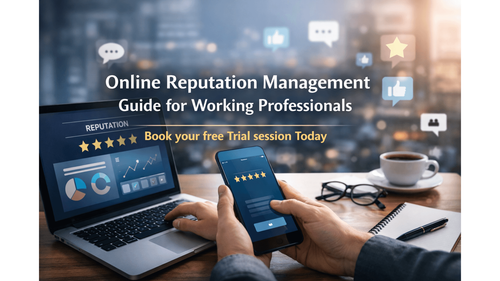
Online Reputation Management Guide for Working Professionals

Online Reputation Management for Professionals: A Complete Guide to Building and Controlling Your Digital Presence
Before you walk into an interview, pitch to a client, or even send a cold email, something important has already happened—someone has searched your name online.
What they see in those search results often becomes your first impression.
For many working professionals, this is where opportunities are quietly lost. An outdated LinkedIn profile, inconsistent information across platforms, or a lack of visible expertise can create doubt—even if you are highly capable in reality.
This is where Online Reputation Management (ORM) becomes critical. It is no longer optional or reserved for public figures. It is a practical, career-defining skill.
The Online Reputation Management Guide is designed to help professionals take control of their digital presence, build credibility, and ensure their online identity aligns with their career goals.
Book your free trial session today with Planetspark.
Download for more details or PDF file.
Who Is This Blog For?
- Working professionals with 0–15 years
of experience
- Job seekers preparing for interviews or exploring new roles
- Career switchers repositioning themselves in a new industry
- Consultants and freelancers building authority and visibility
- Managers and leaders in high-visibility roles
- Professionals with outdated or inconsistent online profiles
- Anyone who wants to be taken seriously in their field
Why This Topic Matters Today?
In today’s digital-first professional environment, your online presence is not a secondary factor—it is often the deciding factor.
Recruiters, hiring managers, and clients consistently research professionals online before making decisions. Your LinkedIn profile, Google search results, and visible content collectively shape how others perceive your credibility.
The guide highlights real-world scenarios where professionals lose opportunities due to poor online presence—such as being overlooked for promotions, losing clients, or struggling to transition careers.
The key issue is not lack of capability. It is lack of visibility and alignment.
Online Reputation Management ensures that what people find about you online accurately reflects your current expertise, goals, and professional value.
Core Concept
At its core, Online Reputation Management is about three interconnected actions: auditing, building, and protecting your digital presence.
First, you must understand your digital footprint. This includes everything that exists about you online—profiles, posts, mentions, images, and even outdated content.
Second, you must actively build a strong, credible presence. This is done by optimising key platforms, especially LinkedIn, and consistently sharing meaningful content.
Third, you must protect your reputation by monitoring changes, maintaining security, and responding appropriately to risks or negative situations.
The guide introduces practical frameworks like the digital footprint audit, the content pyramid for visibility, and the 4-step reputation recovery protocol for handling challenges. These frameworks ensure that your reputation is not left to chance but managed strategically.
How This Blog and Guidebook Help You?
This guide helps you move from passive presence to active control.
You gain clarity on what exists online about you and whether it supports your career goals. You learn how to fix inconsistencies and strengthen your professional narrative.
It also equips you with systems to stay visible and relevant—through consistent content, optimised profiles, and ongoing monitoring.
Most importantly, it ensures that when opportunities arise, your online presence reinforces your credibility instead of raising doubts.
Step-by-Step Breakdown
Understanding Your Digital Footprint
The first step is awareness. You cannot manage what you have not evaluated.
The guide recommends running a detailed self-search across platforms like Google, LinkedIn, and social media. This helps you identify what appears in search results, whether it is positive, outdated, or potentially harmful.
You are encouraged to document findings and treat this as a diagnostic exercise, not a judgment.
Building a Personal Monitoring System
Once your audit is complete, the next step is to create a system that keeps you updated.
This includes setting up alerts for your name, tracking mentions, and maintaining a simple reputation log. This log records content you publish, updates you make, and any risks identified.
This transforms reputation management from a one-time task into an ongoing process.
Optimising LinkedIn as Your Anchor Platform
LinkedIn plays a central role in your online reputation.
The guide emphasises optimising key elements such as your profile photo, headline, summary, and experience sections. Each element should communicate value, not just history.
For example, your headline should reflect your expertise and impact rather than simply stating your job title. Your experience section should highlight achievements with measurable outcomes.
Recommendations and consistent engagement further strengthen credibility.
Choosing the Right Platforms
Not all platforms are equally important for every professional.
The guide helps you prioritise platforms based on your goals. For most professionals, LinkedIn is essential, while others like personal websites or industry-specific platforms may add additional value.
The focus is on depth over breadth—being strong on a few platforms rather than average on many.
Creating a Strong Content Strategy
Visibility is built through consistent, high-quality content.
The guide introduces the Content Pyramid model:
- Foundational presence such as optimised profiles
- Engagement content like posts and comments
- Flagship content such as long-form articles
You are encouraged to share insights, lessons, and professional experiences regularly. Even a small weekly commitment can compound into significant visibility over time.
Planning with a 90-Day Content Calendar
To maintain consistency, the guide provides a structured 90-day content plan.
This helps you plan posts, articles, and engagement activities in advance, making it easier to stay consistent without feeling overwhelmed.
The goal is sustainability, not intensity.
Managing Reputation Risks
No professional is immune to reputational challenges.
The guide introduces a 4-step recovery protocol:
Assess the situation carefully
Decide the appropriate response level
Respond professionally if required
Rebuild your presence through positive content
This structured approach ensures that you respond with composure and strategy rather than emotion.
Maintaining Privacy and Security
Your reputation is also influenced by how well you protect your digital presence.
The guide highlights essential practices such as using strong passwords, enabling two-factor authentication, and reviewing privacy settings regularly.
These actions reduce the risk of unauthorised access or unintended exposure.
Supporting Career Transitions
For professionals changing roles or industries, ORM becomes even more critical.
The guide outlines a timeline approach—starting months before applying, updating profiles, building relevant content, and aligning your online presence with your target role.
This ensures that when recruiters search for you, they see relevance, not confusion.
Common Mistakes
Many professionals unknowingly damage their reputation through avoidable mistakes.
Common pitfalls include:
- Treating LinkedIn as a one-time setup instead of a living profile
- Mixing personal and professional content without boundaries
- Responding emotionally to criticism
- Maintaining inconsistent information across platforms
- Ignoring what appears in search results
- Remaining inactive for long periods
- Forgetting old or unused accounts
- Not having a personal website or central professional presence
Avoiding these mistakes can significantly improve how you are perceived online.
How Should You Use This Guidebook Effectively?
To get the best results, approach the guide in phases.
Start by reading it completely to understand the overall system. Then conduct your digital audit and document your findings.
Next, focus on optimising your LinkedIn profile and aligning your key platforms. After that, begin implementing a simple content strategy using the provided calendar.
Set aside 30 to 60 minutes per week for ongoing activities like posting, engaging, and monitoring.
Revisit the guide during major career moments such as job searches, role changes, or transitions to ensure your online presence remains aligned with your goals.
Key Takeaways
- Your online presence is your first professional impression
- Online Reputation Management is a practical, learnable skill
- Auditing your digital footprint is the first critical step
- LinkedIn is your most important professional platform
- Consistent content builds long-term visibility and credibility
- Monitoring systems help you stay proactive, not reactive
- Reputation risks should be handled with strategy and composure
- Strong digital hygiene protects your professional identity
- Align your online presence with your future goals, not your past
- Small, consistent actions create a powerful long-term advantage
Your Next Step: Accelerate Your Career with PlanetSpark
Creating an impact-driven resume is not just about landing your next job—it’s about owning your professional story and presenting it with clarity, confidence, and credibility. When your resume clearly communicates value, results, and impact, opportunities follow naturally.
At PlanetSpark, we are committed to empowering working professionals with practical, outcome-focused resources that drive real career growth. From resume building and workplace communication to leadership presence and professional writing, our programs are designed to help you succeed in today’s fast-evolving job market.
Visit https://www.planetspark.in/resources to explore:
- Career and resume-building guides
- Workplace communication and professional writing resources
- Skill-development tools curated for working professionals
Want a deeper, hands-on experience?
You can also book a free trial session to learn more about PlanetSpark’s Working Professional Courses, designed to accelerate your career through personalised coaching, real-world practice, and expert guidance.
Your career deserves more than generic advice.
It deserves clarity, confidence, and measurable impact.
Start building that advantage today—with PlanetSpark.
Personalized Communication Roadmaps
Record a video to get a AI generated personalized communication reports