
Operational Efficiency Resume Guide for Working Professionals
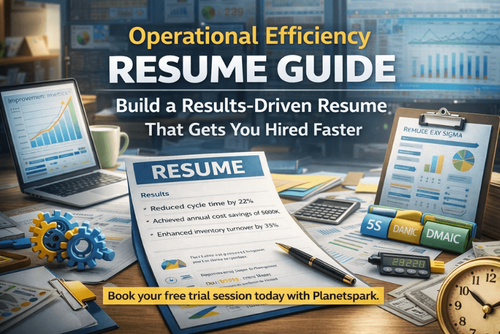

Build a High-Impact Operational Efficiency Resume That Gets You Hired Faster
Most professionals in operations and process improvement face the same frustrating reality—despite years of experience, their resumes fail to generate interviews. The reason is simple: they list responsibilities instead of demonstrating measurable impact. In today’s competitive job market, especially in operational efficiency roles, hiring managers are not looking for what you did—they are looking for what you improved, optimised, and delivered.
This is exactly where the Resume Template Emphasizing Operational Efficiency Strategy by PlanetSpark becomes a game-changer. It helps professionals translate their work into quantifiable outcomes, structured narratives, and domain-specific impact statements that recruiters actively look for.
Book your free trial session today with Planetspark.
Download for more details or PDF file.
Who Is This Blog For?
- Operations managers aiming to showcase measurable business impact
- Process engineers and Lean practitioners working on efficiency improvements
- Supply chain professionals focused on cost reduction and optimisation
- Career switchers entering operations or continuous improvement roles
- Consultants and managers seeking structured, high-impact resume formats
- Early to mid-career professionals with 0–15 years of experience in operations
Why This Topic Matters Today?
Operational efficiency is no longer a support function—it is a core driver of business success. Companies today are under constant pressure to reduce costs, improve productivity, and optimise systems. As a result, hiring managers are prioritising candidates who can demonstrate measurable efficiency gains.
However, most resumes fail to meet this expectation. According to the resource, generic resumes are not just ineffective—they actively harm your chances because they lack quantifiable results, frameworks, and system-level thinking.
In domains like Lean, Six Sigma, supply chain optimisation, and automation, recruiters expect to see:
- Clear metrics such as cost savings, cycle time reduction, or throughput improvement
- Familiar frameworks like DMAIC, Kaizen, or 5S
- Evidence of systems thinking and cross-functional impact
Without these, even highly capable professionals get filtered out by ATS systems before reaching a recruiter.
Core Concept or Framework Explained
At the heart of this guidebook is a powerful idea: operational efficiency resumes must be outcome-driven, framework-backed, and context-specific.
Unlike generic resumes, this approach focuses on three key principles:
Results Over Responsibilities
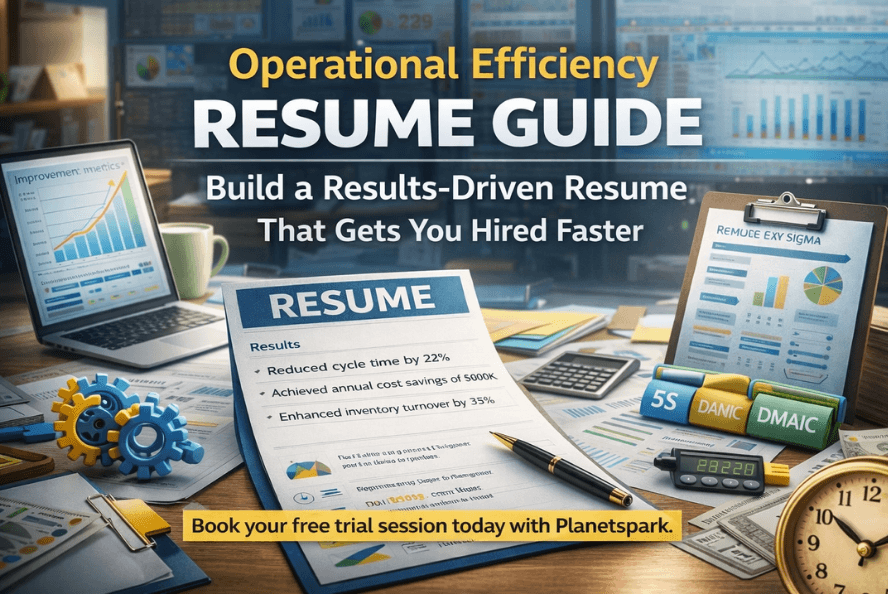
Instead of stating tasks, the templates push you to highlight measurable outcomes. For example, replacing “managed operations” with “reduced cycle time by 22% through process optimisation” transforms your profile instantly.
Framework Visibility
Operational roles rely heavily on structured methodologies such as Lean, Six Sigma, Kaizen, and ERP-driven transformation. The templates ensure these frameworks are explicitly mentioned, improving both credibility and ATS performance.
Scenario-Based Customisation
The resource includes 10 scenario-specific templates tailored to real-world roles such as Lean Transformation Leader, Supply Chain Cost Reduction Specialist, ERP Process Redesign Manager, and Operations Automation Implementer.
This ensures your resume speaks directly to the job you are targeting—not just the industry.
How This Blog and Guidebook Help You?
This blog and the underlying resource help you bridge the gap between experience and presentation. Instead of guessing what recruiters want, you get a structured approach to showcasing your value.
Here’s what you gain:
- A clear method to convert work experience into measurable outcomes
- Professionally structured, ATS-friendly resume templates
- Role-specific formats aligned with real hiring scenarios
- Placeholder-driven guidance to ensure no critical information is missed
- A strong narrative that positions you as an efficiency-driven professional
Ultimately, this leads to stronger interviews, better job opportunities, and faster career growth.
Step-by-Step Breakdown
Step 1: Choose the Right Scenario-Based Template
The guide provides 10 templates, each aligned with a specific operational role. For example:
- Lean Transformation Leader for enterprise-wide improvement initiatives
- Six Sigma Black Belt Candidate for data-driven quality improvement roles
- Supply Chain Cost Reduction Specialist for procurement and logistics optimisation
- ERP Process Redesign Manager for system-driven transformation
- Operations Automation Implementer for RPA and workflow automation
Selecting the right template ensures your resume aligns with the exact expectations of the role you are applying for.
Step 2: Build a Strong Professional Summary
Each template begins with a structured professional summary that highlights:
- Years of experience
- Domain expertise
- Key frameworks used
- Measurable achievements
For instance, a Lean-focused summary emphasises Kaizen, 5S, and value stream mapping, along with cost savings and throughput improvements.
Step 3: Highlight Core Competencies and Tools
The templates include sections for competencies and tools such as:
- Value Stream Mapping, PDCA, and Kaizen
- Statistical tools like Minitab and DOE
- ERP systems like SAP, Oracle, or NetSuite
- Automation tools like UiPath or Power Automate
This ensures your resume is both keyword-rich and technically credible.
Step 4: Convert Experience into Impact Statements
This is the most critical step. Instead of listing duties, you must:
- Quantify improvements
- Highlight efficiency gains
- Show before-and-after results
Examples include:
- Reduced warehouse cycle time by 22%
- Improved forecast accuracy from 65% to 85%
- Delivered $500K annual cost savings through vendor optimisation
Step 5: Showcase Key Metrics and Achievements
Many templates include dedicated sections for metrics such as:
- Cost savings delivered
- Inventory reduction percentages
- Throughput improvements
- OEE and downtime metrics
This makes your impact immediately visible to recruiters.
Step 6: Use Structured Project or Initiative Highlights
For roles like Six Sigma or consulting, the templates include structured project sections covering:
- Problem statement
- Methodology used
- Measurable improvement
- Financial impact
This demonstrates both analytical thinking and execution capability.
Step 7: Ensure ATS Optimisation
The guide emphasises ATS-friendly practices such as:
- Clean formatting without unnecessary graphics
- Standard fonts and layouts
- Keyword alignment with job descriptions
- Proper file naming conventions
Step 8: Replace All Placeholders with Real Data
Every template includes placeholders like [X], [Y], or [$X]. These must be replaced with real, quantified data before submission. Leaving placeholders is identified as one of the most damaging mistakes candidates make.
Common Mistakes or Pitfalls to Avoid
- Listing responsibilities instead of measurable outcomes
- Ignoring key frameworks like Lean or Six Sigma
- Burying important metrics deep within the resume
- Using generic summaries without domain specificity
- Leaving placeholder text unchanged
- Applying with a “one-size-fits-all” resume
These mistakes significantly reduce your chances of passing ATS filters and impressing hiring managers.
How Should You Use This Guidebook Effectively?
To maximise the value of this resource, follow a structured approach:
Step 1: Identify your target role and select the matching template
Step 2: Gather all your performance metrics and achievements
Step 3: Replace every placeholder with real, quantified data
Step 4: Tailor keywords based on the job description
Step 5: Export your resume in ATS-friendly format
Step 6: Review and refine before submission
Time investment:
- Initial setup: 2–3 hours
- Customisation per job: 20–30 minutes
Workflow recommendation:
Start with one master resume using the template, then customise it for each application.
Key Takeaways
- Operational efficiency resumes must focus on measurable impact, not responsibilities
- Frameworks like Lean, Six Sigma, and ERP systems should be clearly highlighted
- Scenario-based templates significantly improve relevance and ATS performance
- Quantification of results is non-negotiable in modern resumes
- Customisation for each role is essential for success
- Avoid placeholders and generic statements at all costs
Your Next Step: Accelerate Your Career with PlanetSpark
Creating an impact-driven resume is not just about landing your next job—it’s about owning your professional story and presenting it with clarity, confidence, and credibility. When your resume clearly communicates value, results, and impact, opportunities follow naturally.
At PlanetSpark, we are committed to empowering working professionals with practical, outcome-focused resources that drive real career growth. From resume building and workplace communication to leadership presence and professional writing, our programs are designed to help you succeed in today’s fast-evolving job market.
Visit https://www.planetspark.in/resources to explore:
- Career and resume-building guides
- Workplace communication and professional writing resources
- Skill-development tools curated for working professionals
Want a deeper, hands-on experience?
You can also book a free trial session to learn more about PlanetSpark’s Working Professional Courses, designed to accelerate your career through personalised coaching, real-world practice, and expert guidance.
Your career deserves more than generic advice.
It deserves clarity, confidence, and measurable impact.
Personalized Communication Roadmaps
Record a video to get a AI generated personalized communication reports